Nudge by Richard H. Thaler & Cass R. Sunstein — Summary & Key Lessons
What this book will teach you in the next 10 minutes — and why it matters for every decision your customers, employees, or clients make.
Written by a Nobel Prize winner. Used by governments, Fortune 500 companies, and behavioral designers worldwide. Now summarized so you can apply it today.
Book Snapshot
- Author – Richard H. Thaler & Cass R. Sunstein
- Category – Behavioral Economics / Decision-Making, Organizational Design, Policy
- Original Book – ~ 293 pages · ~ 6–7 hours average read time
- Free Summary – 08 pages
- Premium Summary – 31 pages
The Big Idea
Most people believe they make choices through logic and willpower. They don’t. Every decision happens inside an environment — and that environment is already shaping behavior through defaults, framing, and social cues, whether anyone designed it intentionally or not. Thaler and Sunstein call the people who design these environments “choice architects.” Their core argument: you don’t need to change people’s minds to change their behavior. You just need to change what surrounds the choice. That small shift in design thinking — from persuading people to designing for people — is what this book is about. And once you see it, you cannot unsee it.
What You’ll Learn — Key Lessons Preview
- Why your defaults are your most powerful policy — and how changing a single starting point can move participation rates from 15% to 90% without a single conversation
- How to use social proof correctly — not as a vague trust signal, but as a precise behavioral tool that outperforms moral arguments every time
- The six nudge types and exactly when to deploy each one — from simplification and salience to feedback loops and framing
- Why reducing friction produces more behavior change than adding incentives — and the one process audit every business owner should run immediately
- How to apply libertarian paternalism ethically — design for better outcomes without manipulation, restriction, or resistance
Free vs Premium Comparison
| Free – $0 | Premium – $4.99 (Recommended) |
| ➡ Book Snapshot ➡ The Big Idea ➡ Key Lessons ➡ Power Quotes ➡ 08 Pages | ✔ Everything in free + ✔ Full Chapter Breakdown ✔ Key frameworks & diagrams ✔ Action steps ✔ Critical analysis ✔ One-page cheat sheet ✔ 31 pages |
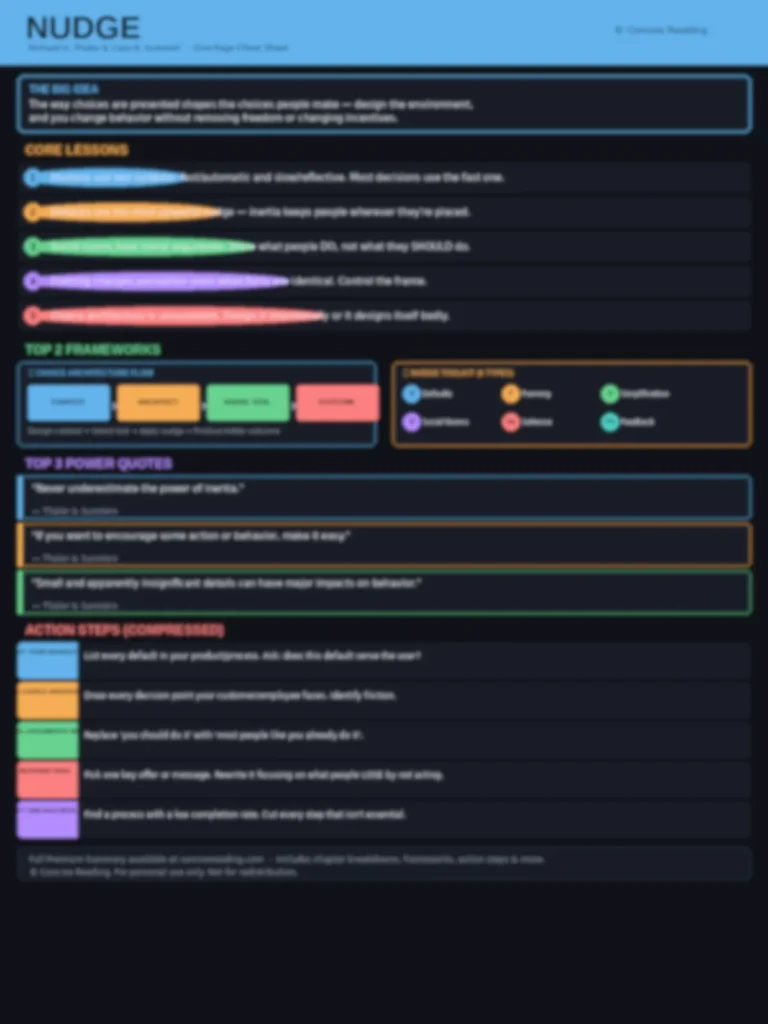
Premium Cheat Sheet Preview
About the Author
Richard H. Thaler is a Nobel Prize-winning economist (2017) and Professor at the University of Chicago Booth School of Business. His decades of research dismantled the assumption that humans make rational decisions — and replaced it with evidence-based models of how people actually behave. Co-author Cass R. Sunstein served as Administrator of the White House Office of Information and Regulatory Affairs, where he applied these exact principles to real federal policy. Together, they are the most credentialed voices in behavioral economics.
Power Quote From the Book:
“If you want to encourage some action or behavior, make it easy.”
— Richard H. Thaler & Cass R. Sunstein, Nudge
Who This Summary is For
- This is for you if…
- You are a business owner, product designer, or marketer who wants to improve customer behavior without increasing your ad budget
- You are a manager or HR leader who designs processes, onboarding flows, or benefit programs that people consistently underuse
- You want to understand why your customers, employees, or readers do what they do — and how to design systems that work with human psychology instead of fighting it
- You are a student of behavioral economics, decision science, or consumer psychology and want the foundational framework in a fraction of the time
- You have heard of Thinking, Fast and Slow or Influence and want the next level of applied behavioral insight
- Skip this if… You are looking for a mathematical economics textbook or highly technical academic treatment of behavioral theory. This book — and this summary — is built for practitioners, not researchers. If pure theory is your goal, start with Kahneman’s Thinking, Fast and Slow instead.
Social Proof
Thousands of readers have used Concise Reading summaries to cut through dense business books and extract what actually matters. If you’ve read this summary — free or premium — we’d love to know how it landed for you. Did a lesson change how you think about a decision you’re currently facing? Did a framework unlock something in your business or product? Drop your thoughts in the comments below. Your experience helps other readers decide whether this summary is right for them — and it helps us keep making these better. No account required. Just honest feedback.
Nudge took Thaler and Sunstein decades of Nobel-level research to write. The Premium Summary gives you the complete system — every chapter, three visual frameworks, five power quotes with context, five specific action steps, and a one-page cheat sheet — in under an hour.
If you found the free version useful, the premium version will change how you build.
Related Summaries
- Thinking, Fast and Slow — Daniel Kahneman: The definitive deep-dive into the two cognitive systems Thaler builds on. If Nudge shows you what to do with human psychology, this book explains the psychology itself.
- Influence — Robert Cialdini: Six proven principles of persuasion that align directly with nudge theory. Essential reading for anyone applying behavioral science to marketing or leadership.
- The Power of Habit — Charles Duhigg: Nudge explains how to design environments for better decisions; this book explains how those decisions become automatic habits. A natural and powerful companion.
[…] concept is similar to ideas discussed in Nudge, which explains how environment shapes […]
[…] insight also connects with ideas explored in The Psychology of Money and Nudge, which explain how emotions shape financial and behavioral […]
[…] Nudge […]