
Cashflow Quadrant by Robert Kiyosaki — Summary & Key Lessons
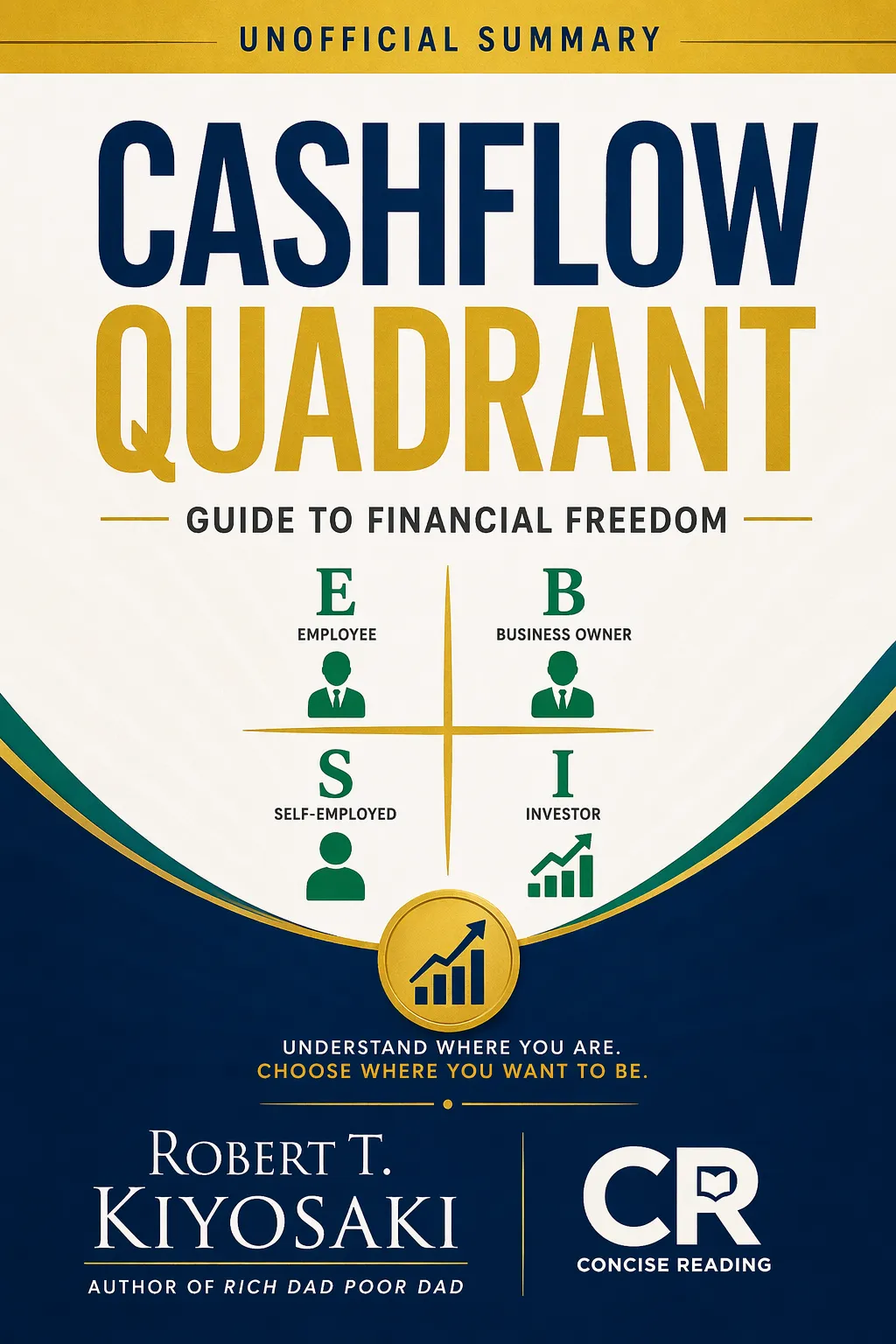
What this book will teach you in the next 10 minutes — and why it matters for your financial independence.
Part of the Concise Reading Library — business & money book summaries built for people who act on what they read. Also included in the Personal Finance & Wealth Building Pack.
Book Snapshot
- Author – Robert T. Kiyosaki
- Category – Personal Finance & Wealth Building / Entrepreneurship & Business Mindset
- Original Book – ~ 352 pages | ~ 6–7 hours average read time
- Free Summary – 07 pages
- Premium Summary – 28 pages | ~ 35–45 minutes read time
The Big Idea
Most people work harder every year and still feel financially stuck. Cashflow Quadrant explains exactly why. Robert Kiyosaki divides every income earner into four positions — Employee, Self-Employed, Business Owner, and Investor. The first two tie your income to your time. The last two build income that works without you. The brutal insight is this: it’s not how much you earn that determines your financial future. It’s which quadrant you earn it from. And the values that make you excellent at your job are the exact same values keeping you from ever escaping it. This isn’t a money book. It’s an identity book about why most people stay financially dependent their entire lives — and what it actually takes to leave.
What You’ll Learn — Key Lessons Preview
- Why your salary is a ceiling, not a path — and how to identify which of the four income positions you’re actually building toward right now
- The S-quadrant trap most entrepreneurs never escape — why freelancers and consultants work the hardest and accumulate the least wealth of anyone
- How business owners and investors pay less tax on the same income — the structural difference that compounds into a massive wealth gap over 10–20 years
- The real reason people fail to move to the right side of the quadrant — it’s not capital or skill; it’s a values problem most finance books never address
- What a true asset actually is — and why your home, your car, and most of what you call “wealth” probably doesn’t qualify under Kiyosaki’s definition
Free vs Premium Comparison
| Free – $0 | Premium – $4.99 (Recommended) |
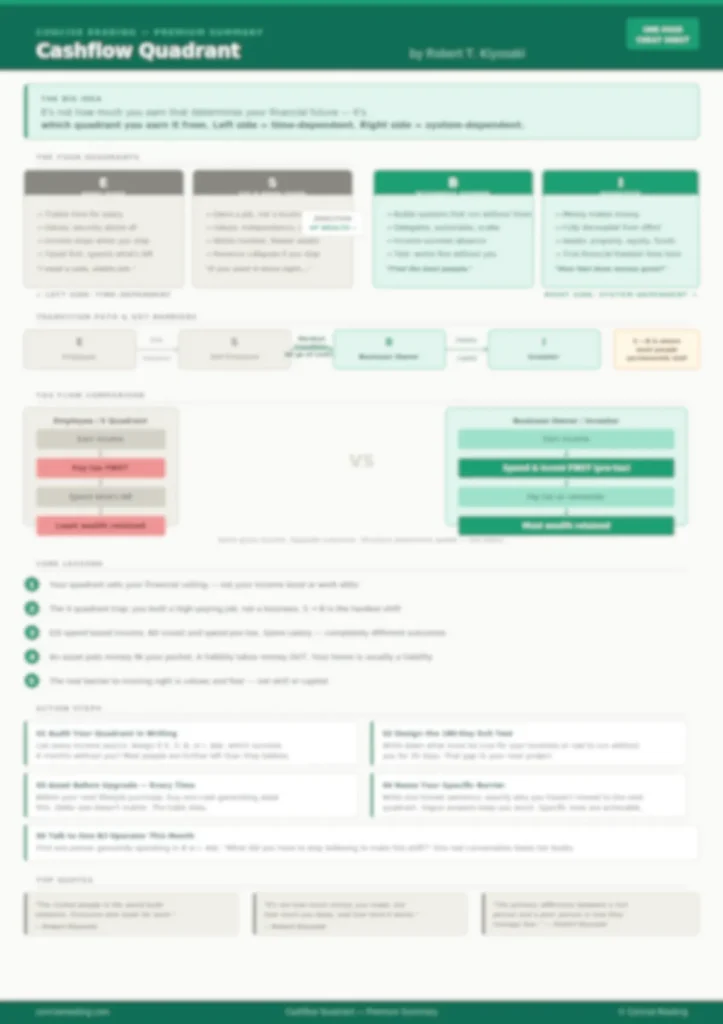
| ➡ Book Snapshot ➡ The Big Idea ➡ Key Lessons ➡ Power Quotes ➡ 07 Pages | ✔ Everything in free + ✔ Full Chapter Breakdown ✔ Key frameworks & diagrams ✔ Action steps ✔ Critical analysis ✔ One-page cheat sheet ✔ 28 pages |
Premium Cheat Sheet Preview
About the Author
Robert Kiyosaki is a financial educator, entrepreneur, and author of Rich Dad Poor Dad — one of the bestselling personal finance books in history with over 40 million copies sold across 109 countries. Before writing, he built and lost multiple businesses, served as a Marine Corps pilot in Vietnam, and arrived at his frameworks through direct financial failure and recovery — not academic theory. That real-world credibility is precisely what makes his work worth studying.
Power Quote From the Book:
“It’s not how much money you make, but how much money you keep, how hard it works for you, and how many generations you keep it for.” — Robert Kiyosaki, Cashflow Quadrant
Who This Summary is For
- This is for you if…
- You are an employee who earns well but suspects a bigger paycheck alone will never produce real financial freedom
- You are a freelancer, consultant, or small business owner who has started to realize you’ve built a job — not a business
- You want a clear mental model for how wealth is actually structured before committing to a side business, investment, or career change
- You are new to personal finance and want to understand how wealthy people think about money before diving into tactics
- You want to start your financial independence journey with the right foundational frameworks — not motivation, not tips, not hacks
- Skip this if… You’re already operating a scalable business or actively investing, and what you need now is tactical execution — specific investment strategies, deal structures, or business systems. This book is a framework, not a playbook. For that, explore the Investing Playbook or the Startup & Entrepreneurship Pack.
Social Proof
This summary is part of a growing library read by thousands of people who take their financial education seriously. If you’ve read this summary — free or premium — we’d genuinely love to know what landed for you. Did one lesson change how you see your current income structure? Did a framework clarify a decision you’ve been sitting on? Drop your thoughts in the comments below. Your experience helps other readers decide if this is the right summary for them — and it helps us keep building the kind of summaries that actually get used.
Cashflow Quadrant took Robert Kiyosaki decades of failure, rebuilding, and contrarian investing to write. The premium summary gives you the complete system — every key framework, full chapter breakdown, visual diagrams, specific action steps, and a one-page cheat sheet — in under 40 minutes.
If this free version made you think differently about how you earn money, the blog post on using the Cashflow Quadrant to plan your financial independence is worth reading next — but the premium summary is where the real work starts.
The original book costs $15 and takes 7 hours. The premium summary is $4.99 and takes 40 minutes. One of those is the obvious choice.
Related Summaries
- Rich Dad Poor Dad — Kiyosaki’s foundational book. Where Cashflow Quadrant gives you the map, Rich Dad Poor Dad delivers the mindset shift that makes the map make sense.
- The Millionaire Fastlane by MJ DeMarco — A harder-hitting, modern take on escaping the slow lane of employment and building scalable wealth systems. Pairs directly with B-quadrant thinking.
- $100M Offers by Alex Hormozi — If Cashflow Quadrant convinces you to move toward the B quadrant, this book teaches you how to build an offer so good your business actually takes off.
[…] can also explore our summary of Cashflow Quadrant inside our Free Summaries […]
[…] If you want to master wealth building, also explore books like Rich Dad Poor Dad, The Millionaire Fastlane, and Cashflow Quadrant. […]
[…] find similar structured approaches in Cashflow Quadrant and The 4-Hour Workweek, both available in our Free […]