One Up on Wall Street by Peter Lynch — Summary & Key Lessons
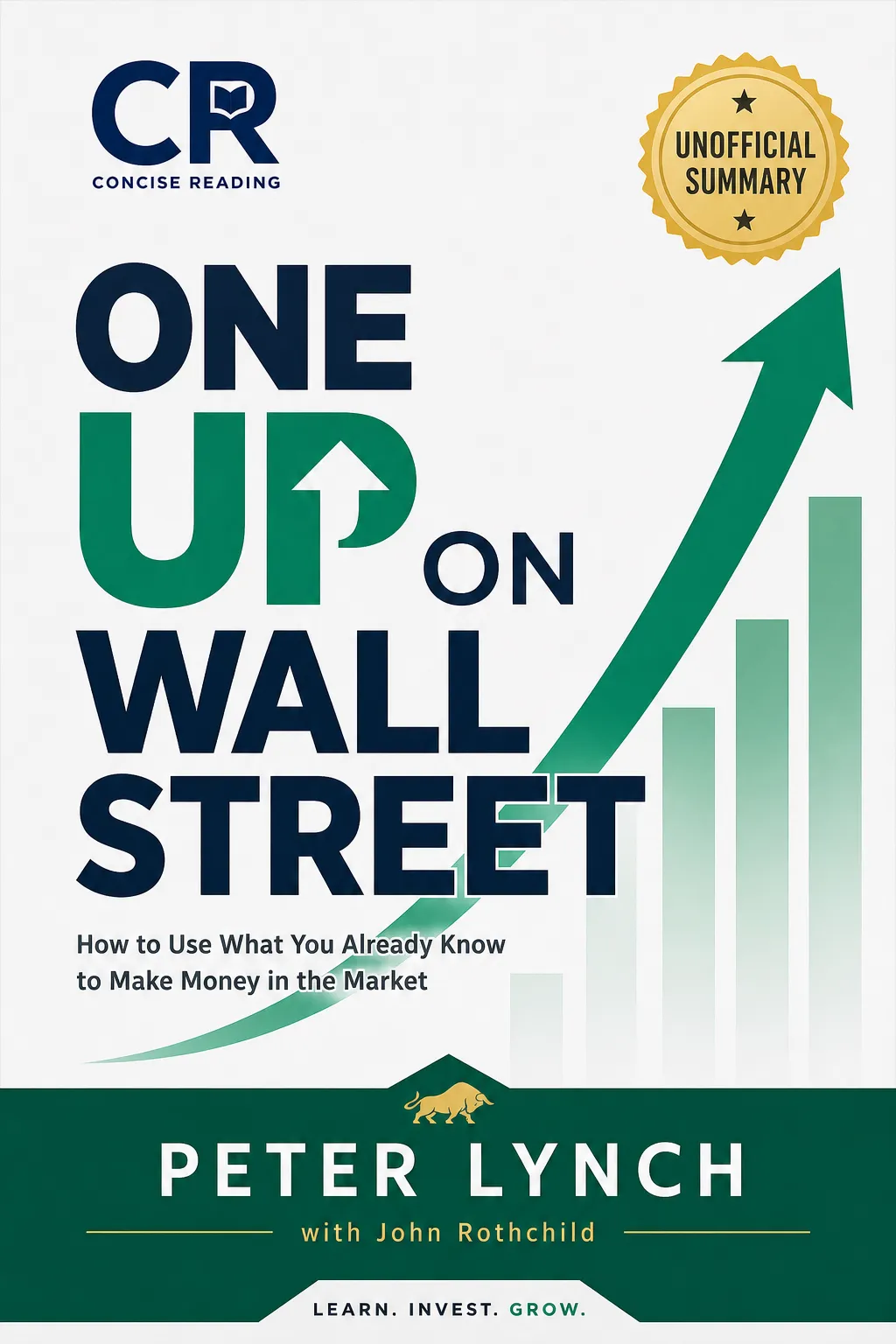
What this book will teach you in the next 10 minutes — and why it matters for the stocks you’re already qualified to pick but haven’t bought yet.
Trusted by readers building serious portfolios — no finance degree required.
Book Snapshot
- Author – Peter Lynch with John Rothchild
- Category – Investing / Stock Market / Personal Finance
- Original Book – ~ 318 pages | ~ 6–7 hours average read time
- Free Summary – 08 pages
- Premium Summary – 31 pages | ~ 35–45 minutes read time
The Big Idea
Peter Lynch ran the world’s best-performing mutual fund for thirteen years — and his secret had nothing to do with Wall Street. It had to do with a shopping mall. Lynch believed that ordinary investors spot great companies first — as customers, employees, and daily observers — long before any analyst writes a report on them. The real problem isn’t a lack of information. It’s a lack of confidence in the information you already have. This book gives you a complete, practical system for finding, evaluating, and holding great stocks using the knowledge you’ve quietly accumulated your entire life.
What You’ll Learn — Key Lessons Preview
- How to find ten-bagger stocks before Wall Street does — using the products, stores, and services already in your daily life
- How to categorize any stock in 60 seconds — and instantly know what to expect from it, how long to hold it, and exactly when to sell
- Why your biggest investing mistakes probably weren’t about picking the wrong stock — they were about selling the right one too early
- How to stay rational when the market is trying to terrify you — and why the investors who panic are the ones funding everyone else’s returns
- The one question you must answer before buying any stock — and why most investors never ask it, which is precisely why they underperform
Free vs Premium Comparison
| Free – $0 | Premium – $4.99 (Recommended) |
| ➡ Book Snapshot ➡ The Big Idea ➡ Key Lessons ➡ Power Quotes ➡ 08 Pages | ✔ Everything in free + ✔ Full Chapter Breakdown ✔ Key frameworks & diagrams ✔ Action steps ✔ Critical analysis ✔ One-page cheat sheet ✔ 31 pages |
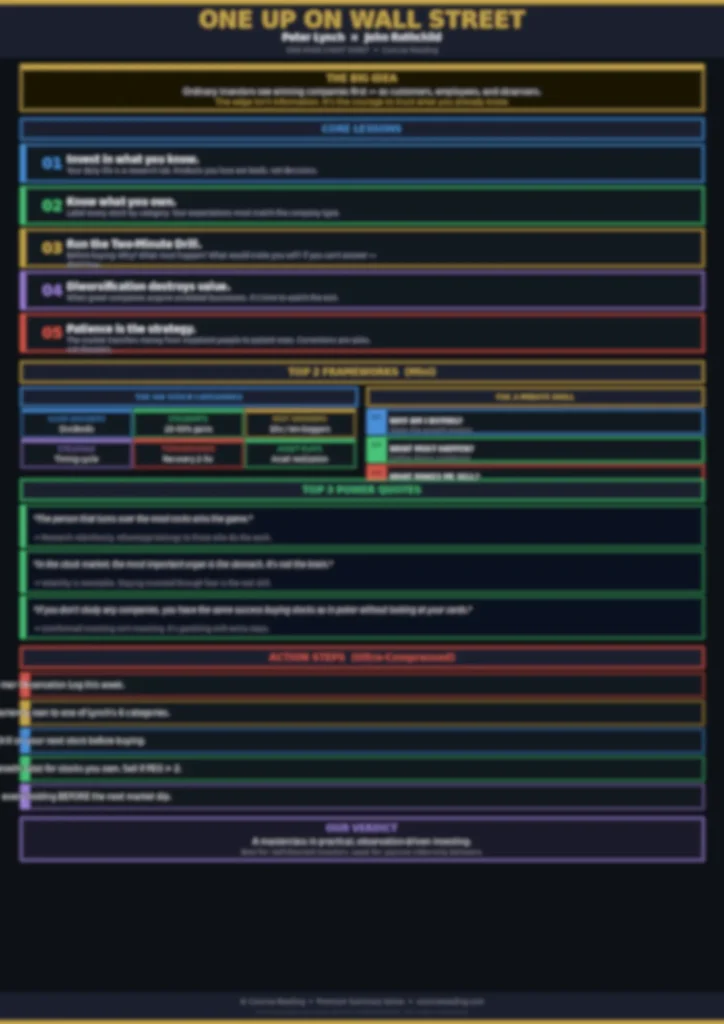
Premium Cheat Sheet Preview
About the Author
Peter Lynch managed Fidelity’s Magellan Fund from 1977 to 1990, compounding at 29.2% annually — one of the greatest track records in investing history. He grew the fund from $18 million to $14 billion before retiring voluntarily at 46. Lynch studied history and philosophy, not finance — a background he credited for teaching him to think about human behavior rather than just numbers. His books have sold over one million copies worldwide.
Power Quote From the Book:
“The person that turns over the most rocks wins the game. And that’s always been the case.” — Peter Lynch, One Up on Wall Street
Who This Summary is For
- This is for you if…
- You are a self-directed investor who wants to pick individual stocks but has no formal finance background — and you’re tired of feeling like that disqualifies you
- You want a clear, repeatable system for evaluating companies — not vague advice like “do your research” but actual criteria you can apply today
- You are a professional or business owner who suspects your industry knowledge gives you an investing edge — and you want to know how to use it
- You want to understand why your portfolio underperforms the market and what behavioral patterns are actually costing you money
- You are building your first serious investment portfolio and need a foundational philosophy before you touch another stock
- Skip this if…
- You’re a committed index-fund investor with no interest in individual stock selection — this book will challenge your approach without fully addressing yours. Likewise, if you’re looking for options strategies, technical analysis, or short-term trading systems, Lynch doesn’t go there.
Social Proof
We’re building something here — and your voice is part of it.
If you’ve read this summary — free or premium — drop a comment below. What landed? What did you apply? What question do you still have? Every piece of feedback shapes the next summary we write. Readers who share their experience help other investors decide whether this book deserves their time. And if this summary saved you six hours and gave you one framework you’ll actually use — that’s worth saying out loud.
(Reviews and ratings are listed below as readers share them.)
One Up on Wall Street took Peter Lynch thirteen years of managing $14 billion to earn the right to write. The premium summary gives you his complete investing system — six stock categories, the Perfect Stock Checklist, the Two-Minute Drill, five power quotes, five discomfort-inducing action steps, a full critical analysis, and a one-page cheat sheet worth printing — in 20 focused pages.
Related Summaries
- If this summary resonated with you, these three go deeper into the same territory:
- The Intelligent Investor — Benjamin Graham’s foundational text on value investing. Lynch built on Graham’s ideas; reading this shows you where Lynch’s philosophy came from.
- A Random Walk Down Wall Street — The counterargument to Lynch’s approach. Reading both gives you a complete, honest picture of what individual stock-picking actually involves.
- The Psychology of Money — Morgan Housel on why behavior, patience, and temperament matter more than any stock-picking system. The perfect companion to Lynch’s tactical advice.
[…] is why successful investors such as those discussed in Market Wizards or One Up on Wall Street often rely on instinct shaped by […]
[…] One Up on Wall Street […]
[…] like A Random Walk Down Wall Street and One Up on Wall Street also emphasize the importance of long-term […]
[…] about investing and financial markets, you may also find our summaries of The Intelligent Investor, One Up on Wall Street, Market Wizards, and The Psychology of Money helpful. These books provide different perspectives on […]
[…] The Intelligent Investor• One Up on Wall Street• A Random Walk Down Wall […]
[…] you’ve already explored popular investing classics like The Intelligent Investor, One Up on Wall Street, or A Random Walk Down Wall Street in our Free Summaries section, this book takes your […]