
Fooled by Randomness by Nassim Nicholas Taleb — Summary & Key Lessons
What this book will teach you in the next 10 minutes — and why it matters for every financial decision, career bet, and business risk you will ever take.
Read by investors, traders, and entrepreneurs who want to stop confusing luck with skill — and build a decision-making process that holds up when randomness strikes.
Book Snapshot
- Author – Nassim Nicholas Taleb
- Category – Behavioral Finance & Decision-Making / Probability Theory, Investing Psychology, Philosophy of Risk
- Original Book – ~ 368 pages · ~ 7 hours average read time
- Free Summary – 08 pages
- Premium Summary – 30 pages · ~ 35–40 minutes estimated read time
The Big Idea
Most of what we call success is randomness we haven’t identified yet. In Fooled by Randomness, Nassim Taleb makes one of the most uncomfortable arguments in modern finance: that the traders, entrepreneurs, and executives we study as role models may have simply been lucky — and that we cannot tell the difference from the outside. The markets don’t reward skill cleanly. They reward variance. And our brains, wired for narrative and pattern, are structurally incapable of seeing this without deliberate effort. This book gives you that effort — packaged as a framework for thinking honestly about luck, risk, and every high-stakes decision you make.
What You’ll Learn — Key Lessons Preview
- You will understand why the most successful person in the room may not be the most competent — and how to tell the difference before you copy their strategy or hire them to run your company.
- You will learn to filter noise from signal — so you stop making emotional, reactive decisions based on daily market fluctuations, short-term business metrics, or social media performance that means almost nothing.
- You will discover why rare, catastrophic events happen far more often than any standard risk model predicts — and how to structure your finances and business so a single bad event cannot wipe out years of progress. If you want to go deeper on this, our Antifragile summary and The Black Swan summary pick up exactly where this book leaves off.
- You will see survivorship bias operating in real time — in the investment strategies you read about, the entrepreneurs you follow, and the business advice you’ve been given. This one shift in perspective will make you a permanently better consumer of information.
- You will build a pre-commitment system for high-stakes decisions — the kind that protects you from your own emotional reactions when markets move, strategies fail, or pressure builds. If you’re applying this to investing specifically, pair this with our Thinking, Fast and Slow summary for the psychological mechanics behind why we fail under pressure.
Free vs Premium Comparison
| Free – $0 | Premium – $4.99 (Recommended) |
| ➡ Book Snapshot ➡ The Big Idea ➡ Key Lessons ➡ Power Quotes ➡ 08 Pages | ✔ Everything in free + ✔ Full Chapter Breakdown ✔ Key frameworks & diagrams ✔ Action steps ✔ Critical analysis ✔ One-page cheat sheet ✔ 30 pages |
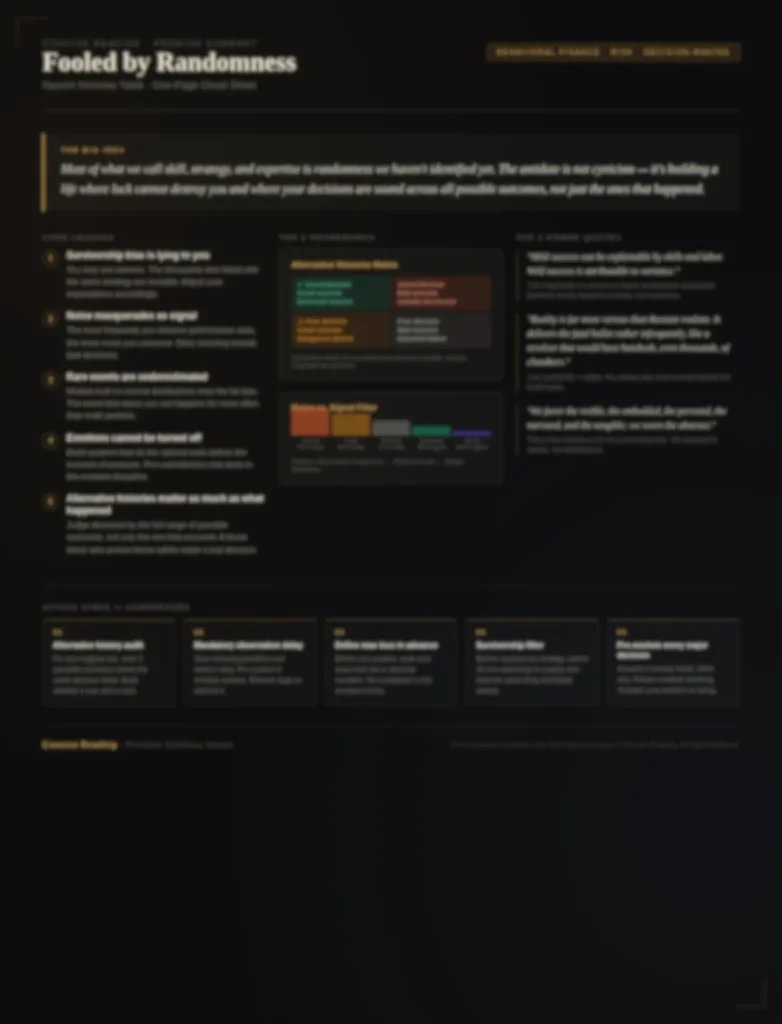
Premium Cheat Sheet Preview
About the Author
Nassim Nicholas Taleb spent two decades as a derivatives trader and hedge fund manager on Wall Street before becoming one of the most cited thinkers in probability theory and risk management. He holds a PhD in management science from the University of Paris and is Distinguished Professor of Risk Engineering at NYU. His Incerto series — which includes The Black Swan and Antifragile — is the most rigorous and readable body of work on uncertainty published in the last twenty-five years.
Power Quote From the Book:
“Mild success can be explainable by skills and labor. Wild success is attributable to variance.”
— Nassim Nicholas Taleb, Fooled by Randomness
Who This Summary is For
- This is for you if…
- You are an investor or trader who wants to honestly evaluate whether your track record reflects skill, favorable conditions, or something in between — before you scale up your risk.
- You are an entrepreneur who makes large, high-stakes bets and needs a more rigorous framework for thinking about downside risk and what you’d do if the unlikely scenario actually happened.
- You want to stop being fooled by confident people — whether they’re influencers, fund managers, or business gurus — and develop a mental filter for evaluating claims of expertise backed only by outcomes.
- You are a manager, executive, or hiring professional who evaluates people by their results and wants to make sure you’re measuring competence, not luck.
- You are a reader of Thinking in Bets, The Psychology of Money, or Principles and want the book that sits one level deeper in the philosophy of decision-making under uncertainty.
- Skip this if…
- You want a specific, step-by-step investing manual or a how-to guide for making money. Taleb is a philosopher of risk, not a financial advisor — and this book will permanently change how you think about success and failure long before it tells you what to do about it. If you want direct prescriptions, start with our Intelligent Investor summary or browse our Investing Fundamentals Pack.
Social Proof
We don’t believe in fake testimonials — so we’re not going to write any.
What we do believe is that the right summary, read by the right person at the right moment, changes how they think. If this summary did that for you — if it made you audit a past decision differently, rethink someone you’ve been following, or restructure a position you were holding — we’d genuinely love to hear it. Leave a comment below. Tell us what shifted, what you’ll do differently, or what you’d add. Real feedback from real readers is the most useful thing on this page, and the most honest form of proof we know.
If you’ve already read the full book and want to compare notes, that’s welcome too. This community is built for people who take ideas seriously — and Fooled by Randomness is one of the few books that earns that standard. You can also explore what other readers are engaging with across our full library.
Fooled by Randomness took Nassim Taleb two decades of trading, surviving market crashes, and building a rigorous framework for probability to write. The premium summary gives you the complete system — every framework, every mental model, every action step — in 22 focused pages you can read in under 40 minutes.
For less than a cup of coffee, you get the chapter-by-chapter breakdown, four visual framework diagrams you can apply immediately, five action steps specific enough to cause discomfort, a critical analysis that tells you exactly what Taleb got right and where he overreaches, and the one-page cheat sheet worth keeping on your desk. If any part of this page made you think differently about a decision you’re facing right now, the premium version will complete that shift.
Browse our other premium summaries in the Wall Street & Financial Markets Pack or the Investing Fundamentals Pack — both include this summary as part of a curated bundle. Or, if you want the full synthesized treatment of risk and investing across multiple books, The Investing Playbook builds on Taleb’s ideas alongside nine other investing classics.
Related Summaries
- The Black Swan — Nassim Nicholas Taleb (Taleb’s direct sequel to this book — goes deeper into extreme, unpredictable events and how to build a life that benefits from them rather than being destroyed by them)
- Thinking, Fast and Slow — Daniel Kahneman (The psychological backbone of why we’re fooled by randomness — covers the cognitive biases and emotional shortcuts that make us vulnerable to Taleb’s warnings)
- Antifragile — Nassim Nicholas Taleb (The prescription to both books above — how to build systems, portfolios, and careers that don’t just survive randomness but actually get stronger from it)
[…] you enjoy deep financial insights like this, also explore related summaries like The Big Short and Fooled by Randomness in our […]