
Margin of Safety by Seth Klarman — Summary & Key Lessons
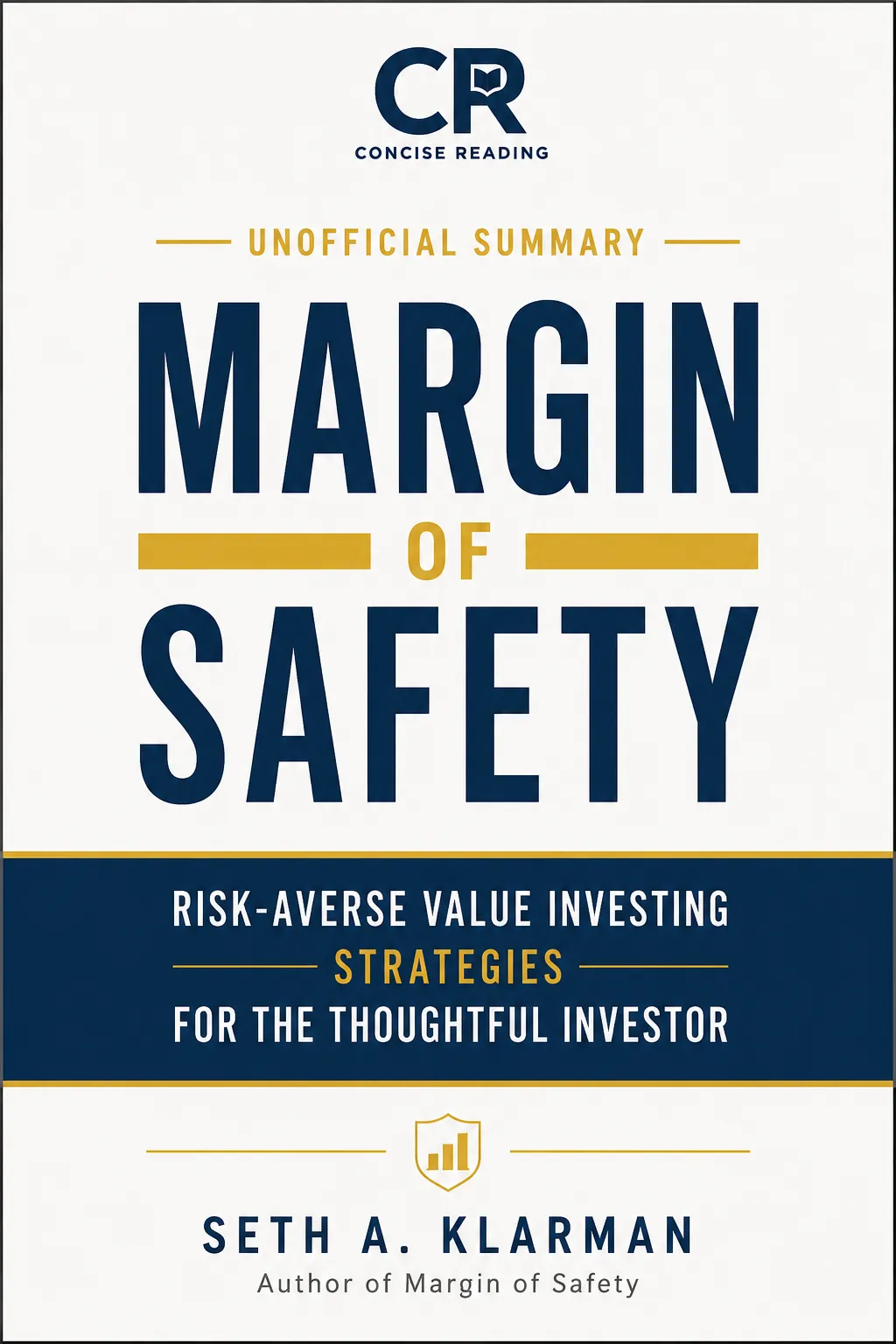
What this book will teach you in the next 10 minutes — and why it matters for every capital decision you will ever make.
Part of the Investing Fundamentals collection at Concise Reading — premium summaries built for serious readers, not casual browsers.
Book Snapshot
- Author – Seth Klarman
- Category – Value Investing / Behavioral Finance / Risk Management
- Original Book – ~ 249 pages | Estimated read time: 7–9 hours
- Free Summary – 08 pages
- Premium Summary – 35 pages | Estimated read time: 45–60 minutes
The Big Idea
Most investors are playing the wrong game. They are tracking prices, chasing momentum, and calling it a strategy. Seth Klarman draws a hard line between that and actual investing. His argument is disarmingly simple: find out what something is worth, then pay significantly less than that figure. The gap between price and value — the margin of safety — is not conservative cushioning. It is the only real defense you have against your own analytical errors, against unpredictable markets, and against the systematic conflicts of interest built into every layer of Wall Street. Everything else follows from this single discipline. This is the book that quietly separates serious investors from everyone else.
What You’ll Learn — Key Lessons Preview
- Why the definition of risk used by most financial professionals is dangerously wrong — and what risk actually means for your capital
- How to calculate what a business is genuinely worth before you ever look at its stock price — so the market can no longer anchor your thinking
- Why Wall Street’s incentive structure is designed to generate activity, not returns — and how to position yourself outside that system
- How to identify the difference between a genuine value opportunity and a value trap that stays cheap forever
- Why holding cash and doing nothing is one of the highest-returning decisions an investor can make — and how to build the discipline to do it
Free vs Premium Comparison
| Free – $0 | Premium – $4.99 (Recommended) |
| ➡ Book Snapshot ➡ The Big Idea ➡ Key Lessons ➡ Power Quotes ➡ 08 Pages | ✔ Everything in free + ✔ Full Chapter Breakdown ✔ Key frameworks & diagrams ✔ Action steps ✔ Critical analysis ✔ One-page cheat sheet ✔ 35 pages |
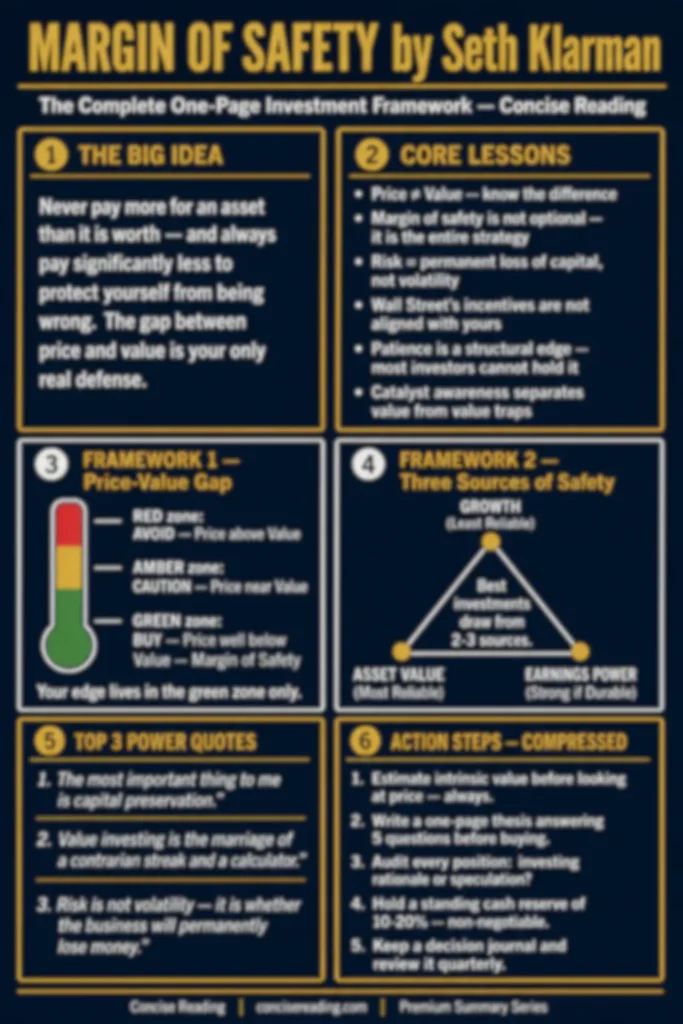
Premium Cheat Sheet Preview
About the Author
Seth Klarman founded Baupost Group in 1982 at age 25 and has compounded investor capital at approximately 20% annually for over four decades — a track record that places him among the most successful investors alive. He earned his MBA from Harvard Business School and has managed through every major market crisis since the early 1980s without a catastrophic drawdown. Margin of Safety, published in 1991 and never reprinted, has sold for over $2,000 on secondary markets. That scarcity alone signals the caliber of what is inside.
Power Quote From the Book:
“Value investing is at its core the marriage of a contrarian streak and a calculator.”
— Seth Klarman, Margin of Safety
Who This Summary is For
- This is for you if…
- You are an individual investor who has moved past the basics and wants a rigorous, honest framework for thinking about capital allocation
- You want to understand how the most disciplined money managers in the world actually evaluate risk — not how textbooks define it
- You are tired of financial media, hot tips, and quarterly performance noise and want a long-term investment philosophy grounded in logic
- You have read The Intelligent Investor or The Psychology of Money and are ready for the next level of depth
- You manage your own capital — in any amount — and want to stop making decisions based on price movement and narrative
- Skip this if…
- You are a complete beginner still learning what a stock is, or you are looking for specific stock picks and a ready-made screener system. This is a philosophy book, not a trading manual. Start with our Investing Fundamentals category and return when you have the foundation.
Testimonials
Concise Reading summaries are built for readers who take what they read seriously. If you have read this summary — free or premium — we want to hear from you. What landed? What shifted in how you think about investing? Drop your experience in the comments below. Your feedback helps other readers decide whether this is the right summary for them, and it helps us keep building summaries worth your time. No fluff, no star-rating theater — just honest responses from real readers. Be the first.
Margin of Safety took Seth Klarman a career’s worth of hard-won investing experience to write — the premium summary gives you his complete framework, five key mental models with visual diagrams, uncomfortable-but-actionable action steps, and a one-page cheat sheet of the entire system, all in 35 pages.
At $4.99, this is the lowest-cost, highest-return decision you will make today. If you are serious about how you think about capital, the premium version belongs in your library next to the Investing Fundamentals Pack and The Investing Playbook.
Related Summaries
- 1. The Intelligent Investor by Benjamin Graham – Margin of Safety is essentially Klarman’s modern extension of Graham’s work. Graham invented value investing; Klarman refined it for a more complex, institutional market. Read Graham first if you haven’t. Read him again after Klarman.
- 2. The Psychology of Money by Morgan Housel – Klarman explains the logic of disciplined investing. Housel explains why most people can’t execute it — because behavior, not intellect, is the real variable. These two books together give you the full picture: the framework and the obstacle.
- 3. Common Stocks and Uncommon Profits by Philip Fisher – Fisher represents the growth-investing counterpoint to Klarman’s deep value approach. Understanding both schools sharply improves your ability to evaluate any investment. Klarman and Fisher don’t contradict each other — they’re looking for the same thing from different angles.
[…] principle mirrors strategies in Margin of Safety and Security Analysis—profit is made at the […]
[…] Margin of Safety […]