
Accounting QuickStart Guide by Josh Bauerle — Summary & Key Lessons
What this book will teach you in the next 10 minutes — and why it matters for your business finances, your bookkeeping, and every money decision you make from here forward.
Part of the Accounting & Bookkeeping collection at Concise Reading — where we turn dense financial books into focused, actionable summaries you can actually use.
Book Snapshot
- Author – Josh Bauerle
- Category – Accounting & Financial Literacy
- Original Book – ~ 284 Pages | Estimated read time: 6–8 hours
- Free Summary – 08 pages
- Premium Summary – 32 Pages | Estimated read time: 35–45 minutes
The Big Idea
Most business owners treat accounting as something to hand off and ignore. That’s exactly why they get blindsided. Josh Bauerle’s argument is simple and uncomfortable: accounting is the operating system of your business, and if you can’t read your own financial statements, you are permanently dependent on someone else to interpret your own reality. The entire discipline rests on one equation — Assets = Liabilities + Equity — and once you understand how it flows into your income statement, balance sheet, and cash flow statement, your numbers stop being noise and start being a decision-making tool that tells you exactly where your business stands and what to do next.
What You’ll Learn — Key Lessons Preview
- Why your business can show a profit on paper and still run out of cash — and how to read the one statement that tells you the truth before it’s too late
- How the accounting equation governs every single financial transaction your business will ever make — and how to use it to catch errors before they cost you
- The real difference between cash-basis and accrual accounting, which method your business should be using right now, and what it costs you to choose wrong
- How to read a balance sheet, income statement, and cash flow statement with enough confidence to ask the right questions — and stop nodding along when your accountant talks
- Why your Chart of Accounts is the most overlooked setup decision in your business — and how a messy one silently corrupts every financial report you generate
Free vs Premium Comparison
| Free – $0 | Premium – $4.99 (Recommended) |
| ➡ Book Snapshot ➡ The Big Idea ➡ Key Lessons ➡ Power Quotes ➡ 08 Pages | ✔ Everything in free + ✔ Full Chapter Breakdown ✔ Key frameworks & diagrams ✔ Action steps ✔ Critical analysis ✔ One-page cheat sheet ✔ 32 pages |
Premium Cheat Sheet Preview
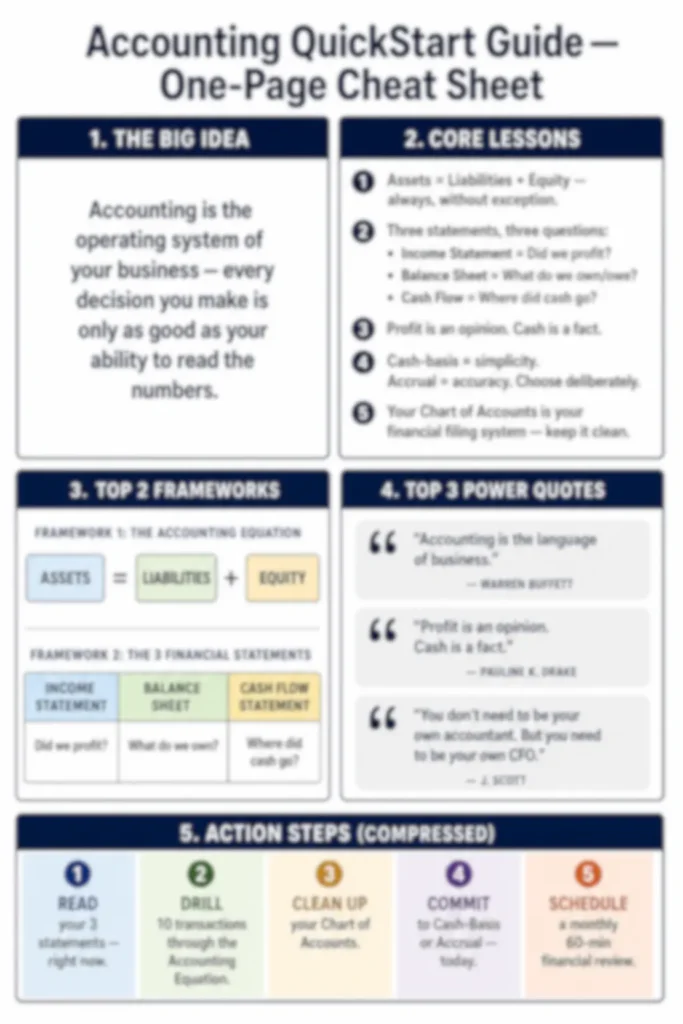
About the Author
Josh Bauerle is a Certified Public Accountant (CPA) and founder of CPA on Fire, an accounting firm built specifically for entrepreneurs and small business owners. With over a decade of hands-on experience helping non-accountants understand their finances — and as host of the CPA on Fire podcast — Bauerle has an unusually clear sense of where real business owners get stuck. He doesn’t write for finance students. He writes for people running actual businesses who need the numbers to make sense.
Power Quote From the Book:
“Profit is an opinion. Cash is a fact.”
— Josh Bauerle, Accounting QuickStart Guide
Who This Summary is For
- This is for you if…
- You are a small business owner, freelancer, or entrepreneur who handles your own books but isn’t fully confident you understand what they’re telling you
- You are a founder who has hired a bookkeeper or accountant but feels lost every time they send you a report
- You want to understand financial statements well enough to make smarter pricing, spending, and growth decisions
- You are building a business from scratch and want to set up your accounting correctly from day one instead of cleaning up a mess later
- You are curious about accounting and want the clearest, most practical starting point available without enrolling in a course
- Skip this if…
- You already have formal accounting training or a CPA qualification — this book covers foundational ground you already own. If you’re looking for advanced topics like corporate finance, tax strategy, or investment analysis, explore our Financial Intelligence & Analysis or Investing Fundamentals categories instead.
Testimonials
Have you read this summary — free or premium? We’d love to hear what landed for you. Scroll down to the comments and let us know: what was your biggest takeaway, what changed in how you think about your business finances, or what you’re going to do differently this week. Concise Reading is built for readers who actually apply what they learn — your experience helps other business owners decide whether this summary is right for them. Leave a comment below. It takes two minutes and helps more than you think.
Josh Bauerle spent years working with hundreds of small business owners, hosting a podcast, and running an accounting firm before distilling everything into this book. The Premium Summary gives you the complete system — frameworks, action steps, chapter breakdown, and a one-page cheat sheet — in 20 focused pages.
If you found the free summary useful, the Accounting & Bookkeeping Pack includes 32 summaries in this category — including Profit First, Financial Intelligence, and Bookkeeping Made Simple — at a fraction of the individual price.
Related Summaries
If this summary was useful, these three are the natural next step:
- Financial Intelligence — Karen Berman & Joe Knight
A deeper dive into how managers and business owners can read and use financial data strategically. Highly practical. - Profit First — Mike Michalowicz
Takes what you’ve learned about cash flow and turns it into a simple, counterintuitive system to ensure your business is always profitable — from day one. - The Accounting Game — Darrell Mullis & Judith Orloff
Uses a lemonade stand to teach accounting concepts in a remarkably simple, story-driven way. A perfect complement if you want the concepts to stick even deeper.
[…] This concept is also explained in Accounting Game and Accounting QuickStart Guide. […]