Be Smart Pay Zero Taxes by Mark J. Quann — Summary & Key Lessons
What this book will teach you in the next 10 minutes — and why it matters for how much of your own money you actually get to keep.
Part of the Personal Finance & Wealth Building collection at Concise Reading — alongside summaries of Rich Dad Poor Dad, The Psychology of Money, and I Will Teach You to Be Rich.
Book Snapshot
- Author – Mark J. Quann
- Category – Personal Finance & Tax Strategy
- Original Book – ~ 200 pages | Average read time: 4–5 hours
- Free Summary – 08 pages
- Premium Summary – 31 pages | Estimated read time: 35–45 minutes
The Big Idea
The U.S. tax code is not designed to punish you. It is designed to reward specific behaviors — investing, building businesses, owning property — and the people who pay the least in taxes are simply doing those things. Mark J. Quann’s core argument is that the average American overpays every single year not because the law requires it, but because they were never taught how it actually works. The moment you understand that income type matters more than income amount, everything about how you earn, save, and invest changes. This book is the manual for making that shift.
What You’ll Learn — Key Lessons Preview
- Why your salary is the most heavily taxed income you can earn — and the legal structures that let business owners and investors keep dramatically more of the same dollar amount
- How to use retirement accounts as a tax-reduction engine, not just a retirement savings tool — including the HSA strategy most financial advisors forget to mention
- Why real estate creates paper losses on real profits — and how depreciation, mortgage deductions, and 1031 exchanges combine to make it the most tax-advantaged asset class available to ordinary people
- The S-Corporation strategy that saves self-employed earners $5,000–$20,000 per year in self-employment tax alone — and exactly when it makes sense to use it
- Why proactive tax planning beats reactive tax filing every time — and what to look for in an advisor who will actually reduce your bill, not just document it
Free vs Premium Comparison
| Free – $0 | Premium – $4.99 (Recommended) |
| ➡ Book Snapshot ➡ The Big Idea ➡ Key Lessons ➡ Power Quotes ➡ 08 Pages | ✔ Everything in free + ✔ Full Chapter Breakdown ✔ Key frameworks & diagrams ✔ Action steps ✔ Critical analysis ✔ One-page cheat sheet ✔ 31 pages |
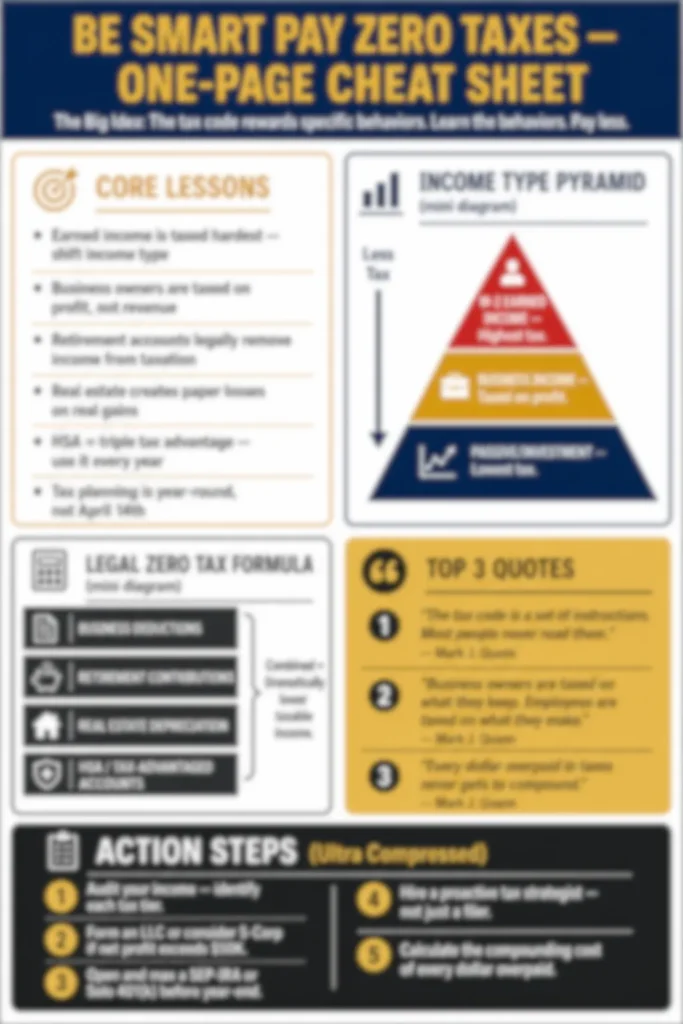
Premium Cheat Sheet Preview
About the Author
Mark J. Quann is a financial educator and wealth strategist who has spent over two decades helping ordinary Americans understand and legally navigate the U.S. tax system. He is a bestselling author in personal finance, recognized for translating dense IRS code into plain-language strategies that employees, freelancers, and small business owners can act on immediately. His work is grounded in real client outcomes — not theory — and has helped thousands of readers discover they were overpaying taxes they were never legally required to pay. If you want more context on the authors behind our summaries, visit our About page.
Power Quote From the Book:
“The tax code is not your enemy. It’s a set of instructions. The problem is most people never read them.”
— Mark J. Quann
Who This Summary is For
- This is for you if…
- You are a salaried employee who feels the gap between your gross pay and your take-home growing wider every year — and you want to understand why
- You are a freelancer, consultant, or solopreneur generating real income but still operating and filing like an employee
- You want to start investing in real estate and need to understand the tax mechanics before you buy your first property
- You are a small business owner who has never had anyone clearly explain entity structure, S-Corp elections, or retirement account stacking in plain English
- You want your money to compound — and you’ve started to realize that tax strategy is as important as investment strategy in determining how fast that happens
- If you’re looking to go deeper on the wealth-building mindset behind these strategies, the Cashflow Quadrant summary and The Millionaire Fastlane summary pair well with this one. You can also explore the full Personal Finance & Wealth Building category or the The Personal Finance & Wealth Building Pack for 15 summaries at a significant discount.
- Skip this if…
- You already work with a proactive CPA who specializes in tax strategy — not just filing — and have an active plan covering your entity structure, retirement accounts, and investment vehicles. This summary is the foundation. If your foundation is already built, you likely know most of what’s here.
Testimonials
We’re building something honest here — and that means we’d rather earn your trust than manufacture it. If you’ve read this summary (free or premium), we’d genuinely like to know what landed for you. Did a specific lesson change how you think about your income? Did one of the frameworks push you to finally set up that LLC or open a retirement account? Leave a comment below. Real feedback from real readers is the only kind worth having — and it helps other people like you decide whether this summary is worth their time. We read every comment. We take all of it seriously.
Not sure where to start on the site? The Start Here page walks you through exactly how to get the most from Concise Reading, and the Library has all summaries in one place.
Be Smart Pay Zero Taxes took Mark J. Quann two decades of client work and financial education to distill. The premium summary gives you the complete system — five key frameworks with visual diagrams, five curated power quotes, chapter-by-chapter breakdown, discomfort-level action steps, and a one-page cheat sheet built to be saved and used — in under 45 minutes of reading. At $4.99, it costs less than the tax you’ll overpay this month by not knowing what’s inside it.
Related Summaries
- Rich Dad Poor Dad — Robert Kiyosaki’s foundational breakdown of why the wealthy think about money, assets, and income differently than employees — the philosophical companion to Quann’s tactical strategies.
- Profit First — Mike Michalowicz’s system for restructuring business cash flow so taxes and profit are handled proactively rather than reactively. Directly applicable if you’re self-employed or running a small business.
- The Millionaire Next Door — Thomas Stanley’s data-driven look at how ordinary Americans actually build wealth — heavy on tax efficiency, frugality, and playing the long game rather than earning big and spending bigger.