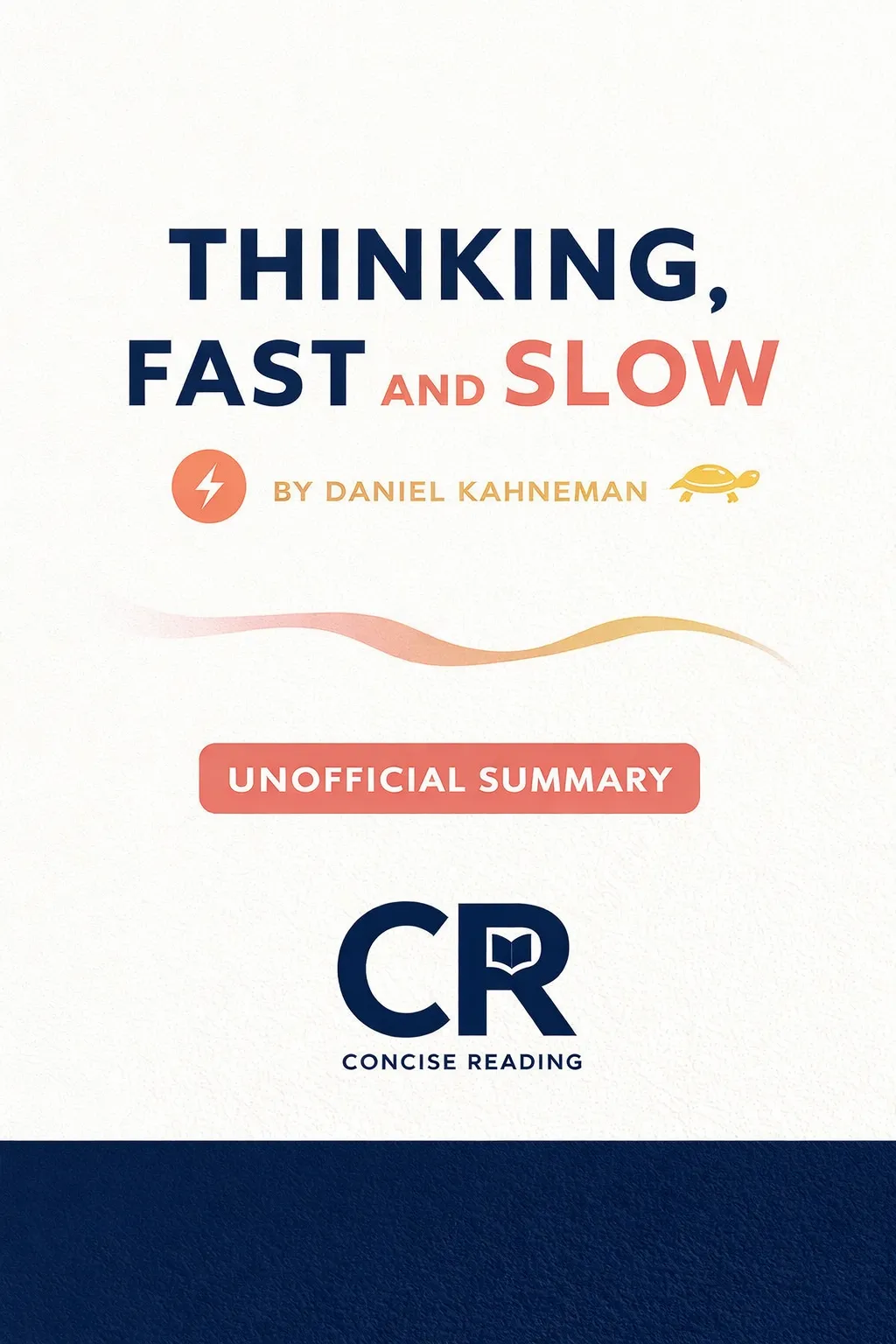
Thinking, Fast and Slow by Daniel Kahneman — Summary & Key Lessons
What this book will teach you in the next 10 minutes — and why it matters for every decision you make with your money, your business, and your career.
Written by the Concise Reading editorial team. Grounded in Kahneman’s original research. No fluff, no filler — just what actually matters.
Book Snapshot
- Author – Daniel Kahneman
- Category – Behavioral Psychology / Decision-Making, Behavioral Economics
- Original Book – ~ 499 pages | Avg. reading time: 12–15 hours
- Free Summary – 08 pages
- Premium Summary – ~ 48 pages | Estimated reading time: 45–60 minutes
The Big Idea
Your brain has two operating systems, and the one you trust most is the one that lies to you. Daniel Kahneman spent five decades proving that human beings are not the rational decision-makers economics assumed. We are overconfident, anchored by irrelevant numbers, manipulated by how questions are framed, and haunted by losses we can’t let go of. This is not a character flaw — it’s how every human brain is wired. Understanding it won’t make you immune. But it will make you dangerous in the best possible way: the rare person who can catch their own brain mid-error and course-correct before the damage is done.
(If you want the complete breakdown of every chapter, all five key frameworks with visual diagrams, and specific action steps you can use this week — the premium version has everything.)
What You’ll Learn — Key Lessons Preview
- Why smart, experienced people make catastrophically bad decisions — and the one question that exposes the bias before it costs you
- How the anchoring effect is silently controlling every negotiation, purchase, and investment you make — and a simple two-step move to neutralize it
- Why you will hold a losing position, relationship, or business strategy long past the point of reason — and what Kahneman’s research says is the only reliable way out
- How your memory is actively rewriting your past — and why the way a customer, employee, or partner remembers you has nothing to do with what you actually delivered
- The planning fallacy: why your last project ran over budget and over time — and a counterintuitive pre-mortem technique that fixes it before the project starts
(These are the free summary highlights. The premium version goes deeper on all five — with frameworks, visual diagrams, and specific action steps for each.)
Free vs Premium Comparison
| Free – $0 | Premium – $4.99 (Recommended) |
| ➡ Book Snapshot ➡ The Big Idea ➡ Key Lessons ➡ Power Quotes ➡ 08 Pages | ✔ Everything in free + ✔ Full Chapter Breakdown ✔ Key frameworks & diagrams ✔ Action steps ✔ Critical analysis ✔ One-page cheat sheet ✔ 48 pages |
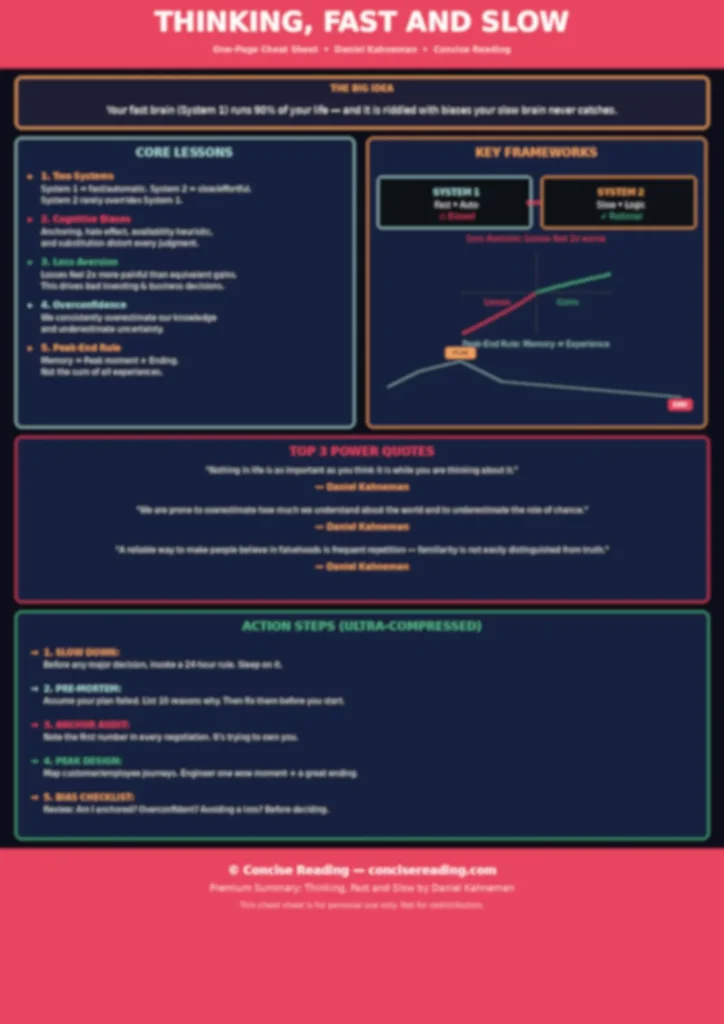
Premium Cheat Sheet Preview
About the Author
Daniel Kahneman is Professor Emeritus of Psychology and Public Affairs at Princeton University and the only psychologist ever awarded the Nobel Prize in Economic Sciences (2002). Over five decades, his research with collaborator Amos Tversky dismantled the myth of human rationality and gave birth to behavioral economics — a field that now shapes government policy, financial markets, and business strategy worldwide. If you want to understand why people — including you — make the decisions they do, there is no more qualified person on earth to learn from.
(For the complete author profile, research history, and list of Kahneman’s other works, see the premium summary’s Author Background section.)
Power Quote From the Book:
“Nothing in life is as important as you think it is while you are thinking about it.”
— Daniel Kahneman, Thinking, Fast and Slow
Who This Summary is For
This is for you if…
- You are an entrepreneur or business owner who has ever made a major decision and wondered afterwards why it seemed so obvious at the time
- You are an investor or trader who wants to understand the psychological roots of bad market behavior — especially your own
- You are a manager, team lead, or executive responsible for hiring, strategy, or performance decisions, and you want to reduce the invisible biases that degrade every one of those processes
- You want to understand why the people you negotiate with, sell to, or persuade behave the way they do — and how to use that understanding ethically
- You have already read Influence by Cialdini, Blink by Malcolm Gladwell, or Thinking in Bets by Annie Duke and want the foundational science behind all three
Skip this if…
You want a quick tactical checklist with zero psychology — this book requires some patience with ideas before they become tools. If that’s not you right now, our The 7 Best Books on Decision Making guide might be the better starting point.
Social Proof
This summary is newer than the reviews below — which means you have a rare chance to be among the first readers to weigh in. If you read the free summary or the premium version, drop your honest reaction in the comments. What landed? What surprised you? What will you actually use? Every comment helps the next reader decide whether this is worth their time — and your experience is worth sharing. Real feedback from real readers is the only social proof that means anything here.
(Already explored other summaries? See what readers are saying across our full library.)
Thinking, Fast and Slow took Daniel Kahneman over a decade of research and 499 pages to write. The premium summary gives you the complete system — all five frameworks with visual diagrams, five curated power quotes with practical breakdowns, five specific action steps written to cause discomfort, a full critical analysis, and a one-page cheat sheet worth pinning to your wall — in under 60 minutes.
Every bad decision you’ve made in the last year had a name. Kahneman named them all. The premium summary tells you exactly what to do about it.
Related Summaries
1. Blink — Malcolm Gladwell Kahneman’s System 1 thinking, explored through gripping real-world stories. Gladwell asks when to trust snap judgments — Kahneman tells you when not to. Read together, they’re a complete picture.
2. Influence — Robert Cialdini If Kahneman explains why your brain is vulnerable to manipulation, Cialdini shows exactly how others exploit it — and how to defend yourself. Essential companion read.
3. Thinking in Bets — Annie Duke A professional poker player applies Kahneman’s research to decision-making under uncertainty. More practical and tactical than Kahneman. If you want to act on what you just read, start here.