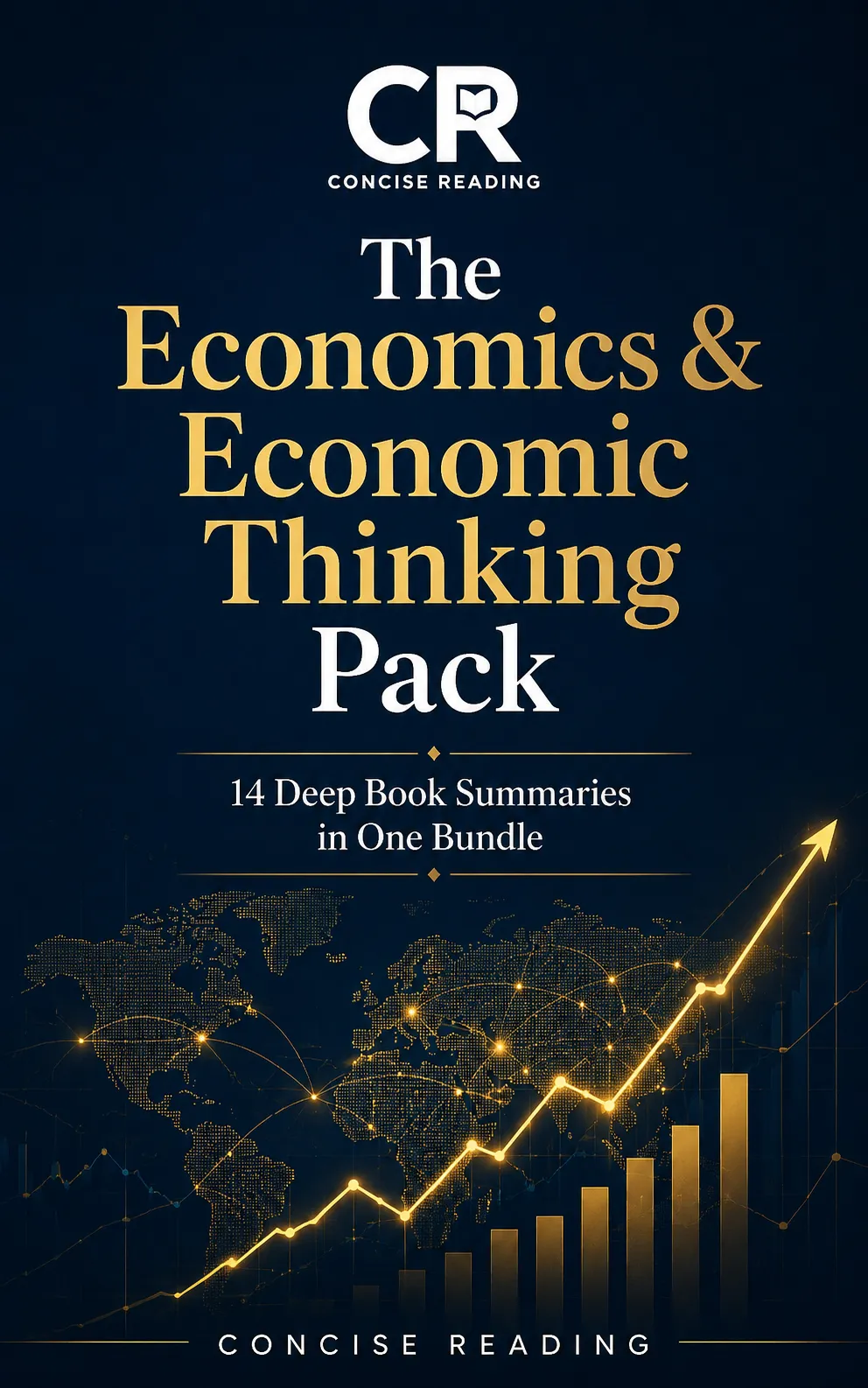
The Economics & Economic Thinking Mastery Pack — 14 Deep Summaries in One Bundle
Everything Adam Smith, Nassim Taleb, Daniel Kahneman, and 11 other landmark thinkers discovered about how money, markets, and human behavior actually work — extracted, distilled, and delivered so you can read it in hours, not months.
| 14 Deep Summaries | $ 2.4 per Summary |
$ 70
Instant download. PDF format. Use on any device.
The Problem This Pack Solves
You already know that understanding economics and behavioral finance gives you an edge — in investing, in business decisions, in negotiations, in simply making sense of the world around you. But every time you try to actually read these books, the same thing happens: The Wealth of Nations is 1,000 pages of 18th-century prose. Thinking Fast and Slow takes weeks to finish. Antifragile requires you to think through Taleb’s philosophy before the frameworks even click. You either never start, or you start and stop three books in, knowing you missed something important but unable to pinpoint what.
The result? You walk into conversations about inflation, market irrationality, or global economics with a half-formed understanding stitched together from podcasts and Wikipedia. You make decisions — in your business, your investments, your financial life — without the mental models the best thinkers in the world spent decades building.
This pack gives you the complete economics and behavioral economics education — every key idea, framework, and insight — without the 14,000 pages.
What’s Inside — Full Book List
Every book in this pack was chosen for a specific reason. This is not a random collection of “popular economics books.” Each title covers a distinct lens: classical economics, behavioral bias, risk psychology, global systems, and human irrationality. Together, they form a complete mental model library for understanding how the economic world actually works.
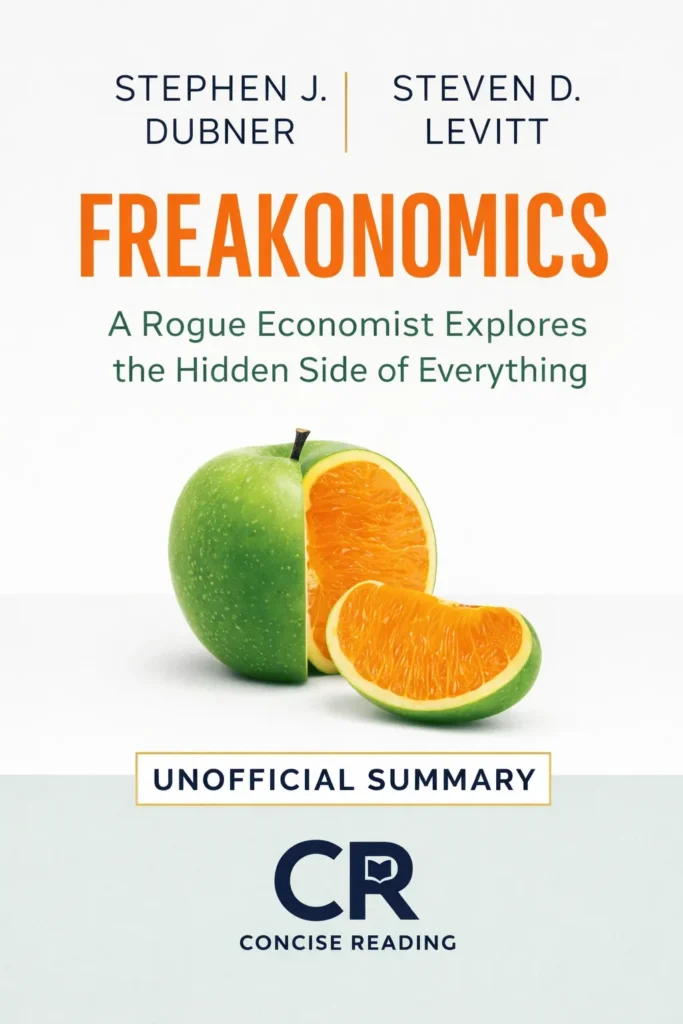
- Freakonomics — Steven D. Levitt & Stephen J. Dubner
- Included because it rewires how you ask questions — teaching you to find hidden causes behind obvious outcomes using data and counterintuitive logic. It is the gateway to economic thinking.
- Thinking, Fast and Slow — Daniel Kahneman
- Included because it is the definitive map of the two systems driving every financial and business decision you make — and why System 1 keeps costing you money.
- Nudge — Richard H. Thaler & Cass R. Sunstein
- Included because it shows how the architecture of choices changes behavior without force — essential reading for anyone designing products, policies, or incentive systems.
- The Wealth of Nations — Adam Smith
- Included because every serious conversation about markets, trade, and economic policy traces back to Smith’s framework. You cannot think clearly about capitalism without this foundation.
- Economics in One Lesson — Henry Hazlitt
- Included because it is the single clearest explanation of how economic policies actually work — including their invisible second-order effects that most people never consider.
- Basic Economics — Thomas Sowell
- Included because Sowell systematically dismantles economic myths using plain language and logic. It is the book that makes every other economics book easier to understand.
- The Undercover Economist — Tim Harford
- Included because it translates abstract economic theory into daily life — showing you the economics hiding inside coffee shops, supermarkets, and traffic jams.
- Antifragile — Nassim Nicholas Taleb
- Included because it gives you a complete framework for building systems — financial, business, personal — that get stronger from volatility instead of breaking under it.
- The Black Swan — Nassim Nicholas Taleb
- Included because rare, high-impact events shape outcomes far more than most predictions account for, and this book teaches you how to think about and prepare for what models miss.
- Animal Spirits — George A. Akerlof & Robert J. Shiller
- Included because it explains the psychological forces — confidence, fairness, corruption, money illusion — that drive economic cycles in ways pure data never can.
- Irrational Exuberance — Robert J. Shiller
- Included because Shiller predicted two major market crashes before they happened. This book teaches you to read the structural signals that markets are overvalued before the crowd figures it out.
- Against the Gods — Peter L. Bernstein
- Included because it traces the entire history of risk — from ancient probability theory to modern finance — showing you how humanity learned to measure and manage uncertainty.
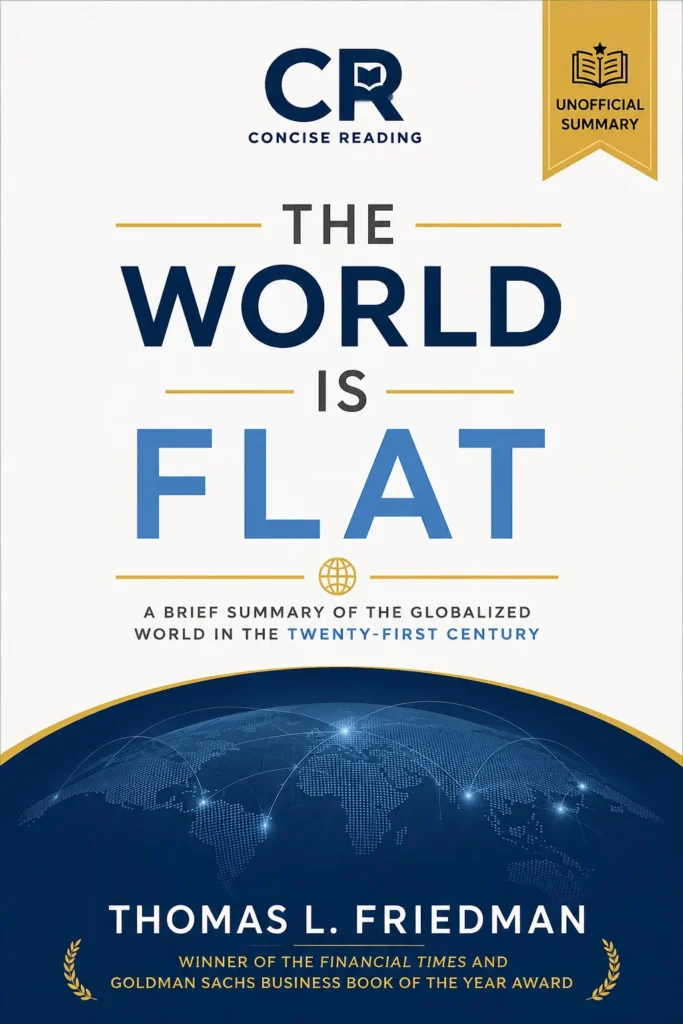
- The World Is Flat — Thomas L. Friedman
- Included because it explains how globalization reshapes competition, supply chains, and opportunity — the context every entrepreneur and investor needs to understand the modern economy.
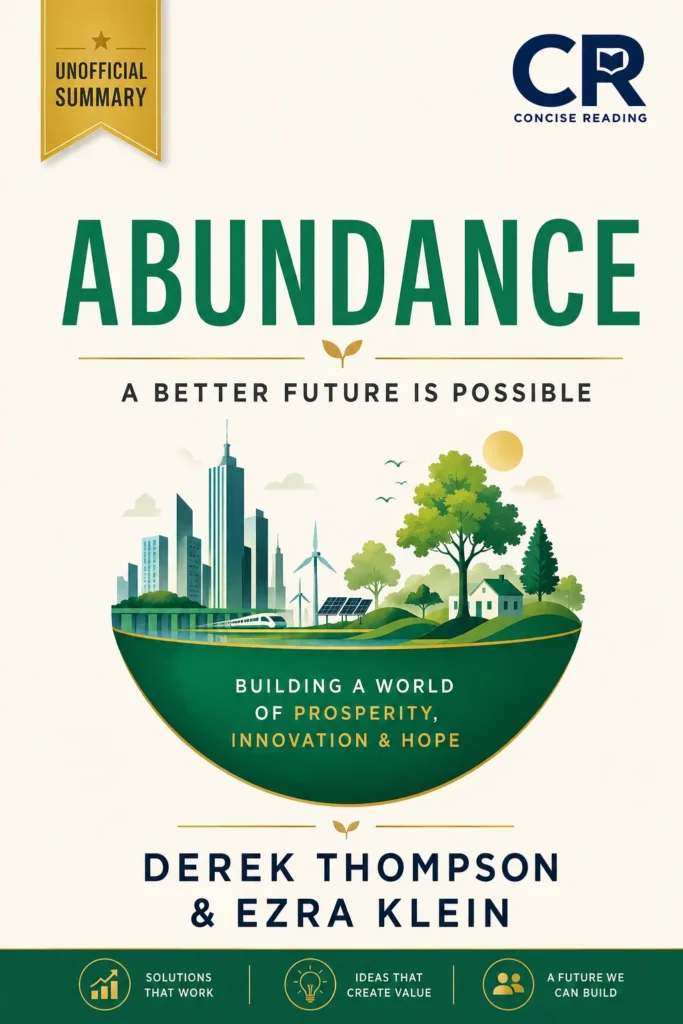
- Abundance — Peter H. Diamandis & Steven Kotler
- Included because it offers the counterargument to scarcity-based economic thinking — backed by data on exponential technology, showing why the future is more resource-rich than most economists predict.
Suggested Reading Order
If you want to build the strongest possible mental model, read in this sequence:
Start with Basic Economics by Sowell — it gives you the logic framework that makes everything else click. Then move to Economics in One Lesson by Hazlitt to sharpen your ability to see second-order effects. Next, read The Wealth of Nations to understand where modern market theory began. From there, go to Thinking Fast and Slow to understand the psychology sitting beneath every economic decision. Then Freakonomics — now you can read it with full economic reasoning behind you, and it will hit completely differently. Move into Nudge next, since it builds directly on Kahneman’s framework. Then read The Undercover Economist to see all of this theory in practical, daily life situations. At this point, switch to risk: Against the Gods first for the history, then The Black Swan for the implications, then Antifragile for the solution. From risk, move into markets and irrationality — Animal Spirits followed by Irrational Exuberance. Finish with the macro perspective: The World Is Flat for global economic systems, then Abundance to end on the structural forces shaping the next century.
This sequence is not arbitrary. It moves from foundations to psychology to risk to markets to global systems. Each book reinforces and deepens the one before it.
What Each Summary Includes
For every summary in this pack, the reader gets:
- Book snapshot & author background
- Full chapter-by-chapter breakdown
- Key frameworks with visual diagrams
- specific action steps
- Critical honest analysis
- One-page cheat sheet
- Further reading recommendations
What You’ll Be Able To Do After This Pack
- After reading this pack, you will be able to spot the hidden economic incentives driving behavior in any situation — in a negotiation, a market trend, a political debate, or a business model — before most people in the room even ask the question.
- You will be able to identify when your own thinking is being distorted by cognitive bias — loss aversion, anchoring, availability heuristic — and course-correct before it costs you money.
- You will be able to evaluate business decisions and investments with a second-order lens, asking not just “what happens if this works?” but “what are the invisible consequences most people are ignoring?”
- You will be able to build financial and business systems that are genuinely antifragile — structured to benefit from volatility and uncertainty rather than simply survive it.
- You will be able to read market signals — irrational exuberance, animal spirits, structural overvaluation — with frameworks used by Nobel Prize-winning economists, not just headlines and Twitter takes.
- You will be able to speak and think with confidence on economics, globalization, and behavioral finance in professional and investment contexts — not because you memorized facts, but because you understand the underlying logic.
- You will be able to approach risk with mathematical and philosophical clarity — understanding probability, rare events, and uncertainty in a way that permanently improves how you plan for the future.
Summaries vs Reading the Original Books
The original books in this pack are exceptional. Adam Smith, Kahneman, Taleb, and Shiller are among the most important thinkers of the last three centuries. This pack does not replace them — it extracts everything that matters and shows you exactly what to do with it.
Reading all 14 original books vs. reading this pack:
Time required: Reading all 14 originals would take the average reader 4 to 6 months of consistent reading — assuming you finish every page of The Wealth of Nations, push through Kahneman’s 500 pages, and work through Taleb’s dense philosophical frameworks. This pack delivers the full substance in 6 to 10 hours of focused reading.
Cost: The 14 original books together cost between $180 and $220 depending on format. This pack is $34 — that is a saving of up to $186 on source material alone.
Structure: The original books are written for depth and academic completeness. Whole chapters exist to build an argument across 60 pages that this pack distills into its core insight and application in three pages. The signal-to-noise ratio in this pack is dramatically higher.
Actionability: Most readers finish a book like Thinking Fast and Slow fascinated but uncertain what to actually change. Every summary in this pack includes the key frameworks and the specific behaviors or decisions those frameworks should change.
Retention: Research on reading comprehension consistently shows that structured, chapter-by-chapter breakdowns with explicit key takeaways produce significantly better retention than reading a full book once. These summaries are engineered for retention — you will remember more from this pack than from reading three of the originals.
Completeness: Because you are reading all 14 books in one consistent format, you will see the connections between them — Kahneman’s System 1 and Thaler’s nudge theory, Taleb’s Black Swan and Shiller’s irrational exuberance — that most readers who read books one at a time completely miss.
Who This Pack is For ?
This is for you if you are an entrepreneur, investor, or professional who knows that economic and behavioral thinking gives you a serious edge — but every time you pick up The Wealth of Nations or Thinking Fast and Slow, life gets in the way before you finish them.
This is for you if you are making investment, hiring, pricing, or strategic decisions and you want the frameworks used by Nobel Prize-winning economists to inform those decisions — not just your gut instinct and whatever you last read on Twitter.
This is for you if you have tried to follow economic news and debates — inflation, interest rates, globalization, market crashes — and you feel like you are always one level of understanding behind the conversation.
This is for you if you run a business and you want to understand incentive structures, consumer irrationality, and market forces at the level where you can design better products, better pricing, and better systems — not just react to what competitors do.
This is for you if you are a student, a self-educator, or simply someone who takes ideas seriously and wants to understand the economic world you are operating in — without spending a year reading books that, if we are being honest, have chapters that could be 60 pages shorter.
This is not for you if you are looking for a surface-level overview. Every summary in this pack goes deep. You will come out of this pack with a genuine command of these ideas — not just the ability to name-drop them.
Testimonials
This pack was built for readers who take economics seriously — and the best signal of its value comes from the people who have actually read it. If you have worked through any of the summaries in this pack, the single most useful thing you can do is leave a comment below. Not a rating — a real sentence. What clicked for you? Which summary changed how you think about a decision? Which book did you finally understand after years of it sitting on your reading list? Your experience helps other serious readers find what they need, and it helps this community become something genuinely useful. Scroll down, leave a comment, and tell us what hit hardest. You know things from this pack that most people spent months learning. Share one of them.
FAQs
- Q: What format is this? → PDF, readable on any device, instantly downloadable.
- Q: How long are the summaries? → 25–35 pages each with full frameworks and cheat sheets.
- Q: Is this the same as Blinkist? → No. Blinkist gives 8-page overviews. These are 25+ page actionable deep-dives with frameworks, critiques, and cheat sheets.
- Q: Do I need to have read the books? → No. Each summary is completely standalone.
- Q: What if I already own some of these books? → You still get the frameworks, cheat sheets, and action steps for every book — including the ones you’ve read. Most buyers say they got more from the summary than the original.
14 deep, chapter-by-chapter economics book summaries. $34 total. That is $2.43 per book — less than a single espresso for a complete economic thinking education built from some of the most important books written in the last 300 years.
Every summary in this pack would cost you $4.99 individually through the Concise Reading library. As a pack, you are saving over $35 on the individual price alone — before you factor in the $186 you are not spending on the original books.
Want more than summaries? The Wealth Playbook synthesizes the financial and economic insights from 14 classics into one unified, fully actionable system — built for people who want a complete roadmap, not just the individual frameworks. If this pack gave you the pieces, The Wealth Playbook shows you how to put them together.