Reminiscences of a Stock Operator by Edwin Lefevre — Summary & Key Lessons
What this book will teach you in the next 10 minutes — and why it matters for every financial decision you’ll make in volatile markets.
Read by traders, investors, and entrepreneurs in 40+ countries. Part of the Wall Street & Financial Markets collection at Concise Reading.
Book Snapshot
- Author – Edwin Lefevre
- Category – Investing & Trading / Financial Psychology
- Original Book – ~ 320 pages | Average read time: 7–9 hours
- Free Summary – 08 pages
- Premium Summary – 41 pages | Estimated read time: 45–60 minutes
The Big Idea
Jesse Livermore made and lost millions multiple times — not because he lacked skill, but because he kept letting emotion override his own system. This book, written a century ago, contains the most accurate diagnosis of why traders fail that has ever been put to paper. The market doesn’t care about your opinion, your hope, or your pride. It only rewards the people who observe patiently, act decisively, and exit without ego. If you’ve ever held a losing position too long, acted on a tip, or abandoned a working strategy after one bad trade — this book is about you.
What You’ll Learn — Key Lessons Preview
- Why patience — not analysis — is the skill that separates profitable traders from everyone else, and the one practice Livermore called the hardest thing he ever learned
- How to identify the “line of least resistance” — the direction a market is already leaning — before you commit a single dollar to any position
- The four emotional patterns that destroy trading accounts (hope, fear, greed, ego) and the specific triggers that activate each one in your decision-making
- Why tips, hot takes, and social media signals are structurally designed to cost you money — and a dead-simple rule to neutralize them before they reach your brokerage account
- How to build positions the way professional traders do — entering small, letting the market confirm your thesis, and scaling up only when it proves you right
Free vs Premium Comparison
| Free – $0 | Premium – $4.99 (Recommended) |
| ➡ Book Snapshot ➡ The Big Idea ➡ Key Lessons ➡ Power Quotes ➡ 08 Pages | ✔ Everything in free + ✔ Full Chapter Breakdown ✔ Key frameworks & diagrams ✔ Action steps ✔ Critical analysis ✔ One-page cheat sheet ✔ 41 pages |
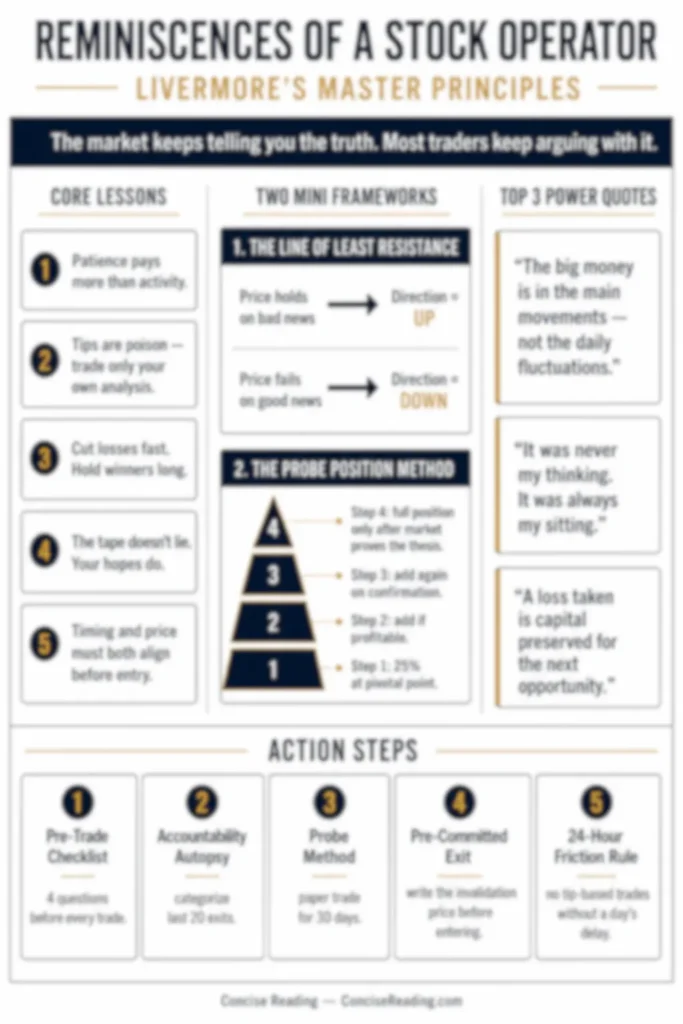
Premium Cheat Sheet Preview
About the Author
Edwin Lefevre was a Wall Street journalist and author who spent decades embedded in the world of professional speculation at the turn of the 20th century. His unmatched access to Jesse Livermore — the greatest speculator of his era — produced this fictionalized biography, first serialized in The Saturday Evening Post in 1922. Lefevre didn’t just report Livermore’s trades. He extracted the psychological architecture behind them, producing a work that Warren Buffett, Paul Tudor Jones, and generations of professional traders have called essential reading.
Power Quote From the Book:
“It never was my thinking that made the big money for me. It always was my sitting.”
— Jesse Livermore, as told through Edwin Lefevre
Who This Summary is For
- This is for you if…
- You are an active trader or investor who understands the mechanics of markets but keeps undermining your own positions with emotional decisions
- You are an entrepreneur or business owner who takes calculated financial risks and wants a sharper mental framework for when to hold conviction and when to cut losses
- You want to understand how markets actually behave — not how textbooks say they should — through the lens of someone who moved them
- You’ve read modern investing books like The Psychology of Money or Thinking in Bets and want the historical foundation those books were built on
- You are serious about building the investing fundamentals that compound over a lifetime, not just the next trade
- Skip this if…
- You are a purely passive investor following an index-fund strategy with no interest in individual securities — Livermore’s lessons are for active decision-makers. If you’re looking for a quick-fix trading system with backtested entry signals, this isn’t that book.
Testimonials
We’re building something at Concise Reading that rewards the readers who show up. If you’ve read this summary — free or premium — we’d genuinely like to know what landed for you. Which lesson changed how you’re thinking about a current position? Which framework are you planning to apply first? Drop your thoughts in the comments below. Your experience doesn’t just help us improve — it helps the next trader who lands on this page decide whether this summary is worth their time. Real feedback from real readers is the only social proof that matters here.
Reminiscences of a Stock Operator took Jesse Livermore a lifetime of gains and losses worth hundreds of millions of dollars to produce. The premium summary gives you the complete system — every framework, every action step, and a one-page cheat sheet you can keep next to your trading desk — in under an hour. At $4.99, that is the cheapest tuition in trading education you will ever find. If you’re serious about Wall Street and financial markets, you might also want to explore the full Wall Street & Financial Markets Premium Pack — 14 summaries including Market Wizards, The Big Short, and The Intelligent Investor, bundled at a fraction of individual pricing. Or if you want the complete synthesized system across all investing classics, the Investing Playbook brings it all together in one unified guide. Not sure where to start? Visit our Start Here page or browse the full Library.
Related Summaries
- The Psychology of Money by Morgan Housel — Livermore mastered the mechanics of trading but repeatedly lost to his own psychology. Housel’s book is the modern companion piece — explaining why behavior, not intelligence, determines financial outcomes.
- Thinking in Bets by Annie Duke — Livermore intuitively understood probabilistic thinking. Duke formalizes it. This summary teaches you how to make decisions under uncertainty the way professionals do — separating good decisions from good outcomes.
- Market Wizards by Jack Schwager — Direct interviews with the greatest traders of the modern era. Nearly every trader profiled cites Livermore as an influence. Read this alongside Reminiscences to see how his lessons survived into the 21st century.