The World Is Flat by Thomas L. Friedman — Summary & Key Lessons
What globalization really did to the economy — and what it means for your career, business, and financial future right now.
Read by professionals in 40+ countries. Part of Concise Reading’s Economics & Economic Thinking library — summaries and counting.
Book Snapshot
- Author – Thomas L. Friedman
- Category – Economics / Globalization / Business Strategy
- Original Book – ~ 660 pages | Estimated read time: 18–22 hours
- Free Summary – 08 pages
- Premium Summary – 31 pages | Estimated read time: 45–60 minutes
The Big Idea
Around the year 2000, something permanent happened to the global economy. Technology, infrastructure, and geopolitics converged in a way that demolished the geographic advantages wealthy nations had relied on for centuries. Suddenly, a developer in Bangalore competed directly with one in Boston. A factory in Shenzhen undercut one in Ohio. A freelancer in Lagos had access to the same clients as a consultant in London. Thomas Friedman calls this the flattening of the world — and his central argument is both simple and brutal: geography no longer protects you. The only thing that does is how valuable, adaptable, and irreplaceable you make yourself. This isn’t a book about the past. It’s a warning — and a blueprint — for the world you’re operating in right now.
What You’ll Learn — Key Lessons Preview
- Why the job market feels brutally competitive even when you’re doing everything right — and the structural force that explains it
- How to identify whether your career or business is “flat-world proof” — and what to do immediately if it isn’t
- The four categories of workers who remain irreplaceable regardless of globalization, automation, or AI — and how to position yourself in one of them
- Why the instinct to protect your current position is the most dangerous response to disruption — and what to do instead
- How countries like India and China captured trillions in economic value not by inventing something new, but by strategically plugging into the global economy — and what entrepreneurs can learn from that playbook
Free vs Premium Comparison
| Free – $0 | Premium – $4.99 (Recommended) |
| ➡ Book Snapshot ➡ The Big Idea ➡ Key Lessons ➡ Power Quotes ➡ 08 Pages | ✔ Everything in free + ✔ Full Chapter Breakdown ✔ Key frameworks & diagrams ✔ Action steps ✔ Critical analysis ✔ One-page cheat sheet ✔ 31 pages |
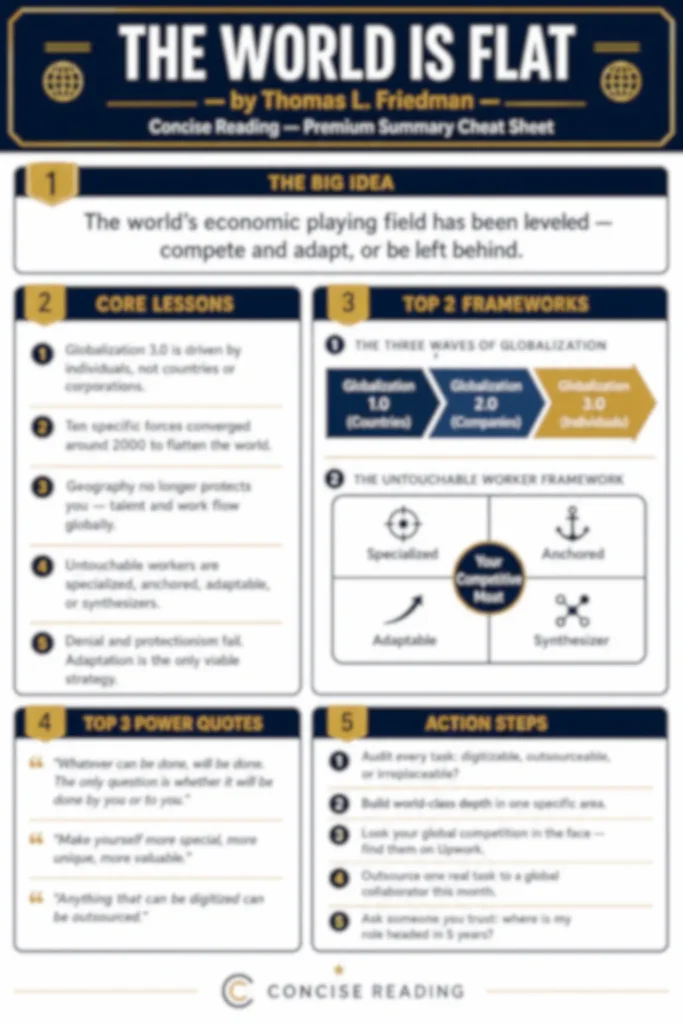
Premium Cheat Sheet Preview
About the Author
Thomas L. Friedman is a three-time Pulitzer Prize-winning journalist and the foreign affairs columnist for The New York Times — one of the most widely read commentators in the world. He has spent decades reporting from the Middle East, South Asia, and across the developing world, giving him a ground-level understanding of how globalization actually operates. The World Is Flat won the inaugural Financial Times and Goldman Sachs Business Book of the Year Award and has been translated into more than 35 languages.
Power Quote From the Book:
“Whatever can be done, will be done. The only question is whether it will be done by you or to you.”
— Thomas L. Friedman, The World Is Flat
Who This Summary is For
- This is for you if…
- You are an entrepreneur or business owner trying to understand why your competitive environment feels permanently harder than it used to
- You are a professional in a field facing disruption — finance, law, accounting, tech, education — and you want a framework for repositioning your value
- You want to understand the real structural forces behind economic inequality, outsourcing, and job displacement — not just the political headlines
- You are an early-career professional or student who wants to future-proof their skill set before the market forces the decision for them
- You are a strategist, leader, or manager building teams in a global, digital, or remote environment and need historical and strategic context for the decisions you’re making now
- Skip this if…
- You want a step-by-step tactical playbook or a deeply critical analysis of globalization’s social costs. This book — and this summary — is strategic and largely optimistic in its framing. If you’re looking for a counterpoint, pair it with our Globalization and Its Discontents summary for the full picture.
Testimonials
Have you read this summary? We’d genuinely like to hear from you.
Drop a comment below and tell us: what was the one idea that hit hardest, or the one thing you’re going to do differently after reading it. Every response gets read. The most thoughtful ones get featured. If this summary saved you time, sharpened your thinking, or changed how you see your industry — say so. That’s what helps other readers decide whether this is worth their 45 minutes.
Thomas Friedman spent years reporting across four continents to write this book. The premium summary gives you the complete system — every framework, every chapter breakdown, every action step, and a one-page cheat sheet — in under 60 minutes for $4.99.
Related Summaries
If The World Is Flat resonated with you, these three summaries are your logical next reads:
- Globalization and Its Discontents — Joseph Stiglitz’s sharp counterpoint to Friedman. Where Friedman is broadly optimistic about globalization, Stiglitz exposes the institutional failures — particularly the IMF’s role — that left developing nations worse off. Read both. The tension between them gives you the full picture.
- The Innovator’s Dilemma — Clayton Christensen’s framework for understanding why successful companies get blindsided by disruptive competitors — often from exactly the kind of flat-world players Friedman describes. Essential reading for any business owner or strategist.
- Zero to One — Peter Thiel’s argument that the best response to a competitive, flat world isn’t to compete on the same playing field — it’s to create a new one entirely. Directly actionable for entrepreneurs building in a globalized economy.