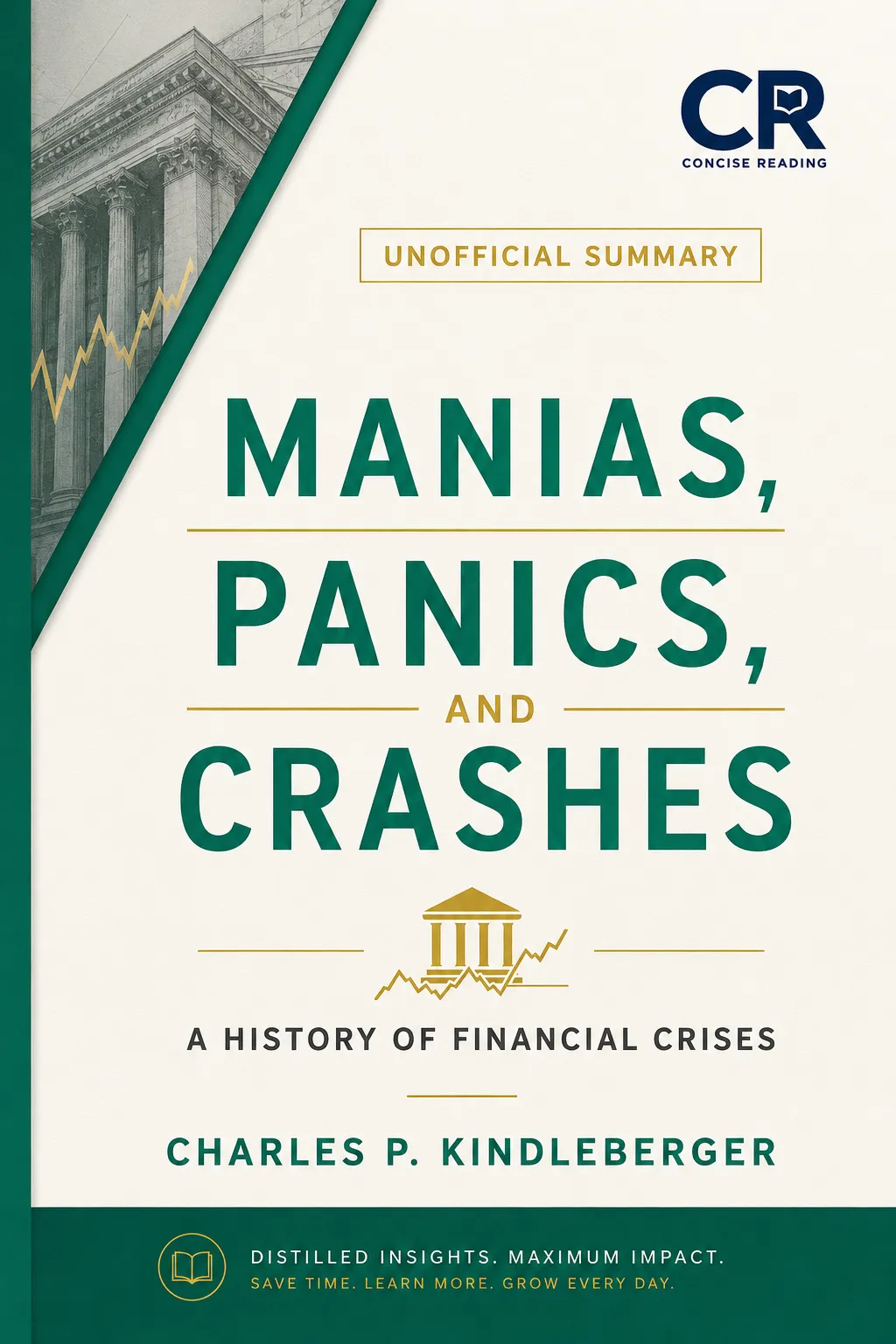
Manias Panics and Crashes Summary | Concise Reading
What this book will teach you in the next 10 minutes — and why it matters for protecting your wealth when the next financial crisis hits.
Part of the Wall Street & Financial Markets collection. Trusted summaries for serious readers.
Book Snapshot
- Author – Charles P. Kindleberger
- Category – Financial History / Macroeconomics / Behavioral Finance
- Original Book – ~ 304 pages | Average read time: 8–10 hours
- Free Summary – 09 pages
- Premium Summary – 34 pages | Estimated read time: 35–45 minutes
The Big Idea
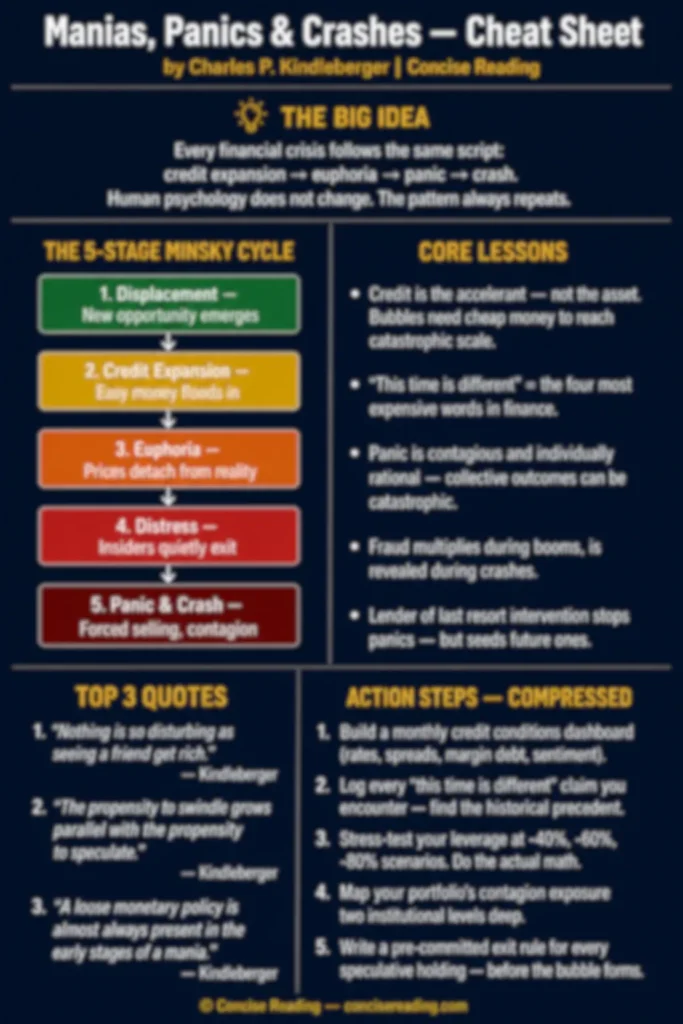
Every financial crash in history — from the tulip mania of 1637 to the 2008 mortgage collapse — followed the same five-stage script. Cheap credit floods a legitimate opportunity. Prices detach from reality. Everyone believes this time is different. Insiders quietly exit. Then the panic begins, and the people who arrived last lose the most. Charles Kindleberger spent decades documenting hundreds of crises across four centuries to prove one uncomfortable truth: human psychology does not change, which means financial catastrophes are not accidents. They are predictable. This summary gives you the complete framework to see them forming before everyone else does.
What You’ll Learn — Key Lessons Preview
- How to identify which stage of a speculative bubble any market or asset class is currently in — before the crash confirms it for you
- Why credit expansion — not the underlying asset — determines how catastrophic any given crisis becomes, and what warning signs to watch for
- How financial panics spread from a single point of failure to a full systemic collapse, and why your “unrelated” investments are rarely as safe as you think
- Why fraud, swindling, and financial scandal always multiply during booms and are only exposed during crashes — and what this tells you about the markets you’re currently in
- What history’s most devastating policy mistake was (the 1930s), what it teaches us about central bank intervention, and how to position yourself around it in any future crisis
Free vs Premium Comparison
| Free – $0 | Premium – $4.99 (Recommended) |
| ➡ Book Snapshot ➡ The Big Idea ➡ Key Lessons ➡ Power Quotes ➡ 09 Pages | ✔ Everything in free + ✔ Full Chapter Breakdown ✔ Key frameworks & diagrams ✔ Action steps ✔ Critical analysis ✔ One-page cheat sheet ✔ 34 pages |
Premium Cheat Sheet Preview
About the Author
Charles P. Kindleberger (1910–2003) was a professor of economics at MIT for over three decades and one of the most respected economic historians of the twentieth century. Before academia, he worked at the Federal Reserve, the Bank for International Settlements, and the U.S. State Department — where he helped design the Marshall Plan. He authored over 30 books on international economics and monetary history. If anyone was qualified to write the definitive study of financial crises, it was the man who spent his life inside the institutions that manage them. You can explore more summaries from the same intellectual tradition in our Economics & Economic Thinking and Financial Intelligence & Analysis collections.
Power Quote From the Book:
“There is nothing so disturbing to one’s well-being and judgment as to see a friend get rich.”
— Charles P. Kindleberger, Manias, Panics, and Crashes
Who This Summary is For
- This is for you if…
- You are an investor — at any level — who wants a historically grounded mental model for navigating market cycles, not just a collection of tactical tips
- You want to understand why 2008 happened, why the 2020–2022 asset bubble formed, and what the early warning signs of the next one look like
- You are a business owner or entrepreneur whose company is exposed to credit cycles, consumer spending, or capital market conditions
- You are studying finance or economics and want the real-world, historically documented version of what your textbooks sanitize
- You want to stop being the person who buys at the top and panic-sells at the bottom — and you understand that the solution is a better framework, not better discipline
- Skip this if…
- You are looking for a step-by-step investment strategy or personal finance action plan. This summary builds a worldview and a diagnostic framework. For tactical personal finance, start with our Personal Finance & Wealth Building collection instead.
Testimonials
Have you read this summary — free or premium? We’d genuinely like to know what landed for you.
If a lesson shifted how you think about markets, if a framework gave you a new way to read the current economic environment, or if you found yourself thinking differently about an investment decision — leave a comment below. Real feedback from real readers is the most useful thing we can offer people who are deciding whether this summary is worth their time. We read every comment, and the best insights from our readers consistently end up shaping how we write future summaries across the library.
Kindleberger spent over forty years researching, writing, and refining this framework across five editions and hundreds of historical crises. The Premium Summary gives you the complete system — every framework, every action step, the full chapter breakdown, and the one-page cheat sheet — in under 45 minutes, for $4.99.
Related Summaries
- 1. The Big Short — Michael Lewis – Where Kindleberger gives you the theory and history, Lewis gives you the visceral, ground-level account of exactly how the 2008 bubble formed and who saw it coming. Read together, these two books create an almost complete picture of how financial crises are built and lived through.
- 2. Irrational Exuberance — Robert Shiller – Shiller provides the behavioral economics foundation for why investors consistently inflate and then destroy asset bubbles — a perfect companion to Kindleberger’s historical pattern analysis. If Kindleberger shows you the what, Shiller shows you the why in the human brain.
- 3. Against the Gods: The Remarkable Story of Risk — Peter L. Bernstein – This book traces how humans have tried to understand, measure, and manage risk across history — and why we keep failing. It sits directly in the intellectual tradition of Kindleberger and rounds out your understanding of why financial risk is so consistently mispriced during boom cycles.