1929 by Andrew Ross Sorkin — Summary & Key Lessons
What a century-old market crash can teach you about the financial bubbles being built right now — and why it matters for your money, your investments, and every financial decision you’ll make next.
Part of the Wall Street & Financial Markets collection at Concise Reading — where we turn dense financial books into sharp, actionable summaries you can read in under an hour.
Book Snapshot
- Author – Andrew Ross Sorkin
- Category – Financial History / Economic Crisis / Behavioral Finance
- Original Book – ~ 400–450 pages | Average read time: 9–11 hours
- Free Summary – 08 pages
- Premium Summary – 28 pages | Estimated read time: 35–45 minutes
The Big Idea
The 1929 crash didn’t arrive without warning. It was built — year by year — through cheap credit, reckless margin lending, institutional greed, and a collective refusal to believe the party would end. Andrew Ross Sorkin’s “1929” strips away the mythology and shows exactly how ordinary people, banks, and regulators constructed a system guaranteed to collapse. The deeper lesson isn’t historical. It’s a blueprint. Every generation recreates the same conditions with different asset names, and the ones who understand the pattern are the ones who survive it. This summary gives you that pattern — clearly, completely, and fast. If you want to understand not just what happened in 1929, but why it keeps happening, this is where you start.
What You’ll Learn — Key Lessons Preview
- You will understand exactly how leverage turns a winning investment into a wipeout — and how to audit your own exposure before the next crash arrives
- You will recognize the three stages of any financial bubble while you’re still inside it, not after it has already destroyed your portfolio
- You will see why financial institutions reliably fail their clients during booms — and how to protect yourself from advisors whose incentives are working against you
- You will learn why confidence in markets collapses almost instantaneously while it builds over years — and why you cannot afford to rely on warning time to exit
- You will walk away with a framework that connects 1929 to 2008 to today — so that the next time someone tells you “this time is different,” you’ll know exactly what to say back
Free vs Premium Comparison
| Free – $0 | Premium – $4.99 (Recommended) |
| ➡ Book Snapshot ➡ The Big Idea ➡ Key Lessons ➡ Power Quotes ➡ 08 Pages | ✔ Everything in free + ✔ Full Chapter Breakdown ✔ Key frameworks & diagrams ✔ Action steps ✔ Critical analysis ✔ One-page cheat sheet ✔ 28 pages |
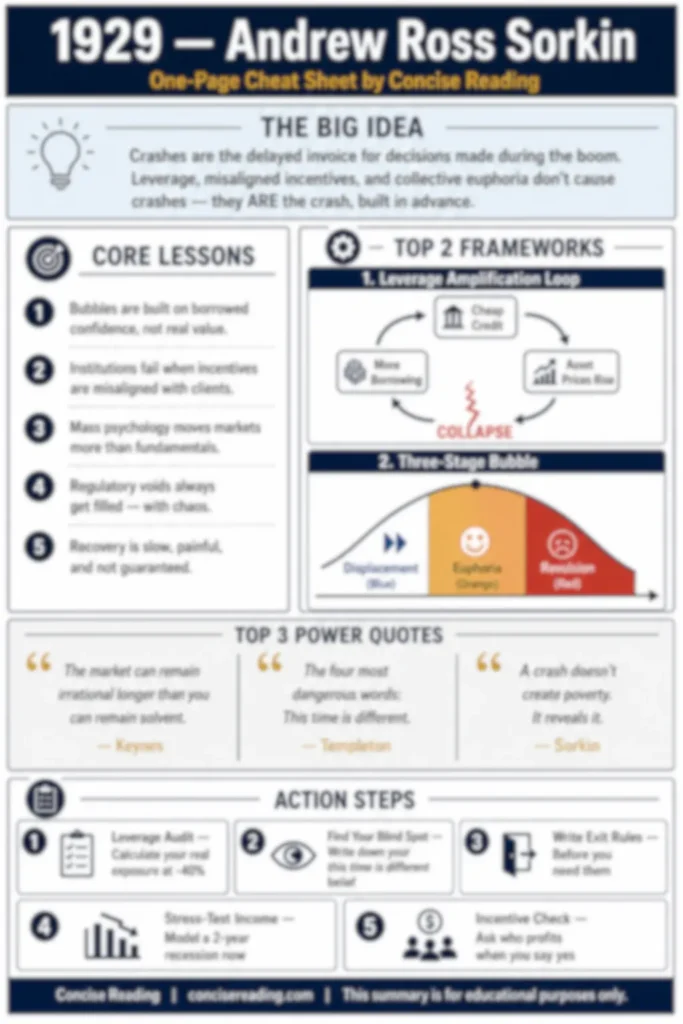
Premium Cheat Sheet Preview
About the Author
Andrew Ross Sorkin is the founder of DealBook at the New York Times and a co-anchor of CNBC’s Squawk Box — making him one of the most widely read and watched financial journalists in the world. He covered the 2008 financial crisis from inside the boardrooms of the Fed, Treasury, and Wall Street’s largest banks, and his previous book “Too Big to Fail” became the definitive account of that collapse. Few writers alive have both the access and the analytical depth to tell this story the way Sorkin does.
Power Quote From the Book:
“A crash doesn’t create poverty. It reveals it.”
— Andrew Ross Sorkin, 1929
Who This Summary is For
- This is for you if…
- You are an investor — experienced or early-stage — who wants to understand systemic risk before it costs you real money
- You are a finance student or professional who wants the human narrative behind the numbers you study in textbooks
- You are an entrepreneur or business owner with exposure to credit markets who needs to understand how macro crashes transmit into the real economy
- You want to stop treating financial history as irrelevant and start using it as a predictive tool for the environment you’re operating in right now
- You are someone who lived through 2008, sensed the déjà vu, and wanted to understand exactly why it felt so familiar
- Skip this if…
- You are looking for a tactical stock-picking guide or a step-by-step investment strategy — Sorkin is a diagnostician of financial systems, not a portfolio manager. If that’s what you need, our Investing Fundamentals category is a better starting point, beginning with summaries like The Intelligent Investor or One Up on Wall Street.
Testimonials
We’re building something here — and you’re part of it. If this summary sharpened your thinking, challenged an assumption, or made you look at your own financial decisions differently, we’d genuinely love to hear about it. Drop a comment below with your biggest takeaway from the summary, a question it raised for you, or how you’re planning to apply one of the frameworks. Your feedback helps us make every summary sharper — and it helps other readers decide whether this is the right book for them. The most useful reviews aren’t star ratings. They’re one honest sentence about what changed for you.
Andrew Ross Sorkin spent years reporting, researching, and reconstructing one of the most consequential financial events in history — the premium summary gives you the complete system: five mental frameworks, five curated power quotes with context, five specific action steps designed to cause productive discomfort, a full critical analysis, and a one-page cheat sheet worth pinning to your wall — all in 22 pages, for $4.99. If you found the free version useful, the premium version will change how you invest.
And if “1929” resonates with you, it pairs exceptionally well with our summaries of Manias, Panics and Crashes, The Big Short, and Irrational Exuberance — or explore the full Wall Street & Financial Markets Pack for the deepest possible education in how financial markets actually work.
Not sure where to go next? Start at our Library or visit Start Here if you’re new to Concise Reading.
Related Summaries
- Manias, Panics, and Crashes — The definitive academic treatment of how financial bubbles form, inflate, and collapse across history. Directly complements 1929 by giving you the theoretical framework to understand what Sorkin documents in narrative form.
- The Big Short — The story of the 2008 financial crisis through the eyes of the few who saw it coming. Reading this alongside 1929 makes the pattern of institutional failure and speculative excess impossible to miss.
- Irrational Exuberance — Robert Shiller’s landmark work on how psychological factors drive asset prices beyond rational value. This is the behavioral science backbone that explains why the mass delusion of 1929 wasn’t a one-time anomaly.