First Break All the Rules by Marcus Buckingham & Curt Coffman — Summary & Key
What this book will teach you in the next 10 minutes — and why it matters for the way you manage, hire, and retain the people on your team.
Based on Gallup’s research across 80,000 managers and over 1 million employees. Summarized by the team at Concise Reading — where serious readers get the core of the world’s best business books in a fraction of the time.
Book Snapshot
- Author – Marcus Buckingham & Curt Coffman
- Category – Leadership & Management / Human Resources / Organizational Psychology
- Original Book – ~ 271 pages | Average read time: 6–8 hours
- Free Summary – 08 pages
- Premium Summary – 32 pages | Estimated read time: 35–45 minutes
The Big Idea
Most management advice is built on a comfortable lie: that people are endlessly moldable, that weaknesses can be trained away, and that the right system will produce results from any person. Marcus Buckingham and Curt Coffman’s Gallup research — the largest of its kind ever conducted — proves otherwise. The best managers in the world don’t try to fix people. They study what each person is naturally wired to do, and they build everything around that. They hire differently, develop differently, and reward differently. The result is not just better performance — it’s lower turnover, higher engagement, and measurably stronger business outcomes. This is management based on evidence, not convention. And the evidence will change how you lead.
What You’ll Learn — Key Lessons Preview
- Why your best people keep leaving — and the one relationship that determines whether they stay or go, regardless of salary, culture, or company reputation
- How to identify real talent before you hire — and stop confusing experience and credentials with the recurring behavioral patterns that actually predict performance
- The 12 questions that reveal whether your team is set up to perform — or quietly disengaging while you assume everything is fine
- Why developing weaknesses is almost always the wrong move — and what great managers do instead that produces extraordinary results with ordinary time investment
- How to reward your best performers without promoting them into roles that destroy them — and why “up” is not the only path worth offering
Free vs Premium Comparison
| Free – $0 | Premium – $4.99 (Recommended) |
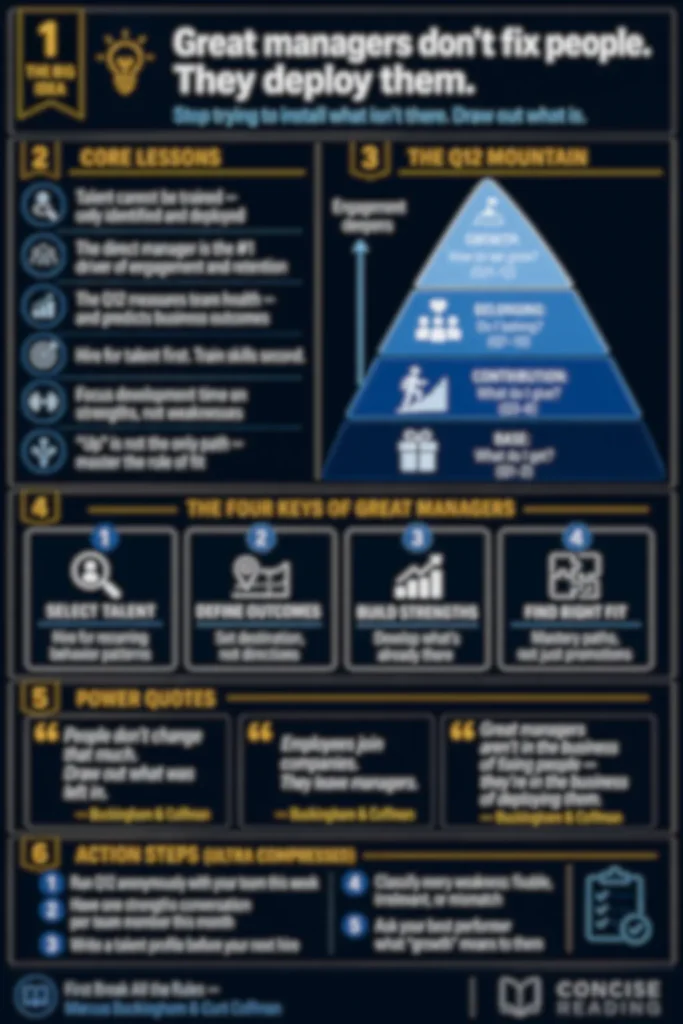
| ➡ Book Snapshot ➡ The Big Idea ➡ Key Lessons ➡ Power Quotes ➡ 08 Pages | ✔ Everything in free + ✔ Full Chapter Breakdown ✔ Key frameworks & diagrams ✔ Action steps ✔ Critical analysis ✔ One-page cheat sheet ✔ 32 pages |
Premium Cheat Sheet Preview
About the Author
Marcus Buckingham spent nearly two decades as a researcher at Gallup, leading studies on human performance and workplace engagement that reached over a million employees worldwide. Curt Coffman served as Gallup’s Global Practice Leader for Workplace Management, co-leading the landmark research that forms the backbone of this book. Together, they bring something almost no management authors can claim: conclusions drawn not from theory or personal experience, but from the largest empirical study of manager behavior ever conducted at the time of publication.
Power Quote From the Book:
“People don’t change that much. Don’t waste time trying to put in what was left out. Try to draw out what was left in. That is hard enough.”
— Marcus Buckingham & Curt Coffman, First Break All the Rules
Who This Summary is For
- This is for you if…
- You are a manager of any team size who feels like you’re constantly fixing performance problems instead of building on strengths
- You are a business owner who has hired talented people and watched them become disengaged — and you want to understand exactly why
- You want a research-backed framework for hiring, developing, and retaining people — not motivational advice with no data behind it
- You are an HR professional or team lead who suspects that conventional management training is producing compliance, not capability
- You want to understand what Gallup’s Q12 framework actually measures — and how to use it as a practical team diagnostic
- Skip this if…
- You have no direct reports and no immediate plans to manage people — this is a management book, not a personal development guide. If you’re looking for career or productivity advice, explore our Mindset & High Performance category instead.
Testimonials
We’re building something at Concise Reading that’s different from every other summary service — and the readers who use these summaries are a big part of what makes them better. If you’ve read this summary (free or premium), we’d genuinely like to know what you thought. Did it change how you think about managing your team? Did a specific lesson hit differently than you expected? Drop your thoughts in the comments below. Every piece of feedback shapes how we write the next one — and your experience might be exactly what helps another reader decide whether this is worth their time.
First Break All the Rules took Buckingham and Coffman nearly two decades of Gallup research to build — the premium summary gives you the complete system, every framework, and a ready-to-use action plan in under 45 minutes.
Related Summaries
- The Culture Code — Daniel Coyle – Dives into how the world’s most successful groups build psychological safety and belonging — a perfect complement to the management philosophy in First Break All the Rules.
- Drive — Daniel H. Pink – Explores what actually motivates people at work (hint: it’s not money). Pairs directly with the strengths-based management approach Buckingham and Coffman advocate.
- Gung Ho! — Ken Blanchard & Sheldon Bowles – A practical, story-driven guide to energizing teams and building a culture where people genuinely want to perform — aligns closely with the engagement research underpinning this book.