Risk Management and Financial Institutions by John C. Hull — Summary & Key Lessons
What banks, insurers, and fund managers actually do to stop themselves from blowing up — and what happens when their models fail.
Part of the Wall Street & Financial Markets collection. Trusted by finance professionals, FRM candidates, and serious investors.
Book Snapshot
- Author – John C. Hull
- Category – Finance & Risk Management / Banking & Financial Systems
- Original Book – ~ 672 pages — average read time 22–26 hours at standard reading pace for technical material
- Free Summary – 08 pages
- Premium Summary – 44 pages — estimated read time 45–55 minutes
The Big Idea
Financial institutions do not fail from taking risk. They fail from taking risk they have not honestly measured. John C. Hull’s central argument is that every major institutional collapse — from LTCM to the 2008 mortgage crisis to Silicon Valley Bank — traces back to the same structural failure: models built on assumptions that quietly broke down, correlations that spiked at the worst possible moment, and organizational cultures that rewarded revenue over honest risk disclosure. The institutions that survive are not the most conservative. They are the most accurate. This book teaches you the measurement systems, capital frameworks, and governance structures that separate institutions that endure from those that require bailouts.
What You’ll Learn — Key Lessons Preview
- Why Value at Risk (VaR) is the industry’s dominant risk metric and its most dangerous blind spot — and what to use alongside it so you’re not flying blind in a crisis
- How banks and insurers use the Risk Capital Stack to separate losses they price for, losses they hold capital against, and losses that threaten survival — and how to apply the same logic to any portfolio or business
- Why diversification fails precisely when you need it most, and how correlation assumptions calibrated in calm markets quietly collapse the moment systemic stress arrives
- How the Three Lines of Defense model is supposed to catch institutional risk failures before they become headline losses — and why it routinely doesn’t
- How to decompose credit risk into Probability of Default, Loss Given Default, and Exposure at Default so you can challenge a credit assessment instead of simply accepting or rejecting it
Free vs Premium Comparison
| Free – $0 | Premium – $4.99 (Recommended) |
| ➡ Book Snapshot ➡ The Big Idea ➡ Key Lessons ➡ Power Quotes ➡ 08 Pages | ✔ Everything in free + ✔ Full Chapter Breakdown ✔ Key frameworks & diagrams ✔ Action steps ✔ Critical analysis ✔ One-page cheat sheet ✔ 44 pages |
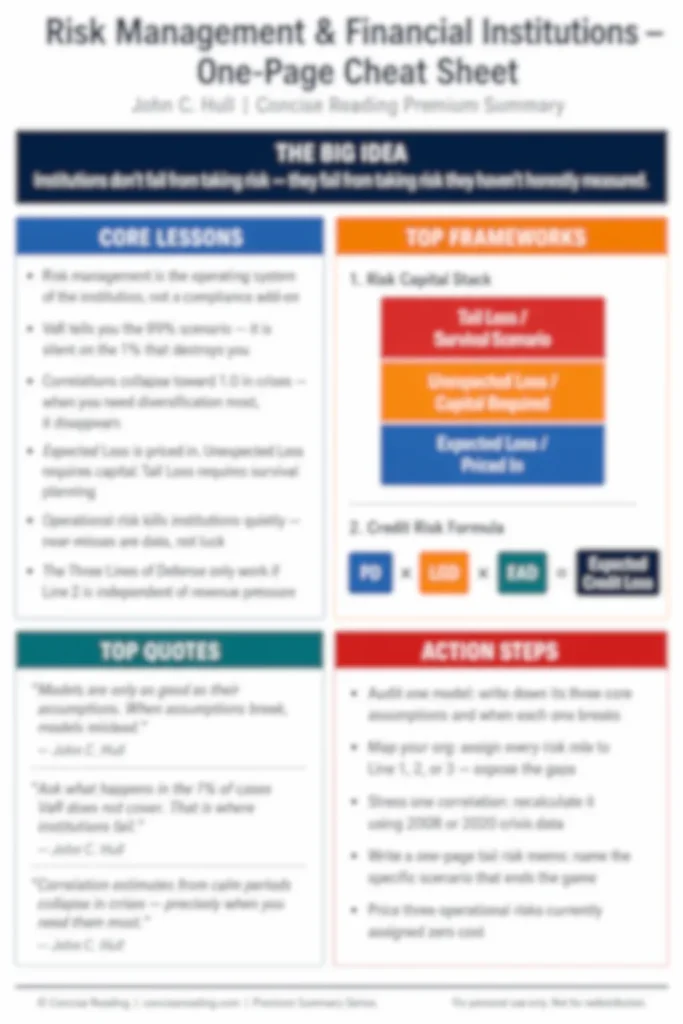
Premium Cheat Sheet Preview
About the Author
John C. Hull is Professor of Derivatives and Risk Management at the Rotman School of Management, University of Toronto, and co-developer of the Hull-White interest rate model — one of the most widely implemented models in global institutional finance. His textbook Options, Futures, and Other Derivatives is the standard reference in derivatives education across more than 60 countries, now in its eleventh edition. Hull has spent four decades at the intersection of academic research and institutional practice, advising financial institutions on the exact risk frameworks he teaches.
Power Quote From the Book:
“Risk managers should not be afraid to be the bearers of bad news. Their job is to make sure that the risks being taken are understood by senior management.”
— John C. Hull
Who This Summary is For
- This is for you if…
- You are a risk manager, bank analyst, or derivatives professional who wants a rigorous framework to sharpen your existing practice
- You are preparing for the FRM or CFA designation and need conceptual depth behind the formulas you are memorizing
- You are a portfolio manager or investment analyst who interacts with leveraged or derivative-heavy counterparties and wants to understand the risk architecture on the other side of the trade
- You are a finance professional making a deliberate move into risk, treasury, or compliance and want the foundational literacy to perform from day one
- You want to understand why the 2008 financial crisis, the LTCM collapse, and the Silicon Valley Bank failure all share the same structural cause — and what that means for how you read markets today
- Skip this if…
- You are looking for personal finance or wealth-building guidance — this book operates entirely at the institutional level. If that is your starting point, our Personal Finance & Wealth Building library is the better place to begin.
Testimonials
If you have read this summary — free or premium — we want to hear what you took away from it. Did a framework change how you think about institutional risk? Did an action step surface an exposure you had not previously priced? Leave a comment below. Every response from a practitioner, student, or investor helps other readers decide whether this is the right summary for where they are right now. Concise Reading is built for financially literate readers who take their reading seriously — your perspective belongs in this conversation.
John C. Hull spent four decades building and refining this framework across hundreds of pages of rigorous finance. The premium summary gives you the complete system — five key frameworks with diagram prompts, five curated power quotes with contextual analysis, five action steps specific enough to cause productive discomfort, a full critical analysis, and a one-page cheat sheet worth pinning to your wall — in under an hour, for $4.99.
If the institutional risk failures of the last two decades interest you, pair this summary with When Genius Failed for the LTCM case study and The Big Short for the 2008 mortgage collapse told at human scale. For the philosophical complement to Hull’s technical treatment of tail risk, The Black Swan by Nassim Taleb is the next logical read.
For readers building systematic financial literacy across the full institutional finance landscape, explore the Wall Street & Financial Markets Premium Pack and The Financial Intelligence Playbook — both include this summary as part of a curated, sequenced reading system.
Related Summaries
- When Genius Failed — Roger Lowenstein’s account of LTCM’s collapse is the best real-world case study of everything Hull warns about: correlation breakdown, model overconfidence, and leverage that looked manageable until it wasn’t.
- The Black Swan — Taleb’s framework for fat-tail thinking is the philosophical complement to Hull’s technical treatment of VaR’s limitations. Read them together and the 2008 crisis becomes structurally predictable in retrospect.
- The Big Short — Michael Lewis documents how a small number of investors saw what the risk models couldn’t: that mortgage correlation assumptions were wrong. A human-level account of institutional risk failure at scale.