The Failure of Risk Management by Douglas W. Hubbard — Summary & Key Lessons
What this book will teach you in the next 10 minutes — and why it matters for every high-stakes decision you make at work.
Part of the Concise Reading Premium Summary Series — built for professionals who want the insight without the 300-page investment. Explore our full Wall Street & Financial Markets and Financial Intelligence & Analysis libraries.
Book Snapshot
- Author – Douglas W. Hubbard
- Category – Risk Management / Business Decision-Making / Quantitative Analysis
- Original Book – ~ 304 pages | Average read time: 7–9 hours
- Free Summary – 08 pages
- Premium Summary – 32 pages | Estimated read time: 35–45 minutes
The Big Idea
Most organizations believe they are managing risk. They have the frameworks, the color-coded matrices, the risk registers, and the quarterly sign-offs. What Douglas Hubbard proves — with research, not opinion — is that the tools behind most of those processes have never been validated. They don’t reduce uncertainty. They manufacture the appearance of control while hiding the honest acknowledgment of danger that would otherwise drive better decisions. The fix isn’t a new proprietary system. It’s applying the same quantitative rigor used in insurance and engineering to the risk processes most organizations are still running on gut feel and guesswork.
What You’ll Learn — Key Lessons Preview
- Why the risk matrix your organization uses is statistically worse than doing nothing — and what the research actually shows
- How to replace meaningless High/Medium/Low ratings with probability estimates your team can track, score, and improve over time
- Why expert judgment fails in predictable ways — and how calibration training turns unreliable intuition into genuine forecasting ability
- How Monte Carlo simulation — already standard in engineering and finance — can replace guesswork in your next major business decision
- Why risk management failures are as much a leadership and culture problem as a methodology problem — and what to do about it
Free vs Premium Comparison
| Free – $0 | Premium – $4.99 (Recommended) |
| ➡ Book Snapshot ➡ The Big Idea ➡ Key Lessons ➡ Power Quotes ➡ 08 Pages | ✔ Everything in free + ✔ Full Chapter Breakdown ✔ Key frameworks & diagrams ✔ Action steps ✔ Critical analysis ✔ One-page cheat sheet ✔ 32 pages |
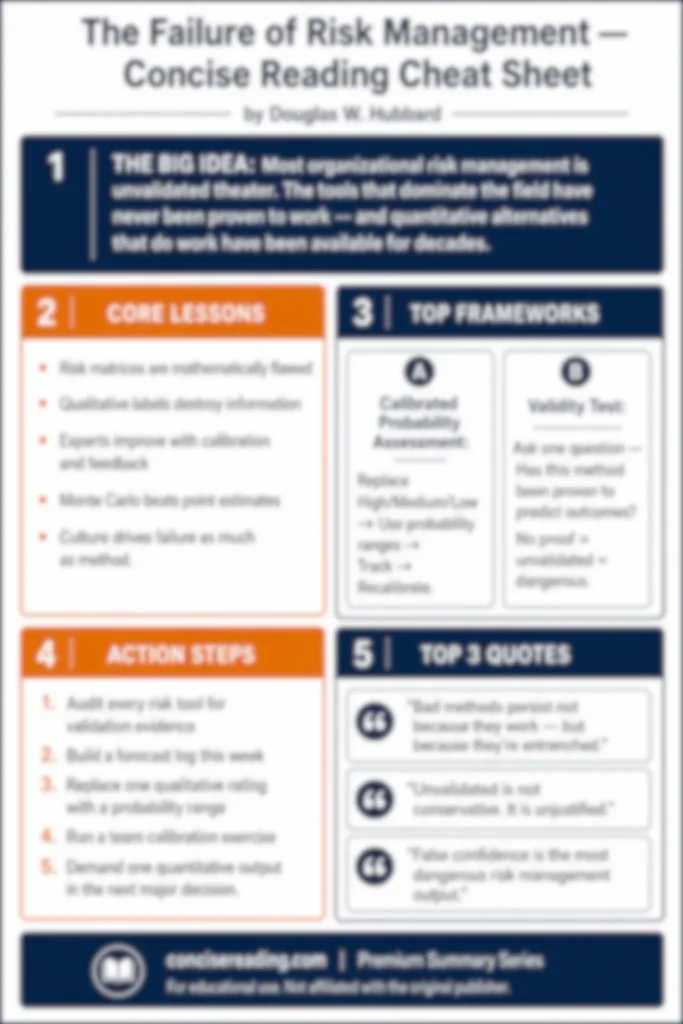
Premium Cheat Sheet Preview
About the Author
Douglas W. Hubbard is the founder of Hubbard Decision Research and the creator of Applied Information Economics, a quantitative decision-making methodology used by Fortune 500 companies and government agencies. He spent over two decades applying rigorous measurement frameworks to complex business problems. He is also the author of the widely respected How to Measure Anything, which has become a foundational text in analytics and decision science.
Power Quote From the Book:
“A method that has never been shown to work is not a conservative choice — it is an unjustified one.”
— Douglas W. Hubbard, The Failure of Risk Management
Who This Summary is For
- This is for you if…
- You are a risk manager, analyst, or consultant who suspects your current frameworks are more compliance paperwork than genuine protection
- You are a CFO, COO, or senior executive who approves risk reports and wants to understand whether they actually mean anything
- You want to understand why quantitative risk methods outperform qualitative tools — and how to make the case for change in your organization
- You are a finance or MBA student who wants a rigorous foundation in how risk should actually be assessed versus how it usually is
- You have read The Black Swan or Thinking in Bets and want the methodological framework to back up those intuitions
- Skip this if…
- You’re looking for a domain-specific implementation manual for cybersecurity, credit, or supply chain risk — this book is a methodology critique and a philosophical case for quantitative thinking, not a step-by-step technical guide for a single risk function.
Testimonials
If you’ve read this summary — free or premium — we’d genuinely like to know what you took from it. Did it change how you think about risk tools in your organization? Did a specific framework land differently than you expected? Drop your thoughts in the comments below. We read every one. Reader feedback is also what helps other professionals in risk, finance, and strategy decide whether this is the right summary for them — so if it was useful, say so. Your two sentences could save someone else three hundred pages.
Douglas Hubbard spent years researching and validating the case made in this book. The premium summary gives you his complete argument, five actionable frameworks with implementation steps, curated power quotes, a full chapter-by-chapter breakdown, and a one-page cheat sheet — in twenty pages and under forty minutes.
If you’re serious about making better decisions under uncertainty, the Wall Street & Financial Markets Premium Pack also includes this summary alongside thirteen other essential reads in financial risk and markets — at a fraction of the individual price.
Related summaries worth reading next: The Black Swan by Nassim Taleb, Thinking in Bets by Annie Duke, and Thinking, Fast and Slow by Daniel Kahneman. Or browse the full Financial Intelligence & Analysis category for more.
Not sure which format is right for you? Visit our Start Here page or check out the FAQs. You can also read Free vs Premium Book Summaries: What’s the Difference if you want the honest breakdown before deciding.
Related Summaries
- The Black Swan — Nassim Nicholas Taleb. The philosophical and statistical case for why rare, high-impact events are systematically underestimated — a perfect companion to Hubbard’s methodological critique.
- Thinking in Bets — Annie Duke. A practical framework for making better decisions under uncertainty, written by a professional poker player turned decision strategist. Where Hubbard is technical, Duke is immediately actionable.
- Thinking, Fast and Slow — Daniel Kahneman. The foundational research on cognitive biases that explains why human judgment fails in precisely the ways Hubbard documents. Understanding the psychology behind bad risk assessment makes Hubbard’s prescriptions make far more sense.