Rich Dad’s Guide to Investing by Robert Kiyosaki — Summary & Key Lessons
What this book will teach you in the next 10 minutes — and why it matters for your path to financial freedom and investing intelligence.
Part of the Investing Fundamentals collection at Concise Reading — where business and finance books are broken down into clear, actionable summaries you can read in under an hour.
Book Snapshot
- Author – Robert T. Kiyosaki
- Category – Personal Finance / Investing / Wealth Mindset
- Original Book – ~ 489 pages | Estimated read time: 12–15 hours
- Free Summary – 08 pages
- Premium Summary – 36 pages | Estimated read time: 35–45 minutes
The Big Idea
Most people never build real wealth — not because they lack income, but because they were never taught how money actually works. Robert Kiyosaki’s Rich Dad’s Guide to Investing makes the case that investing isn’t about picking the right stocks. It’s about becoming the right kind of person first. The rich build businesses and assets that generate passive income while paying the least tax legally possible. Everyone else earns a salary, pays the highest taxes, and saves what little is left. This book shows you the rules of the money game that schools never teach — and why understanding them changes every financial decision you make for the rest of your life.
What You’ll Learn — Key Lessons Preview
- Why your salary — no matter how high — will never make you financially free, and what to build instead
- How the CASHFLOW Quadrant reveals exactly where you stand financially right now and the precise steps to move toward passive income
- The one-question test that instantly tells you whether something is a true asset or a liability disguised as one How the wealthy legally pay far less tax than employees — using tools the tax code explicitly makes available to business owners and investors
- Why you must become a business owner before you become a serious investor — and how to start, even without quitting your job
Free vs Premium Comparison
| Free – $0 | Premium – $4.99 (Recommended) |
| ➡ Book Snapshot ➡ The Big Idea ➡ Key Lessons ➡ Power Quotes ➡ 08 Pages | ✔ Everything in free + ✔ Full Chapter Breakdown ✔ Key frameworks & diagrams ✔ Action steps ✔ Critical analysis ✔ One-page cheat sheet ✔ 36 pages |
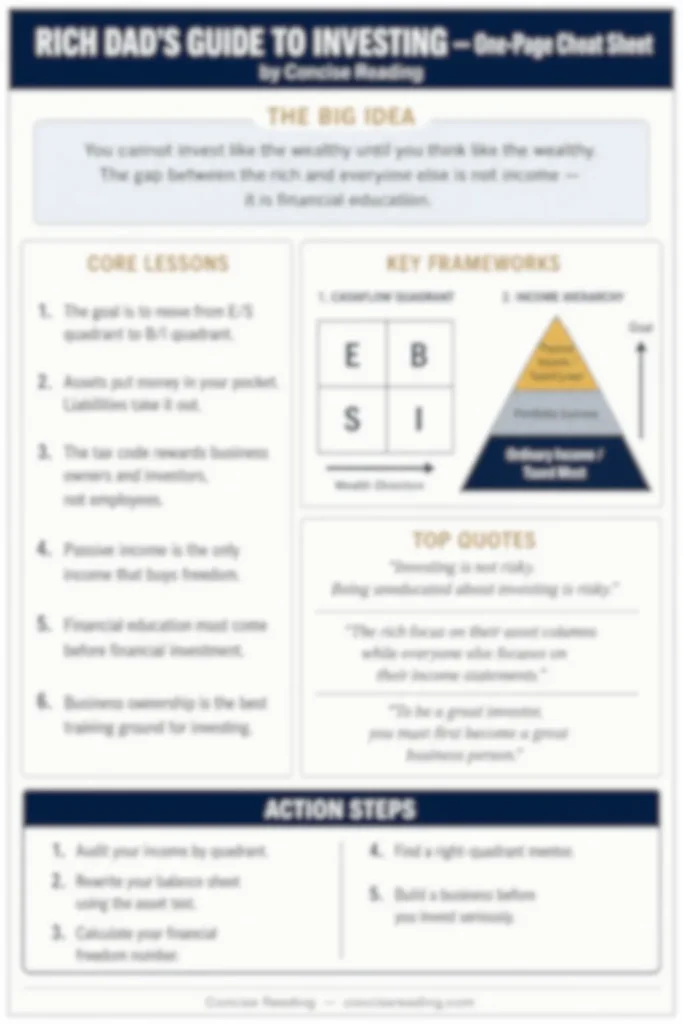
Premium Cheat Sheet Preview
About the Author
Robert T. Kiyosaki is the author of Rich Dad Poor Dad — one of the best-selling personal finance books in history with over 40 million copies sold worldwide. He built his financial education philosophy not in a classroom but through real-world business ownership, real estate investing, and repeated failure and recovery. His Rich Dad series has shaped how millions of people think about money, income, and wealth. You can explore his companion book Cashflow Quadrant and the foundational Rich Dad Poor Dad in our library.
Power Quote From the Book:
“Investing is not risky. Being uneducated about investing is risky.”
— Robert T. Kiyosaki, Rich Dad’s Guide to Investing
Who This Summary is For
- This is for you if…
- You are a salaried professional who earns decent money but can’t figure out why nothing is actually accumulating
- You are a freelancer or self-employed professional who suspects you own a job, not a business — and you want to change that
- You want to understand how investing works conceptually before you put real money into anything
- You have read Rich Dad Poor Dad and want the next level — the actual investing framework, not just the mindset intro
- You want to understand how the wealthy use tax law, leverage, and business structures legally to build generational wealth
- Skip this if…
- You are already generating meaningful passive income from investments and businesses you own — the foundational philosophy here will be familiar ground. If you’re looking for specific stock picks, property analysis models, or portfolio allocation strategies, this book — and this summary — is not that. For tactical investing frameworks, explore our Investing Fundamentals category or the Intelligent Investor summary.
Testimonials
If you’ve read this summary — free or premium — we’d genuinely like to know what you took from it. Did one idea shift how you think about money? Did a framework finally make something click? Scroll to the comments below and share your experience. Every reader who leaves a comment helps the next person decide whether this summary is right for them — and that kind of honest, peer-to-peer signal matters far more to us than any marketing copy. If you found value here, say so. If something could be sharper, tell us that too. We read every comment.
Rich Dad’s Guide to Investing took Kiyosaki decades of business failures, real estate deals, and hard-won financial education to write — the premium summary delivers the complete system, every framework, a full chapter-by-chapter breakdown, specific action steps, and a one-page cheat sheet you’ll actually use, all in 36 focused pages. If you found value in the free version, the Real Estate Investing Pack and The Investing Playbook are also worth exploring — but start here, with the premium summary that covers the complete foundation.
Related Summaries
- 1. Cashflow Quadrant — Robert T. Kiyosaki – The direct companion to this book. Goes deeper into the E-S-B-I model and maps out the practical path from the left side of the quadrant to the right. If Guide to Investing is the philosophy, Cashflow Quadrant is the transition plan.
- 2. The Millionaire Real Estate Investor — Gary Keller – Kiyosaki lays the mindset; Keller gives you the operational playbook for building wealth through real estate specifically. Grounded, systematic, and full of real investor models.
- 3. The Intelligent Investor — Benjamin Graham – The philosophical counterbalance. Where Kiyosaki focuses on entrepreneurial investing and cash flow, Graham teaches disciplined value investing. Reading both gives you a far more complete and resilient investing worldview.