Balanced Scorecard by Kaplan & Norton — Summary & Key Lessons

What this book will teach you in the next 10 minutes — and why it matters for your business strategy and execution.
From the Harvard Business Review’s most reprinted article to Fortune 500 boardrooms — this is the framework that turns strategy from a slide deck into a daily operating system. Summarized and distilled by Concise Reading so you get the full system without the 336-page commitment.
Book Snapshot
- Author – David P. Norton and Robert S. Kaplan
- Category – Business Strategy / Performance Management / Leadership
- Original Book – ~ 336 pages — approximately 8–10 hours average read time
- Free Summary – 08 pages
- Premium Summary – 32 pages — approximately 60–75 minutes read time
The Big Idea
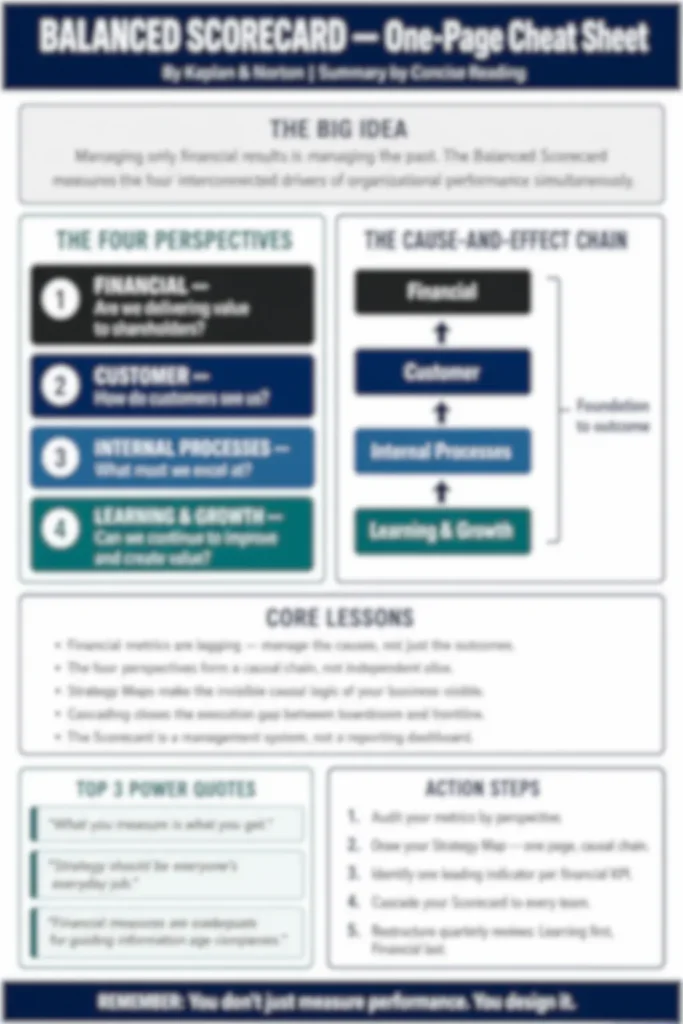
Most businesses are measuring the wrong things. Revenue, profit, and cash flow only tell you what already happened — they are your rearview mirror, not your windshield. Kaplan and Norton’s Balanced Scorecard argues that sustainable performance requires measuring four interconnected perspectives simultaneously: Financial, Customer, Internal Processes, and Learning & Growth. These four areas form a causal chain — your people’s capabilities drive your process quality, which drives your customer experience, which drives your financial results. Manage all four together, and strategy becomes executable. Manage only the financials, and you will always be reacting to problems that were preventable.
What You’ll Learn — Key Lessons Preview
- Why your quarterly revenue numbers are the last thing you should be managing — and what to track instead so financial results become predictable rather than surprising
- How to build a Strategy Map that connects every department’s daily work to your company’s long-term goals — so execution gaps close permanently instead of recurring every planning cycle
- The cascading system that translates boardroom strategy into frontline behavior — the exact mechanism that separates organizations that execute from those that only plan
- How to identify leading indicators that predict performance 60–90 days before it shows up in your financials — giving you time to intervene rather than explain
- Why the order in which you review your business determines the quality of every decision you make — and how restructuring your quarterly reviews around the four perspectives changes everything
Free vs Premium Comparison
| Free – $0 | Premium – $4.99 (Recommended) |
| ➡ Book Snapshot ➡ The Big Idea ➡ Key Lessons ➡ Power Quotes ➡ 08 Pages | ✔ Everything in free + ✔ Full Chapter Breakdown ✔ Key frameworks & diagrams ✔ Action steps ✔ Critical analysis ✔ One-page cheat sheet ✔ 32 pages |
Premium Cheat Sheet Preview
About the Author
Robert S. Kaplan is Professor Emeritus at Harvard Business School and one of the most influential management thinkers of the past 40 years, known for co-developing Activity-Based Costing and the Balanced Scorecard. David P. Norton is the founder of the Palladium Group and a leading practitioner in strategy execution consulting. Together, their 1992 Harvard Business Review article on the Balanced Scorecard became one of the most cited management papers in HBR history, and their subsequent research spans decades of real-world application across hundreds of organizations worldwide.
Power Quote From the Book:
“What you measure is what you get. Senior executives understand that their organization’s measurement system strongly affects the behavior of managers and employees.”
— Robert S. Kaplan & David P. Norton, Balanced Scorecard
Who This Summary is For
- This is for you if…
- You are a CEO, founder, or senior manager whose strategy looks brilliant on paper but consistently underperforms in execution
- You are an operations manager or COO responsible for organizational performance but working without a unified, cross-functional measurement framework
- You want to stop managing your business reactively by last quarter’s numbers and start managing it proactively by the leading indicators that actually predict those numbers
- You are a strategy consultant or MBA student who needs a rigorous, proven framework — not just theory — that you can apply immediately to a real organization
- You want every department, team, and individual in your organization aligned to the same strategic priorities without spending a year on change management
- Skip this if…
- You are a solo operator or a startup in its first 6 months — the Balanced Scorecard requires organizational structure to justify its complexity, and applying it too early creates overhead without payoff. Start with Measure What Matters for simpler goal-setting, and return to this framework when you have a team to align.
Testimonials
We are building something here that most summary services never bother to create: summaries that are genuinely worth reading, not just skimming. If you have gone through this summary — free or premium — we would genuinely like to know what landed for you, what you applied, or what question it left you with. Drop your thoughts in the comments below. Your experience helps other readers decide whether this summary is right for them, and it helps us make every future summary sharper. No rating system, no star prompts — just tell us what you actually got from it.
Kaplan and Norton spent years researching hundreds of organizations across industries to build this system. The premium summary delivers the complete framework — every chapter, every tool, every implementation step — in 32 pages and under 75 minutes.
At $4.99, the premium summary of Balanced Scorecard costs less than a coffee and gives you a management system that Fortune 500 companies paid consulting firms six figures to implement.
If your strategy is not executing the way you planned, this is where you find out exactly why — and exactly what to do about it.
Explore more summaries in Business Strategy & Execution or browse the full Library to find what you need next. And if you want the complete strategic thinking system in one place, the Business Strategy & Execution Pack bundles 14 of the most important strategy books — including this one — at a fraction of the individual price.
Related Summaries
- 1. Measure What Matters by John Doerr – Where the Balanced Scorecard gives you a four-perspective strategic framework, Doerr’s OKR system gives you a ruthlessly simple goal-setting engine used by Google and Intel. The two frameworks complement each other — one for strategic architecture, one for execution rhythm.
- 2. Good Strategy Bad Strategy by Richard Rumelt – Most “strategies” are actually wishlists. Rumelt destroys that habit and teaches you what a real strategy looks like: a diagnosis, a guiding policy, and coherent actions. Pairs directly with the Balanced Scorecard because the Scorecard is only as good as the strategy it’s measuring.
- 3. Execution by Larry Bossidy and Ram Charan – The Balanced Scorecard tells you what to measure. Execution tells you how to build the organizational discipline to actually follow through. Together, they cover the full gap between strategy and results.