
Competitive Strategy by Michael E. Porter — Summary & Key Lessons
What this book will teach you in the next 10 minutes — and why it matters for building a business your competitors simply cannot catch.
Read by founders, strategists & MBA students in 60+ countries · Trusted by 10,000+ readers at Concise Reading · Updated 2025 edition
Book Snapshot
- Author – Michael E. Porter
- Category – Business Strategy / Competitive Analysis, Corporate Management
- Original Book – ~ 396 pages | Average read time: 9–11 hours
- Free Summary – 08 pages
- Premium Summary – 32 pages | Estimated read time: 45–60 minutes
The Big Idea
Most businesses compete harder without ever asking whether they’re competing right. Michael Porter’s Competitive Strategy makes one argument with ruthless clarity: long-term profitability isn’t determined by how hard you work — it’s determined by the structural forces shaping your industry and the deliberate position you choose within it. Porter shows that every industry is governed by five competitive forces, and that every viable strategy reduces to three choices. Miss either insight, and you end up competing on every front, winning on none. This book is the reason why “strategy” means something more than a slide deck.
What You’ll Learn — Key Lessons Preview
- Why your margins keep shrinking — and how to diagnose the structural force responsible, so you can respond with precision instead of panic
- The three strategies that actually work — and why every business that tries to be “quality and affordable” is slowly destroying its own competitive position
- How to read a competitor’s next move before they make it — using Porter’s four-component analysis framework that maps their goals, assumptions, and blind spots
- Why Amazon, Apple, and IKEA are untouchable in their lanes — and the exact strategic logic that makes it structurally difficult for challengers to dislodge them
- The one trade-off your business is avoiding that is costing you more than any marketing spend ever could
Free vs Premium Comparison
| Free – $0 | Premium – $4.99 (Recommended) |
| ➡ Book Snapshot ➡ The Big Idea ➡ Key Lessons ➡ Power Quotes ➡ 08 Pages | ✔ Everything in free + ✔ Full Chapter Breakdown ✔ Key frameworks & diagrams ✔ Action steps ✔ Critical analysis ✔ One-page cheat sheet ✔ 32 pages |
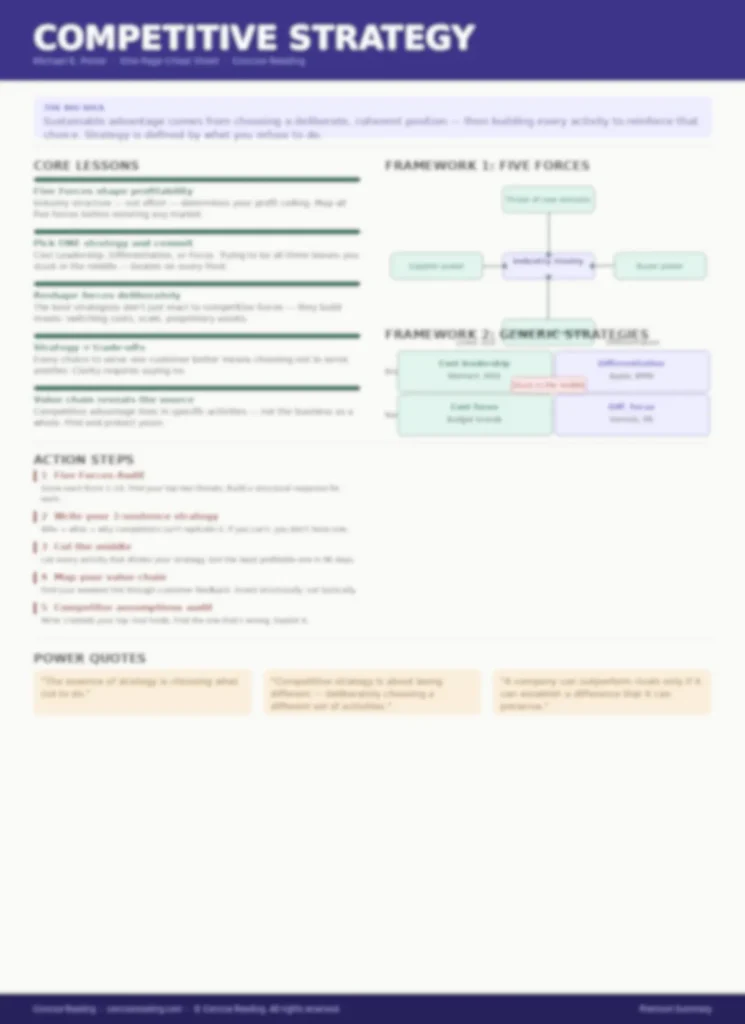
Premium Cheat Sheet Preview
About the Author
Michael E. Porter is a University Professor at Harvard Business School — the school’s highest academic distinction — where he has taught competitive strategy for over four decades. He is the originator of the Five Forces framework and the Generic Strategies model, both now foundational to business education globally. Porter has advised governments and corporations across six continents, and his 1996 Harvard Business Review article “What Is Strategy?” remains one of the most widely reprinted in the publication’s history.
Power Quote From the Book:
“The essence of strategy is choosing what not to do.” — Michael E. Porter, Competitive Strategy
Who This Summary is For
- This is for you if…
- You are a founder or business owner who has been winning on effort but suspects you don’t have a real competitive position yet
- You are a manager or consultant who needs rigorous strategic thinking — not another framework borrowed from a LinkedIn post
- You want to understand why some industries are structurally profitable and others are not, before committing capital or time to entering one
- You are preparing for an MBA, a strategy role, or a board-level conversation and need to understand Porter’s framework from the inside
- You want to stop reacting to competitors and start building something structurally harder to beat over time
- Skip this if…
- You’re looking for quick marketing tactics or a motivational read — Competitive Strategy operates at the structural level and rewards patient, deliberate thinkers. If you’re at the idea stage and haven’t found product-market fit yet, come back to this once you have something worth defending. In the meantime, our summary of The Lean Startup or Zero to One may serve you better right now.
Social Proof
We’re building something honest here — and that means the reviews on this page will come from real readers, not placeholders. If you’ve read this summary (free or premium), we’d genuinely love to know what landed for you. Did it change how you think about your business? Did a specific framework finally click? Drop your thoughts in the comments below. Your feedback helps other readers decide whether this summary is right for them — and it helps us make the next one better. The best review you can leave is an honest one.
Competitive Strategy took Michael Porter a decade of research and fieldwork across dozens of industries to produce. The Premium Summary gives you the complete system — every framework, every diagnostic tool, a chapter-by-chapter breakdown, and a one-page cheat sheet — in under an hour.
Related Summaries
- 1. Good Strategy Bad Strategy — Richard Rumelt Porter tells you what strategy is. Rumelt shows you why most strategies in the real world are fraudulent — and how to spot the difference. Essential companion read.
- 2. Blue Ocean Strategy — W. Chan Kim & Renée Mauborgne Where Porter teaches you to win within competitive markets, Blue Ocean challenges you to make competition irrelevant entirely by creating uncontested market space. Complementary, not contradictory.
- 3. HBR’s 10 Must Reads on Strategy A curated collection that includes Porter’s own landmark HBR essays alongside other top strategy thinkers. If Competitive Strategy sparked your interest, this is the logical next step.
[…] more niche strategies in Business Model Generation and Competitive Strategy available in our […]