Dare to Lead by Brené Brown — Summary & Key Lessons
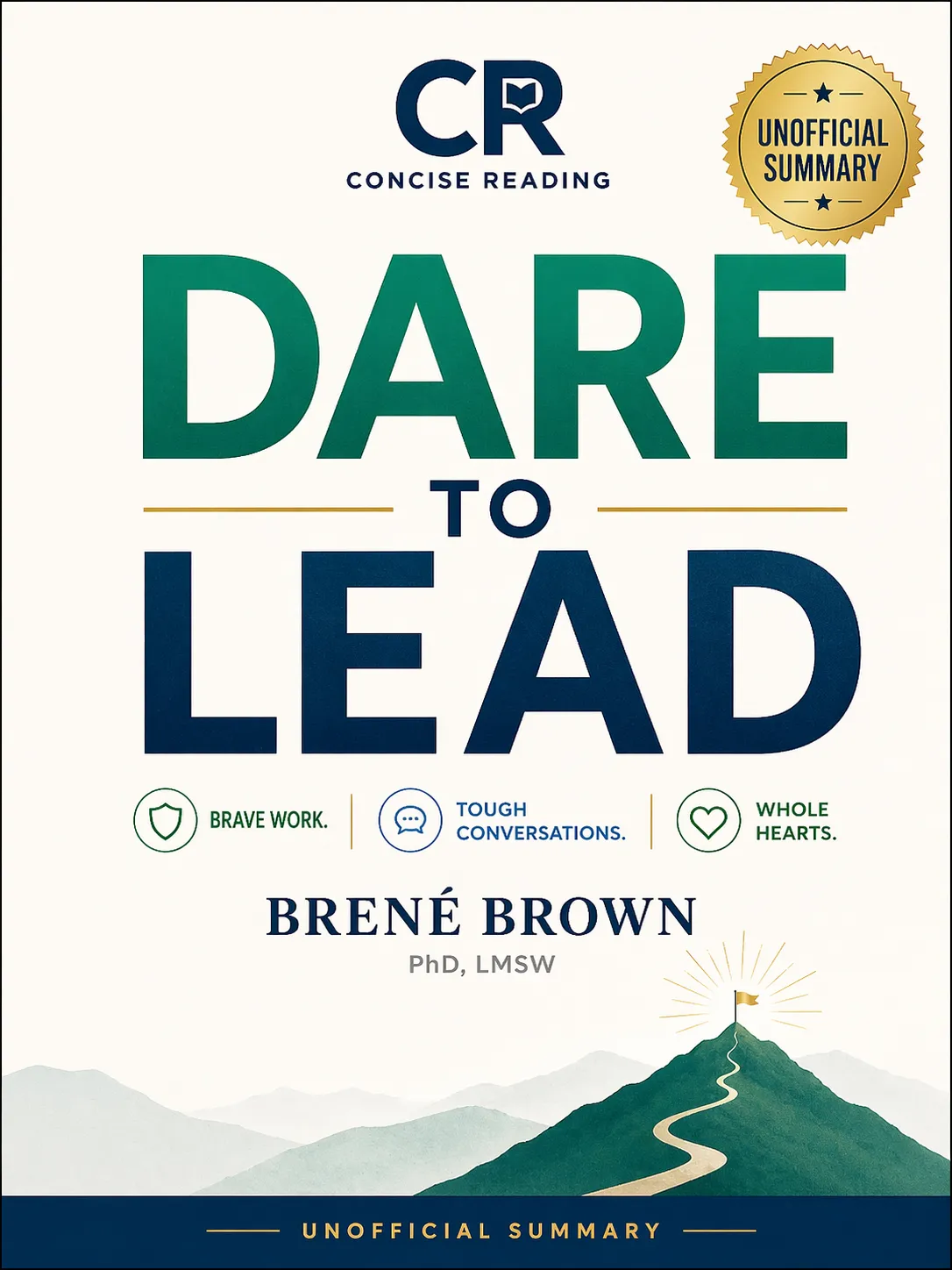
What this book will teach you in the next 10 minutes — and why it matters for your leadership, your team, and every hard conversation you’ve been avoiding.
Read by 40,000+ professionals. Summarised from 20+ years of leadership research. Written for people who actually lead people.
Book Snapshot
- Author – Brené Brown
- Category – Leadership & Organizational Culture
- Original Book – ~ 320 pages | Avg. read time: 6–7 hours
- Free Summary – 08 pages
- Premium Summary – 23 pages | Estimated read time: 35–45 minutes
The Big Idea
Most leaders believe that showing uncertainty, asking for help, or admitting they don’t know is a sign of weakness. Brené Brown’s two decades of research prove the opposite. The leaders who build the most loyal teams, the most innovative cultures, and the most durable organisations are not the ones who project the most confidence — they are the ones willing to be honest about doubt and act anyway. Dare to Lead argues that courage is not a personality trait. It is a learnable, teachable set of four skills — and that the “armored” leadership style most of us were trained to admire is quietly destroying the very performance it claims to protect.
What You’ll Learn — Key Lessons Preview
- Why your “tough” leadership style may be the reason your team won’t take risks — and the single behavioral shift that reverses it
- How to give feedback that people actually act on — using the principle Brown calls the most important idea in modern leadership: “clear is kind”
- The 7 observable behaviors that build unbreakable team trust — and how to audit yourself honestly against each one
- How to stay in hard conversations without shutting down or escalating — a skill Brown calls “rumbling,” and most leaders never develop
- What to do after you fail — Brown’s three-step framework for processing setbacks in a way that makes you stronger, not more guarded
Free vs Premium Comparison
| Free – $0 | Premium – $4.99 (Recommended) |
| ➡ Book Snapshot ➡ The Big Idea ➡ Key Lessons ➡ Power Quotes ➡ 08 Pages | ✔ Everything in free + ✔ Full Chapter Breakdown ✔ Key frameworks & diagrams ✔ Action steps ✔ Critical analysis ✔ One-page cheat sheet ✔ 23 pages |
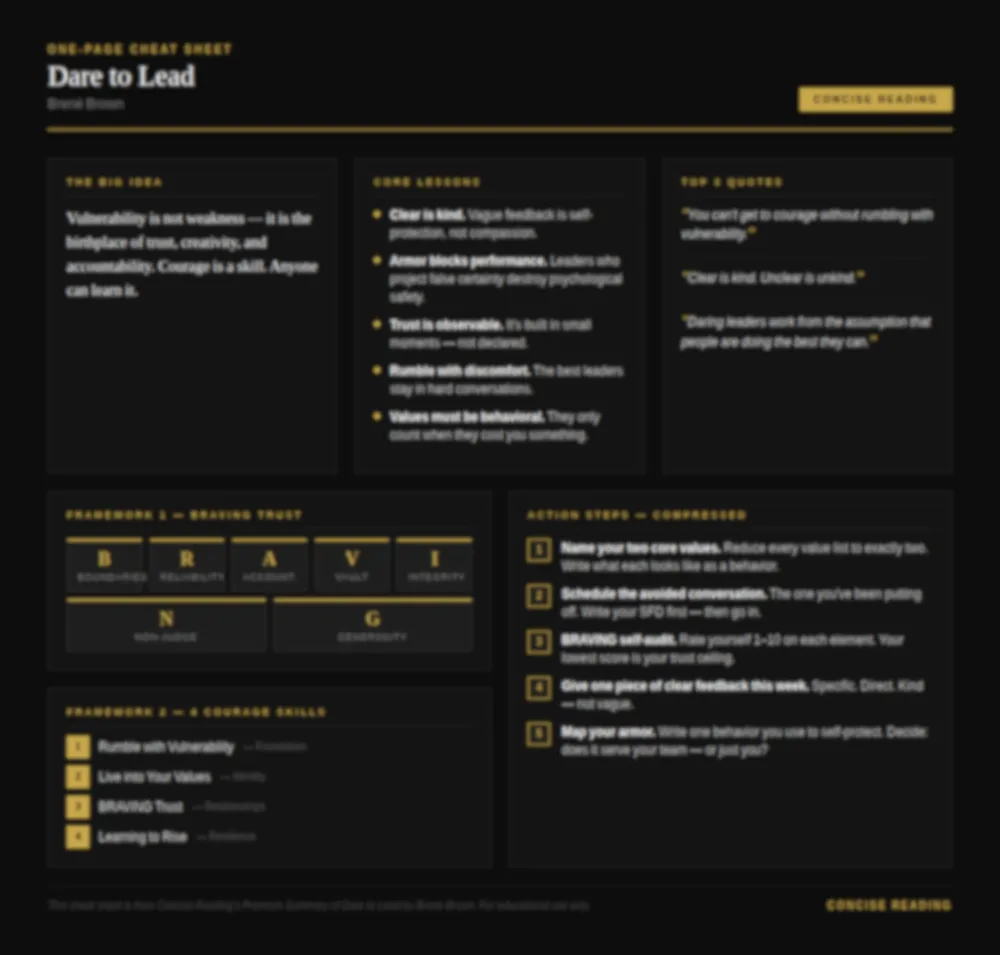
Premium Cheat Sheet Preview
About the Author
Brené Brown is a research professor at the University of Houston and one of the most cited voices in leadership psychology. She has spent over 20 years studying courage, vulnerability, shame, and empathy — publishing five #1 New York Times bestsellers and delivering one of the five most-watched TED Talks in history with over 60 million views. Dare to Lead is the direct result of a seven-year study of 150+ global C-suite leaders, making it one of the most empirically grounded books in the leadership genre.
Power Quote From the Book:
“Clear is kind. Unclear is unkind.”
— Brené Brown, Dare to Lead
Who This Summary is For
- This is for you if…
- You are a manager, team lead, or founder who suspects your leadership style is creating distance rather than commitment — and you want a framework to change it
- You want to understand why the teams with the highest trust consistently outperform the teams with the most authority
- You are preparing for a difficult conversation — with a team member, a co-founder, or a senior stakeholder — and you want to go in with a clear head and the right tools
- You lead people and you’ve never formally examined what your core values actually are — or what your behavior says they are
- You’ve read our Atomic Habits summary or The 7 Habits of Highly Effective People summary and want to go deeper on the leadership and culture side of performance
- Skip this if…
- You are looking for operational tactics, financial frameworks, or sales techniques — Dare to Lead doesn’t cover those. For that, explore our Leadership & Management Pack which bundles ten leadership books in one.
Social Proof
We are building something here — and your voice matters more than you might think.
If this summary helped you think differently about a conversation you’ve been avoiding, a team dynamic you couldn’t name, or a leadership habit you’ve been meaning to change — we want to hear it. Drop your thoughts, your biggest takeaway, or even a challenge you’re still working through in the comments below. Every response gets read. The best ones get featured.
First-time here? You can see what other readers said about our Extreme Ownership summary, our Leaders Eat Last summary, and more in the Leadership section of our Library.
Brené Brown spent seven years interviewing 150+ global leaders to write Dare to Lead. The Premium Summary gives you her complete system — every framework, every action step, and a one-page cheat sheet you’ll actually use — in under 45 minutes.
Related Summaries
- 1. Leaders Eat Last — Simon Sinek Directly complements Dare to Lead. Sinek explores why the best leaders prioritize their team’s safety over their own comfort — and how biology (yes, actual brain chemistry) explains why trust and sacrifice create high-performance cultures.
- 2. The Culture Code — Daniel Coyle If Brown explains why vulnerability and trust matter, Coyle shows how the world’s best teams (Navy SEALs, Pixar, the San Antonio Spurs) actually build them. Packed with specific, repeatable behaviors.
- 3. Emotional Intelligence — Daniel Goleman The scientific foundation beneath everything Brown argues. Goleman’s research on self-awareness, self-regulation, and empathy is the evidence base for why emotionally intelligent leaders consistently outperform technically skilled ones.