The $100 Startup by Chris Guillebeau — Summary & Key Lessons
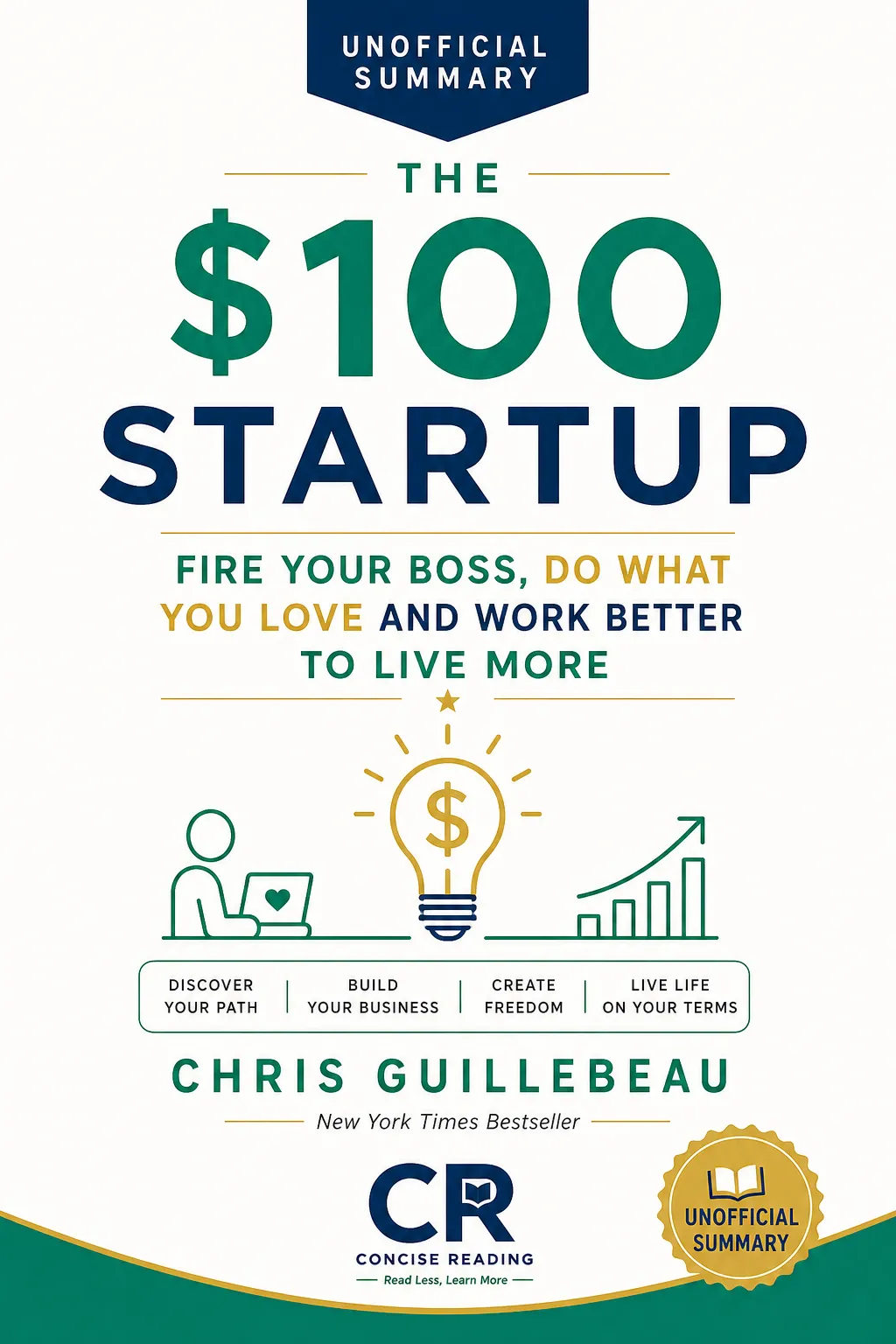
What this book will teach you in the next 10 minutes — and why it matters for building a business you can start this week with what you already have.
Summarized from the original 267-page book. Verified against the full text. Written for people who read to act, not just to finish.
Book Snapshot
- Author – Chris Guillebeau
- Category – Entrepreneurship / Microbusiness / Bootstrapping
- Original Book – 267 pages | ~ 5.5 hours average read time
- Free Summary – 07 pages
- Premium Summary – 28 pages | ~ 35 minutes estimated read time
The Big Idea
Most people think starting a business requires capital, credentials, or the perfect idea. Chris Guillebeau studied 1,500 people who proved otherwise. Every single one of them built a profitable business — earning $50,000 a year or more — with less than $100 in startup costs. The pattern was always the same: find the overlap between a skill you already have and a problem someone else needs solved, make a simple offer, and collect money before building anything else. No business plan. No funding. No permission. Just a specific offer to a specific person and the willingness to begin.
What You’ll Learn — Key Lessons Preview
- Why your day job skills are worth more than you think — and the exact method to identify which ones people will pay for immediately
- How to price your offer so buyers take it seriously — most first-time founders underprice by 40–60%, and this book shows you exactly how to fix that
- The one-page business plan that replaced 40-page decks — four questions that are the only things standing between you and your first dollar
- How to build a business that funds your life — not consumes it — the design principle that separates “freedom businesses” from glorified self-employment
- The launch sequence that gets your first customer before your website is ready — because the market validates your idea better than any research ever will
Free vs Premium Comparison
| Free – $0 | Premium – $4.99 (Recommended) |
| ➡ Book Snapshot ➡ The Big Idea ➡ Key Lessons ➡ Power Quotes ➡ 07 Pages | ✔ Everything in free + ✔ Full Chapter Breakdown ✔ Key frameworks & diagrams ✔ Action steps ✔ Critical analysis ✔ One-page cheat sheet ✔ 28 pages |
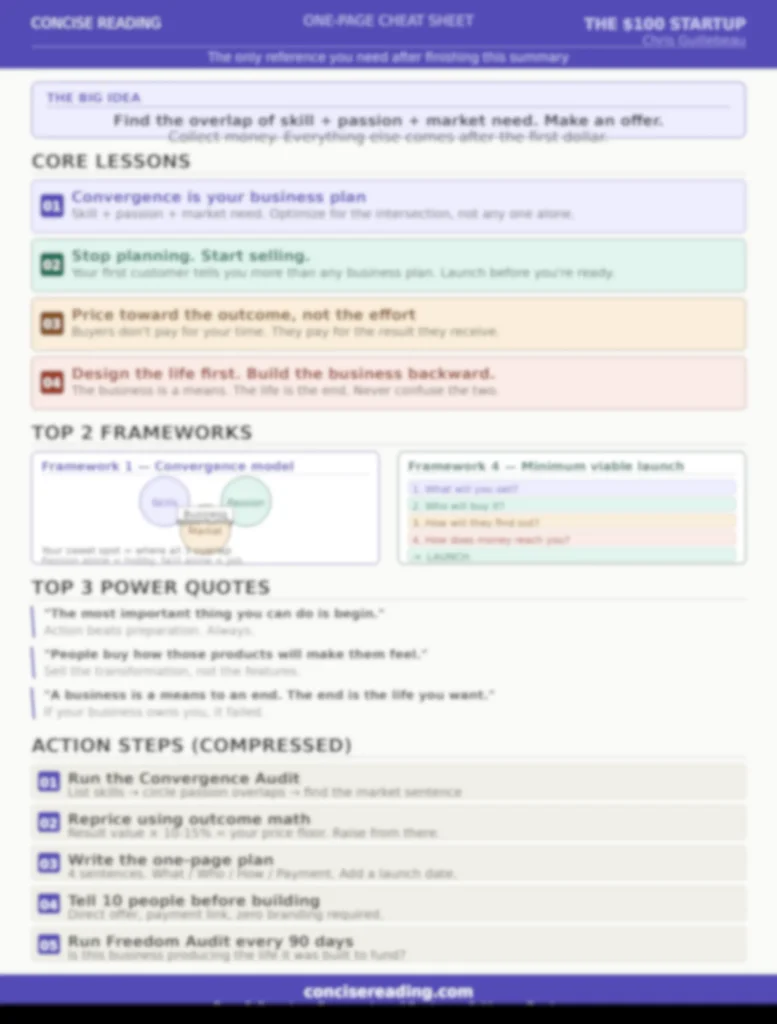
Premium Cheat Sheet Preview
About the Author
Chris Guillebeau is the rare business author who lived the thesis before writing the book. He built and ran multiple online businesses while traveling to all 193 countries — entirely self-funded. He is the founder of the World Domination Summit, a New York Times bestselling author, and has built a readership of hundreds of thousands through direct content and zero outside investment. If the book argues you can build a business with under $100, he’s the person who already did it.
Power Quote From the Book:
“You don’t need an MBA, a business plan, or even employees. All you need is a product or service, a group of people willing to pay for it, and a way to get paid.” — Chris Guillebeau, The $100 Startup
Who This Summary is For
- This is for you if…
- You are an employee who has thought “I could do this myself” at least once in the last six months — but haven’t started yet
- You are a freelancer who wants to stop trading hours for money and start selling something that scales
- You want to build a side income with skills you already have, without quitting your job first
- You are trying to start lean — no funding, no co-founder, no complex tech — just a real offer to real people
- You want the core framework from a 267-page book in under 35 minutes, with action steps you can use this week
- Skip this if…
- You are raising venture capital or building a company designed to scale to 50+ employees. This book — and this summary — is not for empire builders. It is for people who want to fund a life, not build a corporation. If that’s not you right now, our Startup & Entrepreneurship Pack or The Startup Playbook may be a better fit.
Social Proof
We don’t believe in fake testimonials — and we don’t need them to ask for honest ones. If you’ve read this summary — free or premium — we’d genuinely like to know what you took from it. Did one lesson change how you thought about pricing? Did the convergence model give you clarity on an idea you’d been sitting on? Leave a comment below. Real feedback from real readers is what tells us whether this summary did its job — and it helps the next person decide whether it’s worth their time. We read every comment.
The $100 Startup took Chris Guillebeau three years of research and 1,500 case studies to write. The premium summary gives you the complete system — every framework, every action step, and the one-page cheat sheet — in 28 pages and 35 minutes.
Related Summaries
- Company of One — Paul Jarvis | If $100 Startup made you want to build something lean, this book argues that staying small is the smarter long-term strategy, not scaling past what serves your life.
- The 4-Hour Workweek — Tim Ferriss | The philosophical companion to $100 Startup. Where Guillebeau shows you how to start, Ferriss shows you how to systematically remove yourself from operations so the business runs without you.
- $100M Offers — Alex Hormozi | Once you have a business running, this is the book that tells you why your offer is probably leaving money on the table — and exactly how to fix it.
[…] you’re building a business, explore more grounded strategies in summaries like The $100 Startup, Company of One, and Built to Sell, available in our Starting a Business and Small Business […]
[…] to a product, guide users through a journey. This aligns closely with concepts discussed in The $100 Startup and Company of One, available in our […]
[…] Readers of books like The $100 Startup […]
[…] The $100 Startup […]
[…] Readers of The $100 Startup […]
[…] systems connects directly with entrepreneurial thinking from The $100 Startup and Built to […]