Financial Risk Management by Steve L. Allen — Summary & Key Lessons
What this book will teach you in the next 10 minutes — and why it matters for how you measure, manage, and survive financial risk in the real world.
Used in the FRM exam curriculum. Written by a JPMorgan risk veteran with 20+ years building live risk systems. This summary is part of the Wall Street & Financial Markets category — one of the most technically demanding libraries on Concise Reading.
Book Snapshot
- Author – Steve L. Allen
- Category – Finance & Risk Management / Quantitative Finance
- Original Book – ~ 560 pages | Estimated read time: 18–22 hours
- Free Summary – 08 pages
- Premium Summary – 44 pages | Estimated read time: 45–55 minutes
The Big Idea
Most financial losses don’t happen because firms ignored risk. They happen because firms trusted models that worked 99% of the time and assumed that meant they were protected for the 1% that actually matters. Steve Allen’s argument is blunt: risk management is a governance problem dressed in quantitative clothing. VaR doesn’t tell you what happens in a crisis. Stress tests only protect you if they’re designed to find real vulnerabilities. Limit systems only work if they’re unconditional. The firms that survive are the ones with the institutional honesty to say so.
What You’ll Learn — Key Lessons Preview
- You’ll understand exactly where VaR breaks down — and what to run alongside it so you’re not flying blind when market regimes shift
- You’ll learn why stress testing programs at most institutions are designed to confirm safety rather than find vulnerabilities — and how to build one that actually works
- You’ll see how model risk accumulates silently through scope creep and how to catch it before it becomes a loss event
- You’ll understand the predictable cycle through which limit systems get eroded by profitable exceptions — and the governance structures that stop it
- You’ll be able to assess any portfolio’s liquidity risk across two dimensions that standard VaR completely ignores — and know which positions would become existential in a funding crisis
Free vs Premium Comparison
| Free – $0 | Premium – $4.99 (Recommended) |
| ➡ Book Snapshot ➡ The Big Idea ➡ Key Lessons ➡ Power Quotes ➡ 08 Pages | ✔ Everything in free + ✔ Full Chapter Breakdown ✔ Key frameworks & diagrams ✔ Action steps ✔ Critical analysis ✔ One-page cheat sheet ✔ 44 pages |
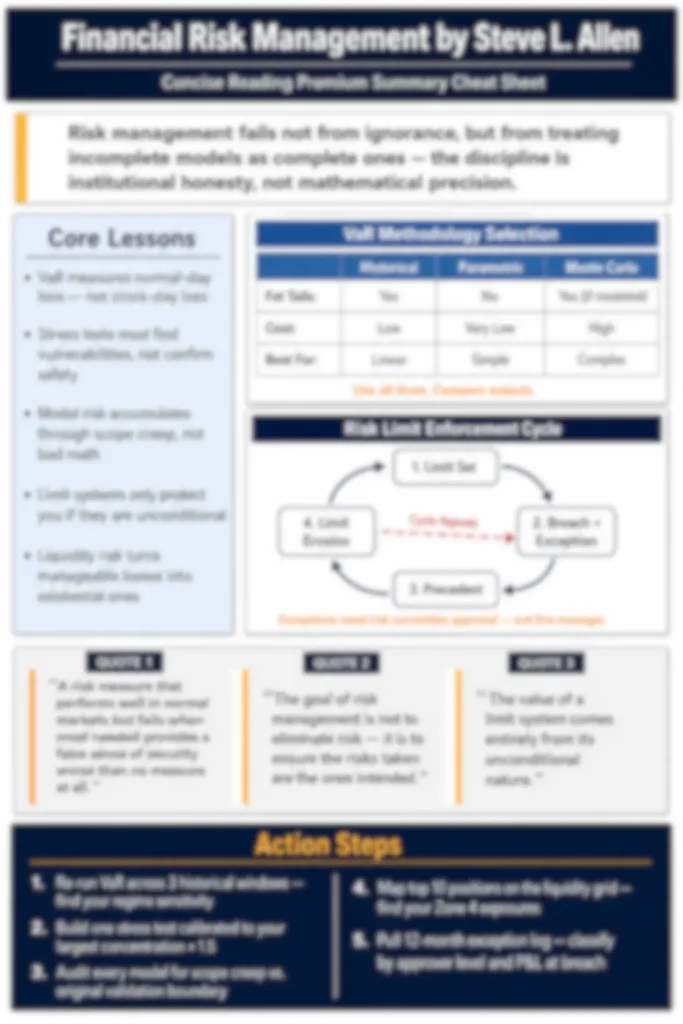
Premium Cheat Sheet Preview
About the Author
Steve L. Allen spent over twenty years as a senior risk professional at JPMorgan Chase, building and operating quantitative market risk systems across derivatives and trading operations. His frameworks weren’t developed in a classroom — they were tested against live markets. Financial Risk Management is a core reference text in the GARP FRM exam curriculum, which alone signals its standing in the profession.
Power Quote From the Book:
“A risk measure that performs well in normal markets but fails precisely when it is most needed provides a false sense of security that may be worse than no risk measure at all.”
— Steve L. Allen, Financial Risk Management
Who This Summary is For
- This is for you if…
- You are a risk analyst, quantitative associate, or derivatives professional who needs to move from model mechanics to model judgment
- You are a senior finance executive, CRO, or audit professional responsible for evaluating whether a risk function is genuinely protecting the institution or just producing reports
- You are an FRM or advanced CFA candidate who wants the institutional context and failure-mode analysis that exam prep materials strip out
- You want to understand how the risk systems at banks, hedge funds, and asset managers actually function — so you can evaluate them as an investor, allocator, or counterparty
- You’ve read The Black Swan or When Genius Failed and want the practitioner’s framework behind the theory
- Skip this if…
- You’re new to finance and looking for an introductory text — Allen writes for professionals with existing fluency in derivatives, statistics, and trading operations. If you’re at the beginning of that journey, start with The Intelligent Investor or our Investing Fundamentals Pack before returning here.
Testimonials
This summary was built for professionals who think seriously about risk — and we’d like to hear from you. If you’ve read the free or premium version, drop your thoughts in the comments below. What was the most useful framework? What changed how you think about your own risk exposure? Your feedback helps other readers decide which version is right for them — and it helps us make every summary sharper. We read every comment.
Financial Risk Management took Steve L. Allen two decades of live institutional practice to write. The premium summary gives you the complete system — five battle-tested frameworks with visual diagram prompts, five curated power quotes with contextual analysis, discomfort-calibrated action steps, and a one-page cheat sheet — in under an hour, for $4.99.
If you found the free version useful, the premium version is where the real work starts. And if you’re building out your full risk and markets reading list, the Wall Street & Financial Markets Pack and the Financial Intelligence Playbook are the logical next steps.
Related Summaries
- When Genius Failed — Roger Lowenstein’s account of LTCM’s collapse is the definitive real-world case study of exactly the risk management failures Allen theorizes about: model overconfidence, liquidity miscalculation, and limit systems that broke under pressure.
- The Black Swan — Nassim Taleb’s framework for thinking about tail risk and the limits of statistical models is philosophically complementary to Allen’s technical treatment. Together they cover both the math and the epistemology of why risk models fail.
- Value at Risk — Philippe Jorion’s book is the technical companion piece. Where Allen focuses on institutional application and failure modes, Jorion covers the mathematical machinery in depth. Premium summaries of both together form a complete risk management education.