
The 4-Hour Workweek by Timothy Ferriss — Summary & Key Lessons
What this book will teach you in the next 10 minutes — and why it matters for the way you work, earn, and spend your time for the rest of your life.
Part of the Concise Reading Library — summaries of the world’s most important business and money books, written for people who read to act, not just to finish.
Book Snapshot
- Author – Timothy Ferriss
- Category – Lifestyle Design & Entrepreneurship, Productivity, Personal Finance, Business Automation
- Original Book – ~ 308 pages | ~ 6–7 hours average read time
- Free Summary – 07 pages
- Premium Summary – 30 pages | ~ 35–45 minutes estimated read time
The Big Idea
Most people spend 40 years working hard so they can finally live. Timothy Ferriss argues this is one of the worst deals ever made — and that the infrastructure to escape it has existed for years. The real problem isn’t money or talent. It’s that almost nobody has done the math, cut the waste, or built a system that runs without them. The 4-Hour Workweek gives you the exact framework to do all three: define what you actually want, eliminate the 80% of your work that produces almost nothing, automate your income, and design a life you don’t need a vacation from. The ideas aren’t theoretical — Ferriss lived them before writing a single page.
What You’ll Learn — Key Lessons Preview
- Why you don’t need more money — you need more time. You’ll learn how to calculate the precise monthly cost of your ideal life (it’s almost always under $5,000) and why most people are chasing a number that’s ten times larger than they actually need.
- How to eliminate 80% of your work without losing 80% of your results. The 80/20 audit will show you which clients, tasks, and meetings are quietly consuming your best hours while generating almost nothing — and what to do about it this week.
- The exact blueprint for building a business that runs without you. Ferriss’s “muse” criteria give you a five-point test to evaluate any business idea before you build it — so you stop creating jobs for yourself disguised as businesses.
- How to stop being busy and start being effective. You’ll learn the low-information diet, the 48-hour email blackout, and the batching system that recovers 10+ hours a week from tasks you never needed to do yourself.
- Why fear — not skill or money — is the only real barrier. The fear-setting exercise is the most practically useful tool in the book. You’ll learn how to price the cost of inaction and realize your worst-case scenario is almost always survivable.
Free vs Premium Comparison
| Free – $0 | Premium – $4.99 (Recommended) |
| ➡ Book Snapshot ➡ The Big Idea ➡ Key Lessons ➡ Power Quotes ➡ 07 Pages | ✔ Everything in free + ✔ Full Chapter Breakdown ✔ Key frameworks & diagrams ✔ Action steps ✔ Critical analysis ✔ One-page cheat sheet ✔ 30 pages |
Premium Cheat Sheet Preview
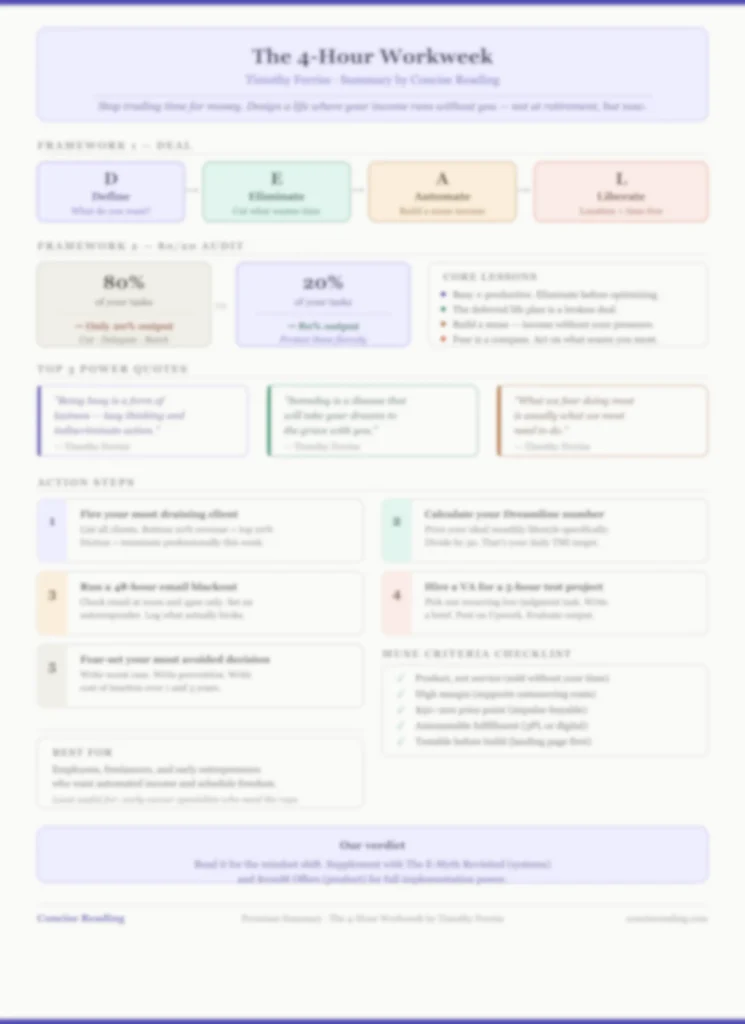
About the Author
Timothy Ferriss is a serial entrepreneur, angel investor, and five-time #1 New York Times bestselling author. Before writing this book, he built and automated a 7-figure supplement business while working under four hours a week — then documented the exact system in these pages. He has since made early investments in Facebook, Shopify, Uber, and Duolingo, and hosts The Tim Ferriss Show, one of the most-downloaded business podcasts in history with over 900 million downloads. He earned the right to write this book by living it first.
Power Quote From the Book:
“Being busy is a form of laziness — lazy thinking and indiscriminate action.” — Timothy Ferriss, The 4-Hour Workweek
Who This Summary is For
- This is for you if…
- You are an employee who does your best thinking during the hours you spend in pointless meetings
- You are a freelancer who is fully booked but one bad month away from financial panic — and suspect the model is broken, not your work ethic
- You are an early-stage entrepreneur who built a business that collapses the moment you take a week off
- You want to understand why your business needs you too much — and what a genuinely automated income stream actually looks like
- You have been saying “I’ll travel / rest / start that thing when things calm down” for more than a year
- If any of that sounds like you, start with the free summary below. It takes ten minutes and will change at least one thing about how you work this week.
- Skip this if…
- You are in the early years of a skill-intensive career where the hours are the point — surgeons, therapists, and elite performers who are still in the reps phase need those reps. Ferriss’s system works best once you have something worth automating. If that’s not you yet, you might find our summary of Grit by Angela Duckworth or Deep Work by Cal Newport more immediately useful.
Social Proof
No review yet — but if you read this summary (free or premium), you are exactly the kind of reader whose opinion matters here.
Did it change how you think about your work? Did the Dreamline exercise produce a number that surprised you? Did the 80/20 audit reveal something uncomfortable? Leave a comment below — your experience helps other readers decide whether this book belongs in their life right now. Honest reactions, including “I didn’t find this useful because…”, are more valuable than five stars. This page gets better every time a real reader shares what actually happened when they applied these ideas.
The 4-Hour Workweek took Timothy Ferriss years of personal experimentation, a near-breakdown, and a complete rebuild of his business to write. The premium summary gives you the complete system — every framework, every action step, the full chapter-by-chapter breakdown, and the one-page cheat sheet — in 22 pages and under 45 minutes. If your time is worth anything at all, the math on that is obvious.
Related Summaries
- 1. The E-Myth Revisited — Michael E. Gerber Most small business owners are technicians who love their craft, not entrepreneurs who build systems. Gerber shows you why your business can’t scale if it depends on you — and how to fix it. Pairs perfectly with Ferriss’s automation framework.
- 2. Deep Work — Cal Newport Ferriss tells you to eliminate shallow work. Newport tells you exactly what to replace it with and how to build the capacity for focused, high-output work in a world designed to distract you. Together, these two books form a complete productivity system.
- 3. $100M Offers— Alex Hormozi Once you’ve freed your time with Ferriss’s framework, you need an offer worth automating. Hormozi’s book is the most practical guide available for building a product or service so compelling that selling it becomes almost effortless.
[…] especially within Free Summaries, you’ll find powerful insights like this across books such as The 4-Hour Workweek and Built to Sell—but Company of One stands out for its bold stance against unnecessary […]
[…] find similar structured approaches in Cashflow Quadrant and The 4-Hour Workweek, both available in our Free […]