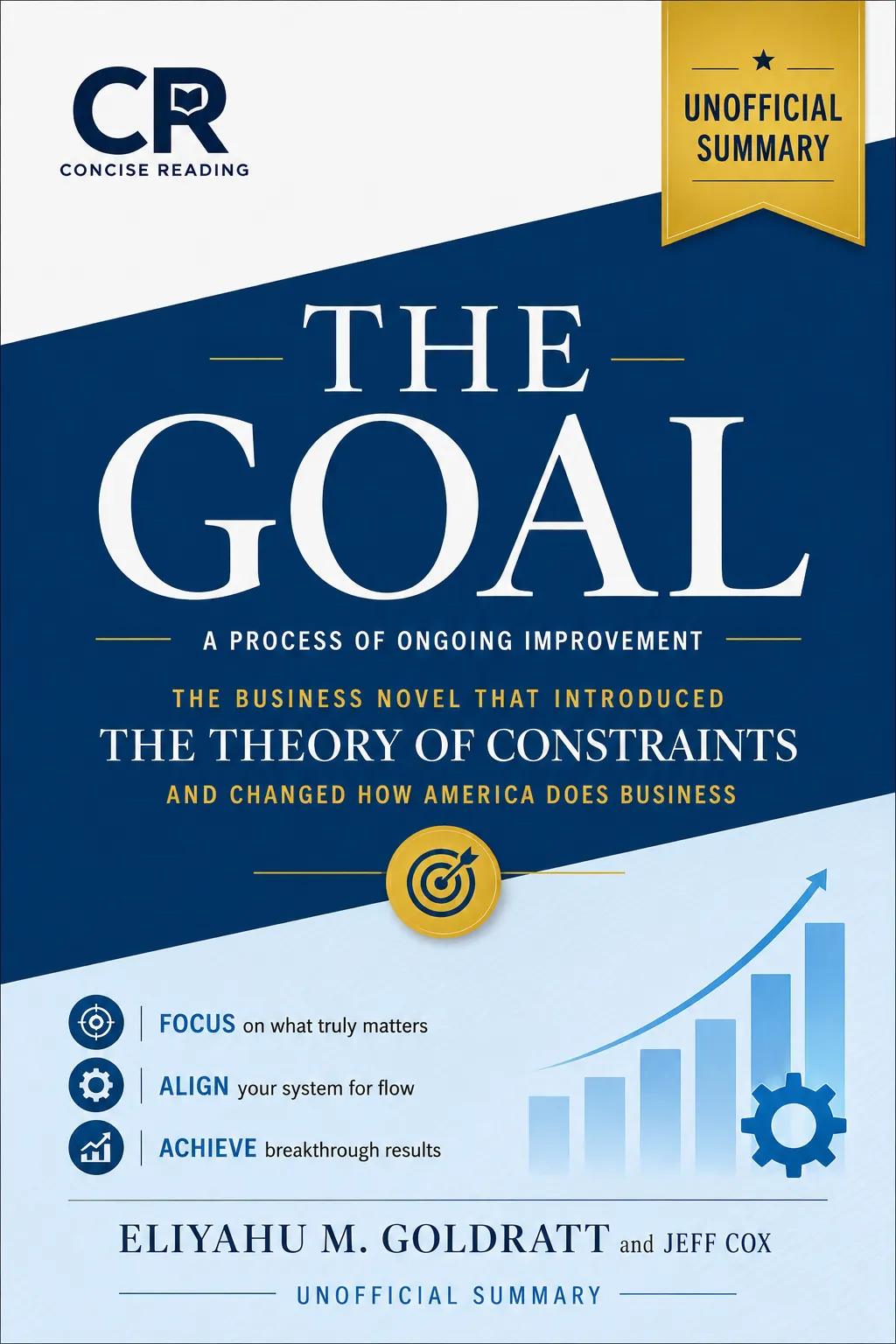
The Goal by Eliyahu Goldratt — Summary & Key Lessons
What this book will teach you in the next 10 minutes — and why it matters for your business operations, team performance, and bottom line.
Read by over 10 million managers worldwide. Taught in MBA programs at Harvard, MIT, and Yale. Written in 1984 — still required reading in 2025.
Book Snapshot
- Author – Eliyahu M. Goldratt and Jeff Cox
- Category – Operations Management / Business Strategy / Systems Thinking
- Original Book – ~ 384 pages | Average read time: 8–10 hours
- Free Summary – 08 pages
- Premium Summary – 29 pages | Estimated read time: 35–45 minutes
The Big Idea
Most businesses try to improve performance by making every part of the operation more efficient. It sounds rational. It doesn’t work. Eliyahu Goldratt’s Theory of Constraints proves that every system — whether it’s a factory, a startup, a service team, or an agency — has exactly one bottleneck limiting its total output. Everything else is secondary noise. Optimize non-bottlenecks and you create overproduction, pile-up, and wasted cost. Find the real constraint, exploit it fully, and align everything around it — and your entire operation accelerates without a single additional hire or dollar invested. This is the most important operational insight of the last century, and most managers have never applied it.
What You’ll Learn — Key Lessons Preview
- Why your team can be 100% busy and still miss every deadline — and the specific measurement change that fixes it immediately
- How to find the one bottleneck silently capping your entire output, using a diagnosis method you can run this week without any tools or consultants
- Why traditional efficiency metrics are destroying your operational decisions — and the three numbers that should replace them on your dashboard
- How to build a scheduling system that protects your constraint from ever sitting idle, so every downstream output accelerates automatically
- Why most management conflicts are never actually solved — and a five-step thinking framework that dissolves even the most entrenched organizational deadlock
Free vs Premium Comparison
| Free – $0 | Premium – $4.99 (Recommended) |
| ➡ Book Snapshot ➡ The Big Idea ➡ Key Lessons ➡ Power Quotes ➡ 08 Pages | ✔ Everything in free + ✔ Full Chapter Breakdown ✔ Key frameworks & diagrams ✔ Action steps ✔ Critical analysis ✔ One-page cheat sheet ✔ 29 pages |
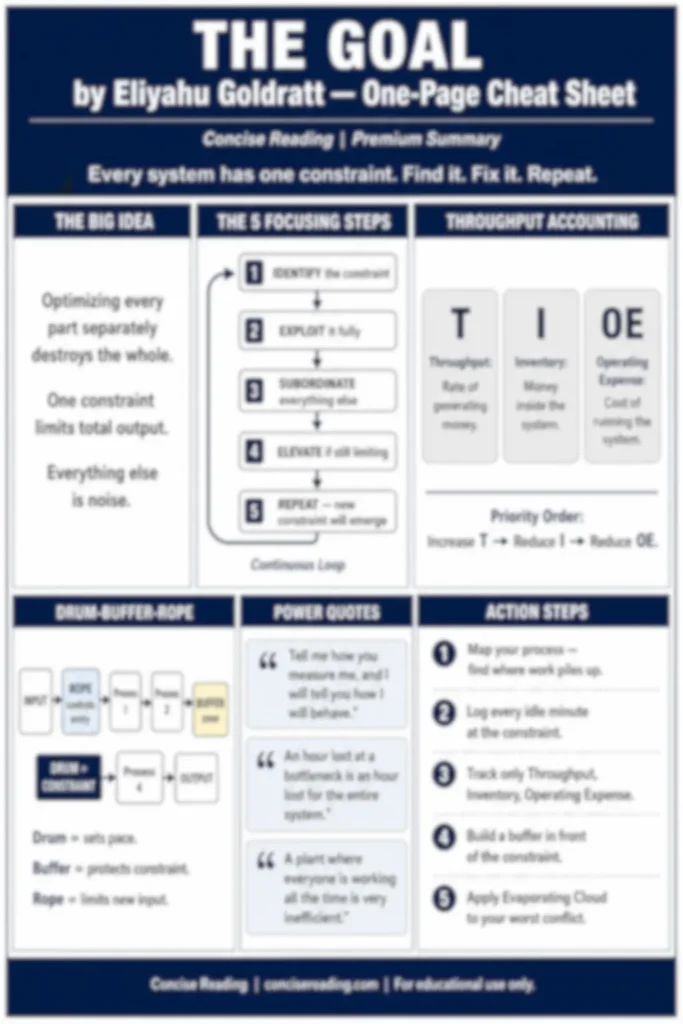
Premium Cheat Sheet Preview
About the Author
Eliyahu M. Goldratt was an Israeli physicist and management theorist whose Theory of Constraints reshaped how organizations worldwide understand operations, scheduling, and performance. He developed the framework empirically — working inside real manufacturing plants where his scheduling software produced results that conventional management theory couldn’t explain. His ideas have since been validated across healthcare, software, construction, and service industries. The Goal, first published in 1984, has sold over 10 million copies and remains required reading in the world’s top business schools.
Power Quote From the Book:
“Tell me how you measure me, and I will tell you how I will behave.”
— Eliyahu M. Goldratt, The Goal
Who This Summary is For
- This is for you if…
- You are a plant manager, operations director, or supply chain lead whose team is consistently working hard but consistently falling behind targets
- You are a business owner who has scaled past the startup phase and adding more people or tools no longer seems to move the needle
- You are an MBA student or strategy consultant who wants a systems-thinking framework that applies far beyond the factory floor
- You want to understand why your projects fall apart on schedule every single time — and have a repeatable diagnostic method to fix it
- You are a team leader who is tired of firefighting and ready to solve the root cause instead of the symptom
- Skip this if…
- You are looking for a quick personal productivity hack or a motivational read — this book operates at the level of systems and processes, not individual habits. If your business has no repeatable operational process yet, return to this one after you’ve built one.
Testimonials
We’re building something here that’s worth your honest reaction. If this summary helped you think differently about your operation, your team, or a problem you’ve been stuck on — we want to hear about it. Drop your experience in the comments below: what hit hardest, what you’re going to apply first, or even where you think Goldratt got it wrong. Real feedback from real readers is what makes Concise Reading better than every algorithm-generated summary on the internet. If you found value here, take sixty seconds to say so — it helps other readers decide, and it helps us know we got it right.
The Goal took Eliyahu Goldratt over a decade of direct factory-floor research to develop. The premium summary gives you the complete system — every chapter broken down, five frameworks with visual diagrams, specific action steps you can apply this week, and a one-page cheat sheet worth printing — in under 45 minutes. If $4.99 is the question, the answer is obvious.
Related Summaries
If The Goal resonated with you, these three summaries will sharpen your thinking further:
- The Lean Startup — Eric Ries applies similar systems thinking to product development. Where Goldratt focuses on constraints in operations, Ries focuses on validated learning loops. Together, they give you a complete operating philosophy for building and running a business efficiently.
- Good to Great — Jim Collins investigates why some companies sustain exceptional performance over decades. His concept of the “Hedgehog Principle” — doing one thing brilliantly instead of many things adequately — is the strategic-level application of the same constraint-focused discipline Goldratt teaches at the operational level.
- Traction (EOS Business System) — Gino Wickman’s Entrepreneurial Operating System gives small and mid-sized businesses a practical structure for execution. After understanding The Goal‘s diagnostic framework, Traction shows you how to build the organizational system that keeps finding and fixing constraints as your business scales.