The Lean Startup by Eric Ries — Summary & Key Lessons
What this book will teach you in the next 10 minutes — and why it matters for building a business that survives first contact with the real world.
Part of the Concise Reading Library — business and money book summaries written for people who act on what they read.
Book Snapshot
- Author – Eric Ries
- Category – Entrepreneurship & Business Strategy
- Original Book – ~ 299 pages | Average read time: ~ 5–6 hours
- Free Summary – 08 pages
- Premium Summary – 27 pages | Estimated read time: ~ 35–45 minutes
The Big Idea
Most businesses fail not because the founder lacked talent or drive — they fail because the entire operation was built on an assumption nobody ever tested. Eric Ries makes a single, uncomfortable argument: the traditional plan-and-launch model is how you waste years of your life building something the market never wanted. His answer is a system called the Build-Measure-Learn loop — a disciplined cycle of building the smallest possible test, measuring what real customers actually do, and using that data to decide whether to continue or change direction. The faster you complete the loop, the faster you build something that works. This book doesn’t just teach you how to start a business. It teaches you how to stop guessing.
What You’ll Learn — Key Lessons Preview
- Why your business plan is your biggest liability — and what to write instead before you build a single feature or spend a single dollar
- How to design a Minimum Viable Product that generates real market data in days, not the months most founders waste building something nobody asked for
- The exact difference between vanity metrics and actionable metrics — and how to rebuild your dashboard so it tells you the truth about whether your business is actually working
- When to pivot and when to push through — including the 10 specific types of pivot available to any startup and how to know which one your data is pointing to
- How to measure progress before you have revenue — using Innovation Accounting, the framework that replaces optimism with a repeatable standard for making build-or-kill decisions
Free vs Premium Comparison
| Free – $0 | Premium – $4.99 (Recommended) |
| ➡ Book Snapshot ➡ The Big Idea ➡ Key Lessons ➡ Power Quotes ➡ 08 Pages | ✔ Everything in free + ✔ Full Chapter Breakdown ✔ Key frameworks & diagrams ✔ Action steps ✔ Critical analysis ✔ One-page cheat sheet ✔ 27 pages |
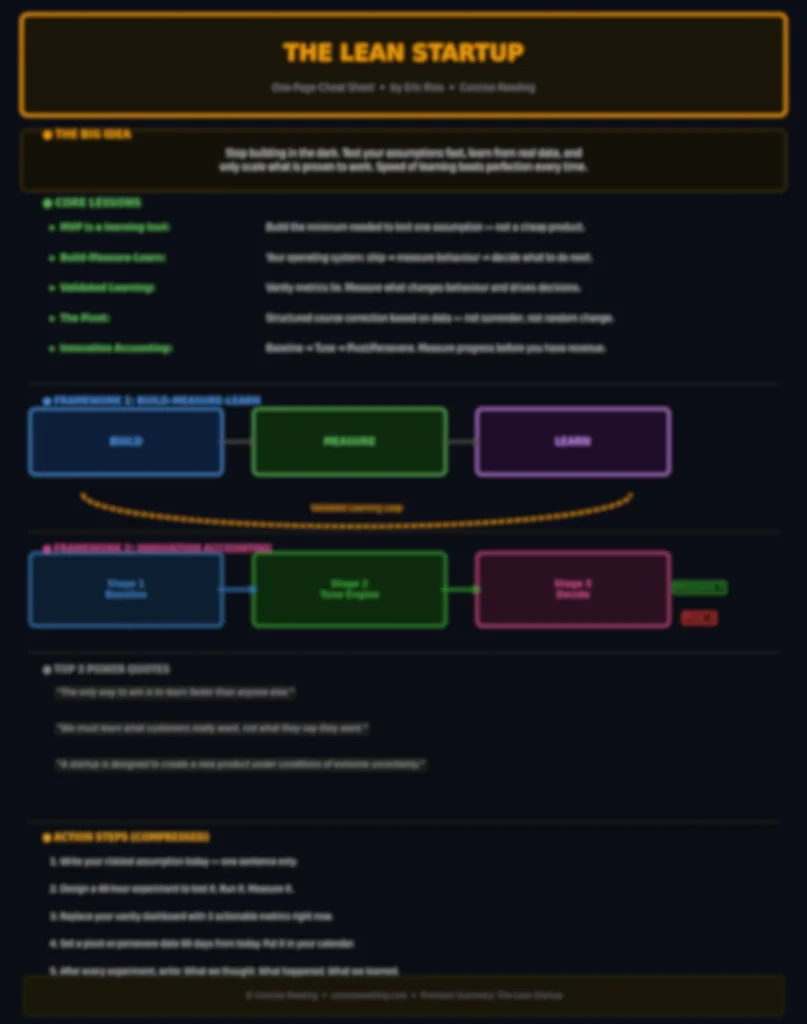
Premium Cheat Sheet Preview
About the Author
Eric Ries co-founded IMVU, an online social platform, and served as its CTO — building the Lean Startup methodology not in a classroom but in the specific pain of watching a talented team build features nobody used. He went on to advise companies and venture capital firms across Silicon Valley, became a partner at Kleiner Perkins, and consulted for the U.S. government’s Presidential Innovation Fellows program. The Lean Startup is required reading at Harvard Business School and Stanford, and has sold over one million copies worldwide. If you want to go deeper into his thinking on innovation inside large organisations, his follow-up The Startup Way applies the same framework to corporations.
Power Quote From the Book:
“The only way to win is to learn faster than anyone else.” — Eric Ries, The Lean Startup
Who This Summary is For
- This is for you if…
- You are a founder or solopreneur who has launched something before and watched it go nowhere — and you’re tired of not knowing why
- You are building a product right now and making decisions based on what you think your customer wants rather than what you’ve proven they’ll pay for
- You are a product manager or innovation lead inside a company who needs a shared framework to justify experimentation and kill slow, expensive development cycles
- You want a system for building your next idea that reduces risk before you commit serious money, time, or team resources to it
- You are already familiar with the concept of the Lean Startup but want a tight, structured breakdown of every key framework — the Build-Measure-Learn loop, Innovation Accounting, and the full pivot taxonomy — in one place
- Skip this if…
- You are running a mature, established business where product-market fit is already proven and your only challenge is scaling operations. This book — and this summary — solves the finding problem, not the scaling problem. For that, Measure What Matters or Good to Great will serve you better.
Social Proof
We’re building something at Concise Reading that’s only as good as the readers who use it. If this summary — free or premium — gave you one idea you’ve already put to use, we’d genuinely like to hear about it. Drop your experience in the comments below: what clicked, what you applied, what you’d add. Your feedback doesn’t just help us write better summaries — it helps the next founder who lands on this page decide whether this is worth their time. Every comment is read. The best ones get featured.
The Lean Startup took Eric Ries years of failed products, wasted capital, and hard-won experiments to write. The premium summary gives you the complete system — every framework, every action step, and a one-page cheat sheet you can use tomorrow — in under 40 minutes.
If you’re serious about building something that works, the Startup & Entrepreneurship Pack pairs this summary with Zero to One, The Hard Thing About Hard Things, and Traction — the four books that together cover the complete arc from idea to scale. Or go straight to The Startup Playbook if you want all twelve startup frameworks synthesised into one unified system.
Related Summaries
- Zero to One — Peter Thiel’s counterintuitive argument for building monopolies instead of competing. Pairs perfectly with Lean Startup by answering what to build before Ries tells you how to build it.
- Traction (Startup Marketing — Gabriel Weinberg & Justin Mares) — The Lean Startup tells you how to validate your product. Traction tells you how to find the one channel that will actually grow it.
- The Hard Thing About Hard Things — Ben Horowitz on what nobody tells you about running a startup after you’ve validated the idea. The honest, brutal follow-up to everything Ries teaches.
[…] The Lean Startup […]
[…] influenced entrepreneurs, investors, economists, and strategists worldwide. If you enjoy books like The Lean Startup, Zero to One, or Principles, you will find Antifragile particularly […]
[…] business strategy, alongside classics like Good Strategy Bad Strategy, Competitive Strategy, and The Lean Startup, all of which you can also explore in our Free Summaries […]
[…] the most successful founders and leaders demonstrate exactly what Duckworth describes. Books like The Lean Startup, Zero to One, and The Hard Thing About Hard Things also highlight how persistence and resilience […]
[…] This type of thinking plays a major role in fields like investing, entrepreneurship, and leadership, topics also explored in books like Principles and The Lean Startup. […]
[…] you enjoy learning from influential business books, you may also want to explore summaries like The Lean Startup, Zero to One, and The Hard Thing About Hard Things — all available in the Free Summaries section […]
[…] explore more summaries in our Library, including popular titles like Good to Great, The Lean Startup, and Zero to […]
[…] The Lean Startup […]
[…] you enjoy learning from business books, you can also explore summaries like The Lean Startup, Good to Great, and Start with Why in our Free Summaries […]
[…] can also explore more powerful books like The Lean Startup, Hacking Growth, and Contagious inside our Library to deepen your marketing […]
[…] section believe startups are the only way forward. But as also highlighted in summaries like The Lean Startup and Zero to One (available in our Free Summaries), building from scratch is risky and […]
[…] you’ve ever explored books like The Lean Startup or Zero to One in our Free Summaries collection, you’ll notice a similar theme—but this book […]
[…] you’ve read summaries like Zero to One or The Lean Startup from our Free Summaries, this book complements them by showing what happens when things don’t go […]
[…] you’ve ever explored summaries like The Lean Startup, Good to Great, or Execution in our Free Summaries section, you already know that clarity and […]
[…] like The 4-Hour Workweek and The Lean Startup reinforce this […]
[…] you’re building a business, also check out The Lean Startup and Zero to One under Startup & Entrepreneurship […]
[…] explore our Library → Free Summaries, you’ll find this book among other powerful titles like The Lean Startup and Zero to One—all focused on building smarter […]
[…] you can explore similar insights in our Free Summaries section, where books like Good to Great, The Lean Startup, and Measure What Matters expand on execution, systems, and […]
[…] ones should be managed carefully. This concept aligns strongly with ideas found in books like The Lean Startup and Good to Great available in our Free […]
[…] this thinking is applied in everything—from startups (see The Lean Startup) to investing (see One Up on Wall […]
[…] like The Lean Startup and Antifragile reinforce this idea, showing how growth comes from uncertainty and […]
[…] can explore more practical insights in The Lean Startup and Zero to One under our Startup & Entrepreneurship […]
[…] can also explore similar insights in The Lean Startup, Zero to One, and The $100 Startup inside our Free Summaries […]
[…] systems that generate predictable income—something deeply aligned with insights from books like The Lean Startup and Zero to One in our Startup & Entrepreneurship […]
[…] you’re interested in similar entrepreneurial journeys, explore summaries like Shoe Dog, The Lean Startup, and Zero to One available in our Free Summaries […]