
A Random Walk Down Wall Street by Burton Malkiel — Summary & Key Lessons
What this book will teach you in the next 10 minutes — and why it matters for the money you’re leaving on the table right now.
Trusted by readers who’d rather build real wealth than pay someone else to guess.
Book Snapshot
- Author – Burton G. Malkiel
- Category – Investing & Personal Finance
- Original Book – ~ 500 pages | Average read time: 10–12 hours
- Free Summary – 08 pages
- Premium Summary – 28 pages | Estimated read time: 45–60 minutes
The Big Idea
The entire investment industry is built on a claim that Burton Malkiel spent fifty years systematically disproving: that trained professionals with expensive tools can reliably predict which stocks will beat the market. They can’t. Markets are efficient enough that stock prices already reflect all available information — meaning every “expert tip,” hot sector, and actively managed fund is mostly noise dressed up as strategy. After fees, taxes, and trading costs, the average active fund underperforms a simple index fund. The fix isn’t complicated. Buy the whole market. Keep costs near zero. Stay disciplined. Don’t act. The boring strategy wins — because it eliminates the two forces that destroy investor returns most reliably: fees and behavior.
What You’ll Learn — Key Lessons Preview
- Why 85% of professional fund managers fail to beat the market — and exactly what that means for anyone paying 1% or more in management fees today
- How to calculate the true 20-year cost of your current fund before your next statement arrives — a single number that will permanently change how you think about investment fees
- The life-cycle allocation framework that tells you precisely how aggressive or conservative your portfolio should be based on your age and actual risk tolerance — not what sounds good in a bull market
- The specific behavioral traps — panic selling, performance chasing, overconfidence — that destroy investor returns far more reliably than any bad stock pick, and the pre-commitment strategy Malkiel recommends to neutralize them
- Why low-cost index funds are not a compromise — but the single most evidence-backed investment vehicle available to ordinary investors, validated by decades of SPIVA data that didn’t even exist when Malkiel first made the argument in 1973
Free vs Premium Comparison
| Free – $0 | Premium – $4.99 (Recommended) |
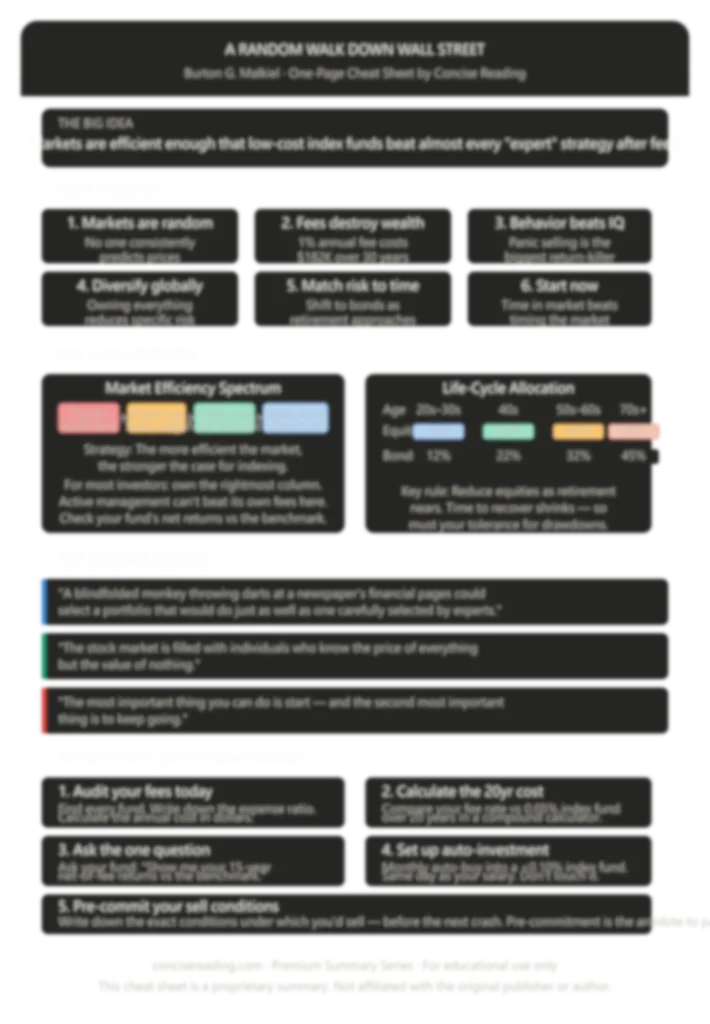
| ➡ Book Snapshot ➡ The Big Idea ➡ Key Lessons ➡ Power Quotes ➡ 08 Pages | ✔ Everything in free + ✔ Full Chapter Breakdown ✔ Key frameworks & diagrams ✔ Action steps ✔ Critical analysis ✔ One-page cheat sheet ✔ 28 pages |
Premium Cheat Sheet Preview
About the Author
Burton G. Malkiel is Professor Emeritus of Economics at Princeton University and one of the most influential voices in personal finance history. He served on the board of directors at Vanguard Group for nearly three decades — the company whose index fund revolution his research helped make possible — and as a member of the Council of Economic Advisers under President Ford. A Random Walk Down Wall Street, first published in 1973 and updated across 13 editions through 2023, has sold over 1.5 million copies and remains the single most cited book in the case for index investing.
Power Quote From the Book:
“A blindfolded monkey throwing darts at a newspaper’s financial pages could select a portfolio that would do just as well as one carefully selected by experts.” — Burton G. Malkiel, A Random Walk Down Wall Street
Who This Summary is For
- This is for you if…
- You are a first-time investor who wants to understand why index funds work before blindly following generic advice — so your strategy actually holds when markets drop 30%
- You are currently paying a financial advisor or active fund manager and have never calculated whether their net-of-fee returns actually justify the cost
- You want a rigorous, evidence-based investing framework — not another “get rich” formula — that you can implement in an afternoon and stick with for thirty years
- You are someone who lost money chasing a hot stock, a crypto cycle, or a fund manager’s five-star past performance, and you want the intellectual framework to make sure it never happens again
- You want to finally understand terms like efficient market hypothesis, asset allocation, and diversification — not as textbook definitions, but as tools you can actually use
- Skip this if…
- You are an institutional quantitative trader or a professional fund manager whose edge is systematic factor investing or proprietary data. This book is written for individual investors — and if you’re already operating at that level, your time is better spent on implementation than on a framework you’ve long since internalized. If you’re already deep into The Intelligent Investor and The Intelligent Asset Allocator, there will be significant overlap.
Social Proof
We’re building something real here, and that means we’d rather earn your trust than manufacture it. If you’ve read this summary — free or premium — we’d genuinely love to know what landed for you. Did a framework change how you think about your current fund? Did the fee calculation make you pick up the phone? Leave a comment below. Your experience helps other readers decide whether this is worth their time, and it helps us make every summary sharper. No five-star review forms. No email surveys. Just scroll down and tell us what you actually think.
A Random Walk Down Wall Street took Burton Malkiel over fifty years of research, thirteen editions, and a career at Princeton to write. The premium summary gives you the complete system — frameworks, chapter breakdown, action steps, and a cheat sheet worth pinning — in under an hour.
Related Summaries
Since you read this, these three will compound your understanding significantly:
- The Intelligent Investor — Benjamin Graham’s foundational framework for value investing. Where Malkiel tells you why active management fails, Graham tells you how disciplined, rational investors can find genuine value. The two books in conversation are more powerful than either alone.
- The Psychology of Money — Morgan Housel’s accessible masterwork on why behavior matters more than intelligence in investing. Directly reinforces Malkiel’s behavioral arguments with modern storytelling and real historical examples.
- The Little Book of Common Sense Investing — John Bogle (founder of Vanguard) makes the index fund case in pure, uncompromising form. Think of it as Malkiel’s thesis distilled to its most practical, actionable core. If Random Walk is the argument, Little Book is the instruction manual.
[…] interested in these topics may also enjoy summaries of A Random Walk Down Wall Street and One Up on Wall […]
[…] A Random Walk Down Wall Street […]
[…] A Random Walk Down Wall Street […]
[…] A Random Walk Down Wall Street […]
[…] concept is also explored in classic investing books such as A Random Walk Down Wall Street and One Up on Wall […]
[…] in similar economic thinking, you can also explore summaries like “The Psychology of Money”, “A Random Walk Down Wall Street”, and “The Intelligent Investor” in our Free Summaries […]
[…] you’ve read A Random Walk Down Wall Street, you’ll recognize similar unpredictability in […]
[…] like A Random Walk Down Wall Street and The Intelligent Investor (available in our Stocks and Investing sections) strongly warn against […]