Capitalism, Socialism and Democracy by Joseph Schumpeter — Summary & Key Lessons
What this book will teach you in the next 10 minutes — and why it matters for your business, your industry, and every strategic decision you’ll make this year.
Read by entrepreneurs, investors, and strategists who want more than surface-level business advice. Part of the Concise Reading Economics & Economic Thinking Pack — summaries built for people who think seriously about how markets actually work.
Book Snapshot
- Author – Joseph Schumpeter
- Category – Economics / Political Economy / Business History
- Original Book – Approximately 431 pages. Average read time: 14–18 hours.
- Free Summary – 08 pages
- Premium Summary – 62 pages. Estimated read time: 60–75 minutes.
The Big Idea
Capitalism doesn’t collapse because it fails. It collapses because it succeeds. Schumpeter’s central argument — Creative Destruction — is not a metaphor for disruption. It is a precise description of how capitalism actually operates: new technologies, business models, and companies continuously destroy old ones, and this process is not a flaw in the system but the system itself. More unsettling is what comes next. The prosperity capitalism creates also produces the intellectuals, bureaucracies, and political forces that will progressively constrain it. Understanding this is not academic. It is the most practical lens available for anyone making serious decisions about business, investment, or strategy today. If you want to go deeper into how economic systems shape the world, explore our summary of The Wealth of Nations and Capital in the Twenty-First Century in the library.
What You’ll Learn — Key Lessons Preview
- You will understand why dominant companies and entire industries collapse even when they are doing everything right — and how to see it coming before it happens to yours.
- You will gain Schumpeter’s precise distinction between the entrepreneur who creates and the manager who optimizes — and why confusing the two is one of the most expensive organizational mistakes a business can make.
- You will learn why capitalism systematically produces educated, articulate critics who will campaign against the system that made their existence possible — and what that means for your business’s political and social license to operate.
- You will see why socialism doesn’t arrive through revolution but through regulation, bureaucracy, and the slow expansion of government management of economic decisions — a pattern visible in almost every major industry today.
- You will walk away with five actionable frameworks for applying Creative Destruction thinking to your own industry, organization, and investment decisions — not as theory, but as a decision-making tool.
- If these ideas connect with how you think about disruption and strategy, the Innovator’s Dilemma summary and our Blue Ocean Strategy summary are the natural next reads in our library.
Free vs Premium Comparison
| Free – $0 | Premium – $4.99 (Recommended) |
| ➡ Book Snapshot ➡ The Big Idea ➡ Key Lessons ➡ Power Quotes ➡ 08 Pages | ✔ Everything in free + ✔ Full Chapter Breakdown ✔ Key frameworks & diagrams ✔ Action steps ✔ Critical analysis ✔ One-page cheat sheet ✔ 62 pages |
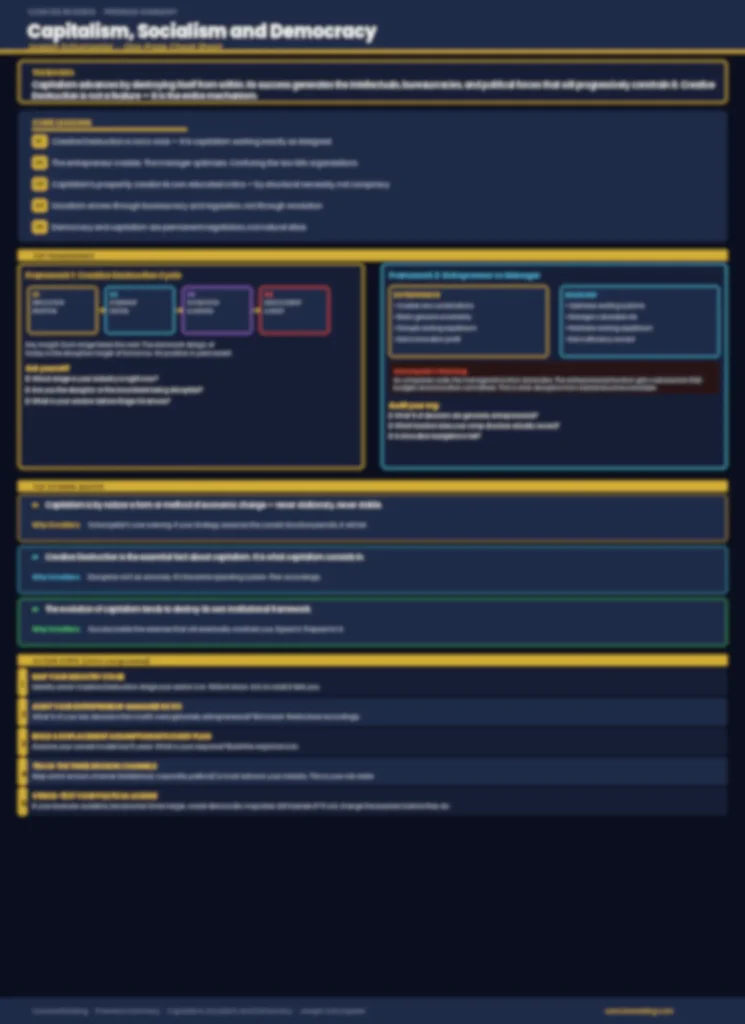
Premium Cheat Sheet Preview
About the Author
Joseph Schumpeter (1883–1950) was an Austrian-born economist, Harvard professor, and one of the most original economic thinkers of the 20th century. He served as Austria’s Finance Minister, ran a private bank, and spent decades studying capitalism from the inside before writing this book. He coined the term “Creative Destruction” and is credited as the intellectual founder of modern innovation economics — influencing everyone from Peter Drucker to Clayton Christensen. His ideas have proven more durable than those of most economists who dismissed him.
Power Quote From the Book:
“Creative Destruction is the essential fact about capitalism. It is what capitalism consists in and what every capitalist concern has got to live in.”
— Joseph Schumpeter, Capitalism, Socialism and Democracy (1942)
Who This Summary is For
- This is for you if…
- You are an entrepreneur who wants a serious intellectual framework for understanding disruption — not Silicon Valley slogans, but the actual structural mechanics of why industries transform.
- You are an investor trying to identify which sectors are structurally vulnerable to displacement before the market prices it in.
- You are a business strategist at a company that is successful today and wants to understand why that success makes you more fragile, not less.
- You are an economics student, policy professional, or intellectually serious reader who wants to engage with one of the most important books in the history of economic thought without spending 18 hours reading 431 pages.
- You want to understand why regulation, redistribution, and government intervention in markets keep expanding — not as a political opinion, but as a structural prediction that Schumpeter made in 1942 and that has been proven right ever since.
- Browse the full Economics & Economic Thinking Pack or visit our Library to see what else we have in this category.
- Skip this if…
- You are looking for a motivational read, simple productivity tips, or investment shortcuts. This is a serious book about serious ideas. The summary is comprehensive and rewarding — but it assumes you want to think, not just feel inspired.
Social Proof
This summary was built to be genuinely useful — not just a quick skim of the chapters. If you’ve read the free version or picked up the premium, we’d love to know what landed for you. Scroll to the comments below and leave your thoughts: which idea hit hardest, what surprised you, what you’re now thinking differently about. Your feedback helps other readers decide if this is the right summary for them — and it helps us build better summaries for you. We read every comment. No account required to leave one.
If you’re exploring this category for the first time, you might also find our blog post on the 20 Best Marketing Books helpful for context on how economic thinking connects to business strategy.
Capitalism, Socialism and Democracy took Schumpeter a lifetime of research, a failed bank, and nearly six decades of studying capitalism from the inside to write. The premium summary gives you the complete system — five frameworks, full chapter breakdown, action steps, power quotes with analysis, a critical assessment, and a one-page cheat sheet — in under 75 minutes. For less than a coffee. If you found the free version useful, the premium version will change how you think about strategy.
Related Summaries
- The Innovator’s Dilemma by Clayton Christensen — Schumpeter described Creative Destruction at the macro level. Christensen shows exactly how it happens inside industries and why even well-managed companies get killed by it. The two books together form a complete picture of disruption.
- Capital in the Twenty-First Century by Thomas Piketty — Where Schumpeter worried that capitalism would be strangled by its own success, Piketty argues it’s being undermined by wealth concentration. Two serious economists, two serious diagnoses. Understanding both gives you a far more complete picture of where capitalism actually stands.
- The Wealth of Nations by Adam Smith — Schumpeter’s entire framework is a response to and evolution of classical economics. Going back to Smith gives you the foundation that Schumpeter was building on and arguing with. You can’t fully appreciate what Schumpeter changed if you don’t know what he started from.