
Business Model Generation by Alexander Osterwalder — Summary & Key Lessons
What this book will teach you in the next 10 minutes — and why it matters for how you design, position, and grow your business.
Used by 5 million+ entrepreneurs worldwide. Taught at Stanford, Harvard, and INSEAD. Translated into 30+ languages. This is the strategy tool most business owners have heard of — and most have never properly applied.
Book Snapshot
- Author – Alexander Osterwalder & Yves Pigneur
- Category – Business Strategy & Entrepreneurship
- Original Book – ~ 288 pages | Estimated read time: 7–9 hours
- Free Summary – 07 pages
- Premium Summary – 24 pages | Estimated read time: 45–60 minutes
The Big Idea
Most people think they understand their business because they know what they sell. That is not a business model — that is a product description. Alexander Osterwalder’s central argument is that every business, regardless of size or industry, can be mapped onto a single page using nine interconnected building blocks. This tool — the Business Model Canvas — forces you to answer the questions most founders avoid: Who exactly is your customer? What do you actually deliver to them? How do you reach them, retain them, and make money from them — and at what cost? When you see your entire business on one page, the blind spots become impossible to ignore. That is where real strategy begins.
What You’ll Learn — Key Lessons Preview
- Why your business model matters more than your product — and how most companies fail not because their product was bad, but because the model around it was broken
- How to design a Value Proposition your customers actually care about — using the pain reliever and gain creator framework that separates winning offers from forgettable ones
- How “free” can be your most powerful business strategy — and why multi-sided platforms like Google, Airbnb, and Spotify built empires by giving their core product away
- How to read a competitor’s business model in under an hour — and identify exactly which blocks are vulnerable to disruption
- How to prototype and stress-test your business model before you spend a dollar — the discipline that separates founders who pivot intelligently from those who discover the mistake at full cost
Free vs Premium Comparison
| Free – $0 | Premium – $4.99 (Recommended) |
| ➡ Book Snapshot ➡ The Big Idea ➡ Key Lessons ➡ Power Quotes ➡ 07 Pages | ✔ Everything in free + ✔ Full Chapter Breakdown ✔ Key frameworks & diagrams ✔ Action steps ✔ Critical analysis ✔ One-page cheat sheet ✔ 24 pages |
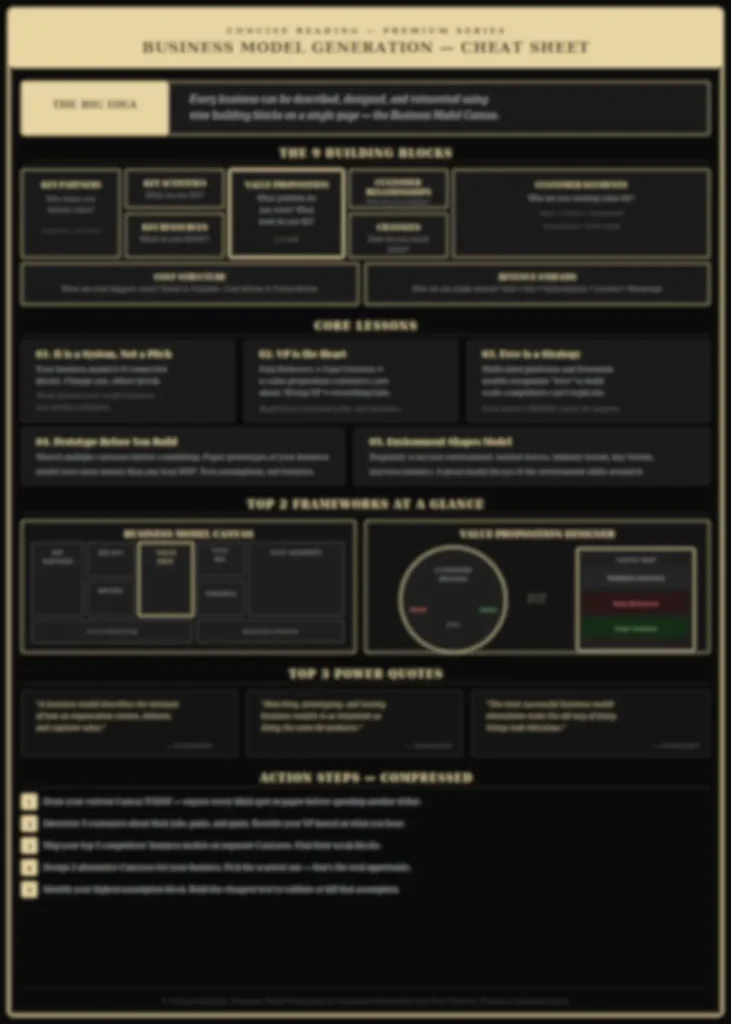
Premium Cheat Sheet Preview
About the Author
Alexander Osterwalder holds a PhD from HEC Lausanne and is the co-founder of Strategyzer, a strategy and innovation firm used by global enterprises including Mastercard, Nestlé, and 3M. He spent over a decade developing the Business Model Canvas — now the most widely used strategic framework in entrepreneurship — with contributions from 470 practitioners across 45 countries before the book was published. His work is taught at Stanford, Harvard, and INSEAD. If you want to understand how great businesses are designed, there is no more qualified guide.
Power Quote From the Book:
“A business model describes the rationale of how an organization creates, delivers, and captures value.” — Alexander Osterwalder, Business Model Generation
Most business advice focuses on one of those three verbs. Osterwalder demands all three. If you cannot answer how you create, deliver, and capture value — clearly, specifically, on one page — you do not yet have a complete business model.
Who This Summary is For
- This is for you if…
- You are a founder, freelancer, or entrepreneur who is making product and resource decisions without a clear picture of how your whole business fits together
- You are building or pivoting a business and want a systematic tool — not another motivational framework — to design your model before you spend money on it
- You are a consultant, strategist, or product manager who needs a shared diagnostic language to align your team or advise clients
- You want to understand how companies like Apple, Airbnb, and Netflix built models that competitors couldn’t copy — and apply the same logic to your own work
- You have tried writing a business plan and found it either too long to be useful or too abstract to act on
- If any of these apply, start with the free summary below. If you want the complete system — frameworks, visual diagrams, action steps, and the cheat sheet — the premium version is built for you.
- Skip this if…
- You are running a fully validated, scaled business in pure execution mode and are not considering any model changes or pivots in the next 12 months. This summary is a design and reinvention tool, not an operations manual. If that is where you are, our Measure What Matters summary or the Business Strategy & Execution Pack will serve you better.
Social Proof
We do not want you to take our word for it. If you read this summary — free or premium — we want to hear what changed for you. Did it clarify your business model? Did it expose a blind spot you had been avoiding? Did it change how you think about a competitor? Leave a comment below and tell us specifically what shifted. Your feedback helps other readers decide whether this is the right summary for them — and it helps us make every future summary sharper. The most useful reviews are not “great summary” — they are “I drew my Canvas for the first time after reading this and found three blocks I had never thought about.” That is the kind of feedback that builds a real reading community. We read every comment.
Business Model Generation took Osterwalder and Pigneur over a decade of research, co-creation with 470 practitioners, and three years of writing to produce. The Premium Summary gives you the complete strategic system — all five business model patterns, the Value Proposition Designer with full application steps, the competitor mapping framework, five curated power quotes with analysis, five specific and uncomfortable action steps, a critical analysis of the book’s strengths and blind spots, and the one-page cheat sheet designed to be saved and used — in 28 pages. One read. Everything that matters. Nothing that doesn’t.
Related Summaries
Based on the themes of business model design, strategic thinking, and entrepreneurship:
- Zero to One — Peter Thiel’s framework for building businesses that don’t just compete but create entirely new categories. Pairs directly with the Value Proposition block.
- The Lean Startup — Eric Ries on how to test and validate your business model before scaling. The operational companion to the Canvas.
- Blue Ocean Strategy — Kim & Mauborgne on how to redesign your competitive canvas so you stop fighting in crowded markets. Shares the same strategic DNA.
[…] enjoy this, you can explore related books like Good Strategy Bad Strategy, Blue Ocean Strategy, and Business Model Generation available in our […]