
Accounting Made Simple by Mike Piper — Summary & Key Lessons
What this book will teach you in the next 10 minutes — and why it matters for your business finances, your tax bill, and every money decision you make from here.
Part of the Accounting & Bookkeeping collection — curated summaries for people who run businesses, not accounting departments.
Book Snapshot
- Author – Mike Piper
- Category – Personal Finance & Business Fundamentals / Accounting & Financial Literacy
- Original Book – ~ 130 pages | Average read time: 3–4 hours
- Free Summary – 08 pages
- Premium Summary – 33 pages | Estimated read time: 45–60 minutes
The Big Idea
Most people avoid accounting because nobody ever gave them the one sentence that makes the whole system click. That sentence is: Assets = Liabilities + Equity. Every financial transaction in every business — every invoice, every payroll run, every loan, every tax filing — is just this equation rearranging itself. Mike Piper strips away the jargon and shows you that underneath all the complexity is a system of pure logic. Once you see it, you cannot unsee it. And once you understand it, financial statements stop being frightening documents and start being stories — stories about what a business owns, what it owes, and what it’s actually worth. This book is the fastest path from financial confusion to financial clarity that exists in print.
What You’ll Learn — Key Lessons Preview
- Understand exactly what a balance sheet, income statement, and cash flow statement are telling you — and why reading only one of them is always misleading
- Finally understand how debits and credits actually work, without the confusion that stops most people cold
- Know the difference between a tax deduction and a tax credit — a distinction that directly changes how much money stays in your pocket
- Recognize why a business can show profit on paper and still run out of cash — and how to make sure that never blindsides you
- Build the foundational vocabulary to read any financial statement, talk confidently with your accountant, and make smarter business and investment decisions starting today
Free vs Premium Comparison
| Free – $0 | Premium – $4.99 (Recommended) |
| ➡ Book Snapshot ➡ The Big Idea ➡ Key Lessons ➡ Power Quotes ➡ 08 Pages | ✔ Everything in free + ✔ Full Chapter Breakdown ✔ Key frameworks & diagrams ✔ Action steps ✔ Critical analysis ✔ One-page cheat sheet ✔ 33 pages |
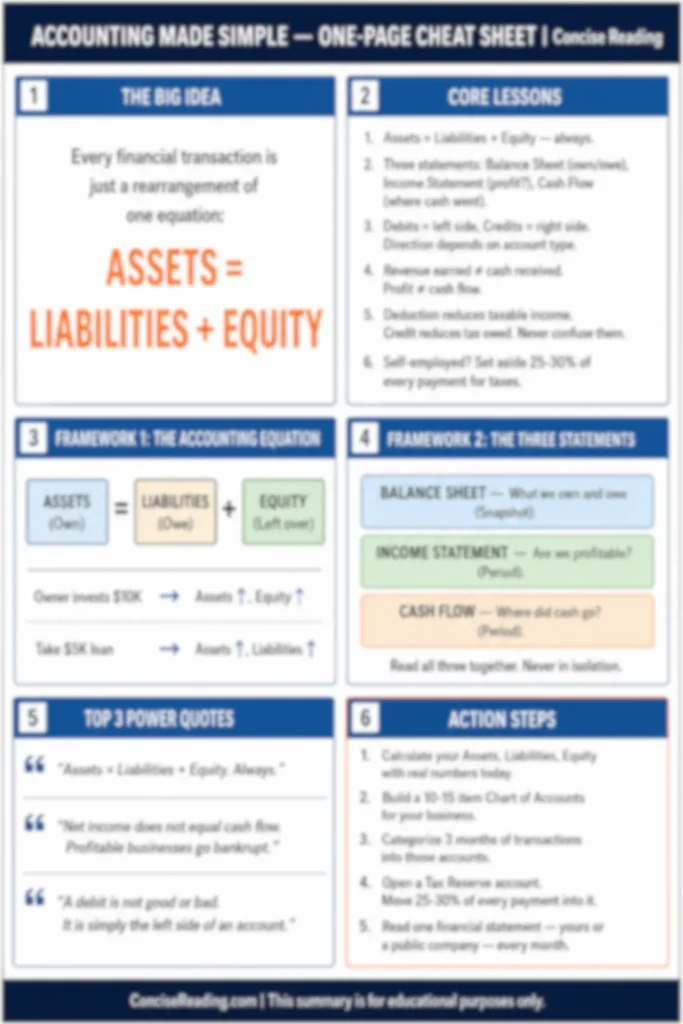
Premium Cheat Sheet Preview
About the Author
Mike Piper is a licensed CPA and the founder of Oblivious Investor, one of the most trusted independent personal finance resources in the United States. He has written over a dozen books on accounting, taxes, and investing — most of which rank consistently among the top-selling titles in their categories on Amazon. His entire body of work is built on one principle: financial concepts should be understandable to anyone willing to sit down with a well-written book. That philosophy is exactly what makes his work worth summarizing — and worth reading.
Power Quote From the Book:
“Net income does not equal cash flow. A business can be profitable on paper while running out of cash.”
— Mike Piper, Accounting Made Simple
Who This Summary is For
- This is for you if…
- You are a freelancer, solopreneur, or small business owner who handles your own finances but has never formally learned accounting
- You are an entrepreneur who nods along during accountant meetings and then googles everything afterward
- You want to read financial statements — yours or any public company’s — without depending entirely on someone else’s interpretation
- You are new to investing and want to understand the numbers behind the businesses you are evaluating
- You are a professional moving into a business role where financial literacy is now expected of you
- Skip this if…
- You have already completed formal accounting coursework or hold a finance credential — this summary, like the original book, is built for beginners, and you will cover no new ground here. If you are looking for advanced financial modeling, corporate-level GAAP deep dives, or industry-specific accounting, browse our Financial Intelligence & Analysis category for more advanced titles.
Testimonials
We do not manufacture five-star reviews. Instead, we ask for something more valuable: your honest reaction after reading.
If this summary clarified something you have been fuzzy on for years — or if you spotted something we could do better — leave a comment below. Real feedback from real readers is how Concise Reading improves every summary we publish, and it helps other readers decide if this is the right starting point for them. If you found this useful, say so. If you think the premium version was worth it, tell us why. Your comment is the social proof that actually means something.
Accounting Made Simple took Mike Piper years of CPA practice and teaching to distill into 130 pages. The premium summary gives you the complete system — five key frameworks with implementation steps, five curated power quotes with analysis, five specific action steps designed to cause productive discomfort, a full critical analysis, and a one-page cheat sheet worth pinning to your wall — in under 40 pages and under an hour.
Mike Piper spent a career learning this so you don’t have to spend one. The premium summary is $4.99. That is less than a coffee, and it will outlast the caffeine by years.
If you are serious about understanding your business finances — not just knowing the vocabulary but actually using the system — the premium version is where that starts. If you have already found value in our free summary of this book, consider exploring the full Accounting & Bookkeeping Pack, which includes 12 summaries covering everything from bookkeeping basics to financial statement analysis, at a fraction of individual pricing.
Related Summaries
- 1. Financial Intelligence — Karen Berman & Joe Knight – The natural next step after Accounting Made Simple. While Piper gives you the vocabulary, Financial Intelligence teaches you how to use financial data to make smarter business decisions — written specifically for non-financial managers and business owners.
- 2. Profit First — Mike Michalowicz – Accounting knowledge is useless if your cash management is broken. Profit First builds a practical cash management system on top of everything you just learned — specifically designed for small business owners who are generating revenue but not keeping any of it.
- 3. Financial Shenanigans — Howard Schilit – Once you understand how accounting is supposed to work, this book shows you how companies manipulate it. Essential reading for investors and entrepreneurs who read financial statements — because knowing the rules also means knowing when someone is breaking them.
[…] you’ve already explored summaries like Accounting Made Simple, Accounting for Dummies, or Financial Statements in our Free Summaries, this book takes your […]
[…] enjoy this approach, you’ll also benefit from related summaries available on our platform like Accounting Made Simple, Accounting for Dummies, and Accounting Principles—all available inside our Library → Free […]
[…] Accounting Made Simple […]