
Bookkeeping Made Simple by David A. Flannery — Summary & Key Lessons
What this book will teach you in the next 10 minutes — and why it matters for the financial survival of your business.
Read by entrepreneurs, freelancers, and small business owners who are done guessing at their own numbers. Part of the Accounting & Bookkeeping summary library at Concise Reading.
Book Snapshot
- Author – David A. Flannery
- Category – Accounting & Financial Literacy
- Original Book – ~ 176 pages | Average read time: 4–5 hours
- Free Summary – 08 pages
- Premium Summary – 35 pages | Estimated read time: 35–45 minutes
The Big Idea
Most small business owners don’t fail because their product is bad. They fail because they never understood their numbers. Bookkeeping Made Simple argues that bookkeeping — the daily, systematic recording of every financial transaction — is not a clerical task to outsource and forget. It is the core financial intelligence system of your business. When done correctly, it produces the three statements that answer every question that matters: Am I profitable? Am I solvent? Will I have cash to operate next month? Flannery’s argument is direct: financial illiteracy is not an innocent gap. It is a slow, quiet killer of businesses that could have survived.
What You’ll Learn — Key Lessons Preview
- Why your bank balance is lying to you — and the three financial statements that tell you the complete, unfiltered truth about your business’s health
- How to record every transaction correctly using the double-entry system — so your books actually balance and your reports actually mean something
- How to build a chart of accounts from scratch — the financial filing structure that makes every report downstream clean, accurate, and actionable
- The one monthly habit that catches errors, unauthorized charges, and missing entries before they become disasters — and how to do it in under an hour
- Why profitable businesses run out of cash — and exactly how to read your financial statements together so you never get blindsided by a cash crisis
Free vs Premium Comparison
| Free – $0 | Premium – $4.99 (Recommended) |
| ➡ Book Snapshot ➡ The Big Idea ➡ Key Lessons ➡ Power Quotes ➡ 08 Pages | ✔ Everything in free + ✔ Full Chapter Breakdown ✔ Key frameworks & diagrams ✔ Action steps ✔ Critical analysis ✔ One-page cheat sheet ✔ 35 pages |
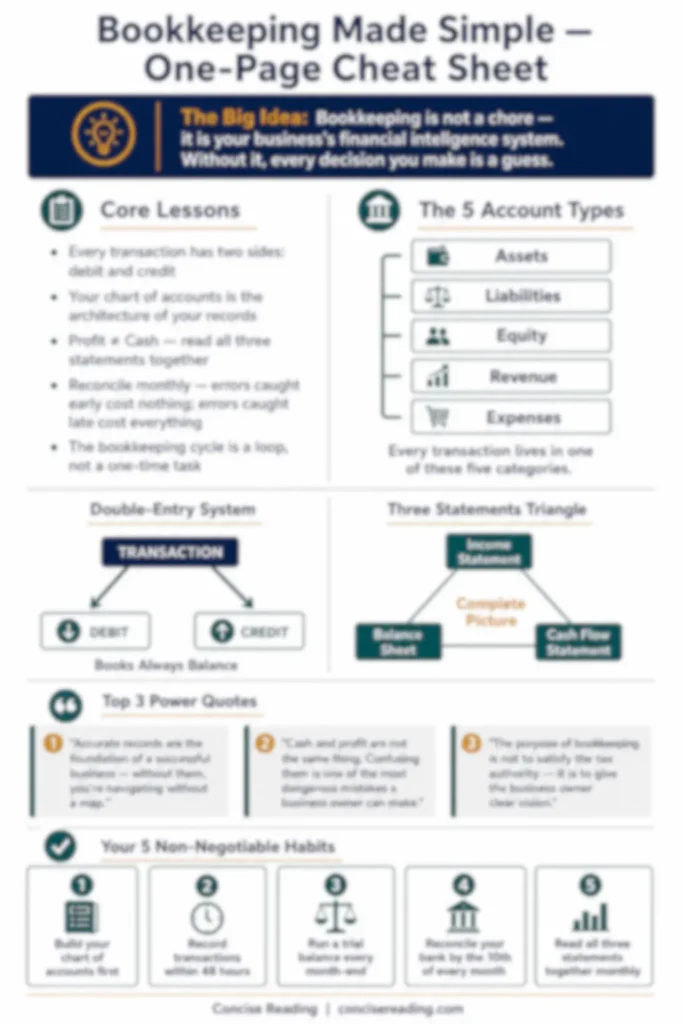
Premium Cheat Sheet Preview
About the Author
David A. Flannery is a Certified Public Accountant with decades of hands-on experience helping small business owners set up and maintain bookkeeping systems that actually work. He has consulted with entrepreneurs across industries who needed practical financial guidance — not academic theory. His writing reflects both the classroom and the consulting room: he knows exactly where beginners get lost, and he addresses those gaps directly. Bookkeeping Made Simple is his most widely adopted work, used in both self-study and vocational training programs across the United States.
Power Quote From the Book:
“Accurate financial records are the foundation of a successful business — without them, you’re navigating without a map.”
— David A. Flannery, Bookkeeping Made Simple
Who This Summary is For
- This is for you if…
- You are a freelancer, solopreneur, or small business owner managing your own finances — but doing it inconsistently and you know it
- You are a new entrepreneur who wants to set up a clean, functional bookkeeping system from day one instead of inheriting a mess six months in
- You are a business owner who has always handed off your books entirely and wants to understand what you’re actually signing off on at tax time
- You want to read a balance sheet, income statement, or cash flow statement without needing someone else to translate it for you
- You are an aspiring bookkeeper or accounting student who wants a plain-English foundation before tackling formal coursework
- If you found our summaries of Profit First or Financial Intelligence useful, this one belongs in the same reading sequence.
- Skip this if…
- You are an experienced accountant or CPA — this book operates at a foundational level and will not challenge you. If you are looking for advanced tax strategy, financial modeling, or corporate finance, browse our Financial Intelligence & Analysis category instead.
Testimonials
We are building one of the most comprehensive business and finance summary libraries available — and the readers who use these summaries are the ones shaping what we build next. If you have read this summary — free or premium — we would genuinely like to know what you took away from it. Did it change how you think about your books? Did it give you a system you actually implemented? Leave your experience in the comments below. Your feedback helps other business owners decide whether this summary is right for them — and it helps us make every future summary sharper. No fluff, no fake five-stars. Just honest reactions from real readers.
David A. Flannery spent years in accounting practice and consulting rooms distilling the financial fundamentals that most business owners never learn — the premium summary gives you his complete system, every framework, every action step, and a one-page cheat sheet you can pin to your wall, in under 45 minutes, for $4.99.
Related Summaries
- Accounting Made Simple — Michael Bragg’s accessible guide to accounting principles for non-accountants. If Bookkeeping Made Simple laid the foundation, this one builds the next floor up.
- Financial Intelligence — Karen Berman & Joe Knight’s book on how to read and understand financial statements the way insiders do. Perfect for business owners who want to move from recording numbers to using them strategically.
- Profit First — Mike Michalowicz’s system for managing business cash flow by allocating revenue into separate accounts as it comes in. Directly complements bookkeeping fundamentals with a practical cash management framework.
[…] you’re new, we recommend also checking summaries like Bookkeeping Made Simple and Bookkeeping Basics in our Library → Free […]
[…] Bookkeeping Made Simple […]
[…] Bookkeeping Made Simple […]