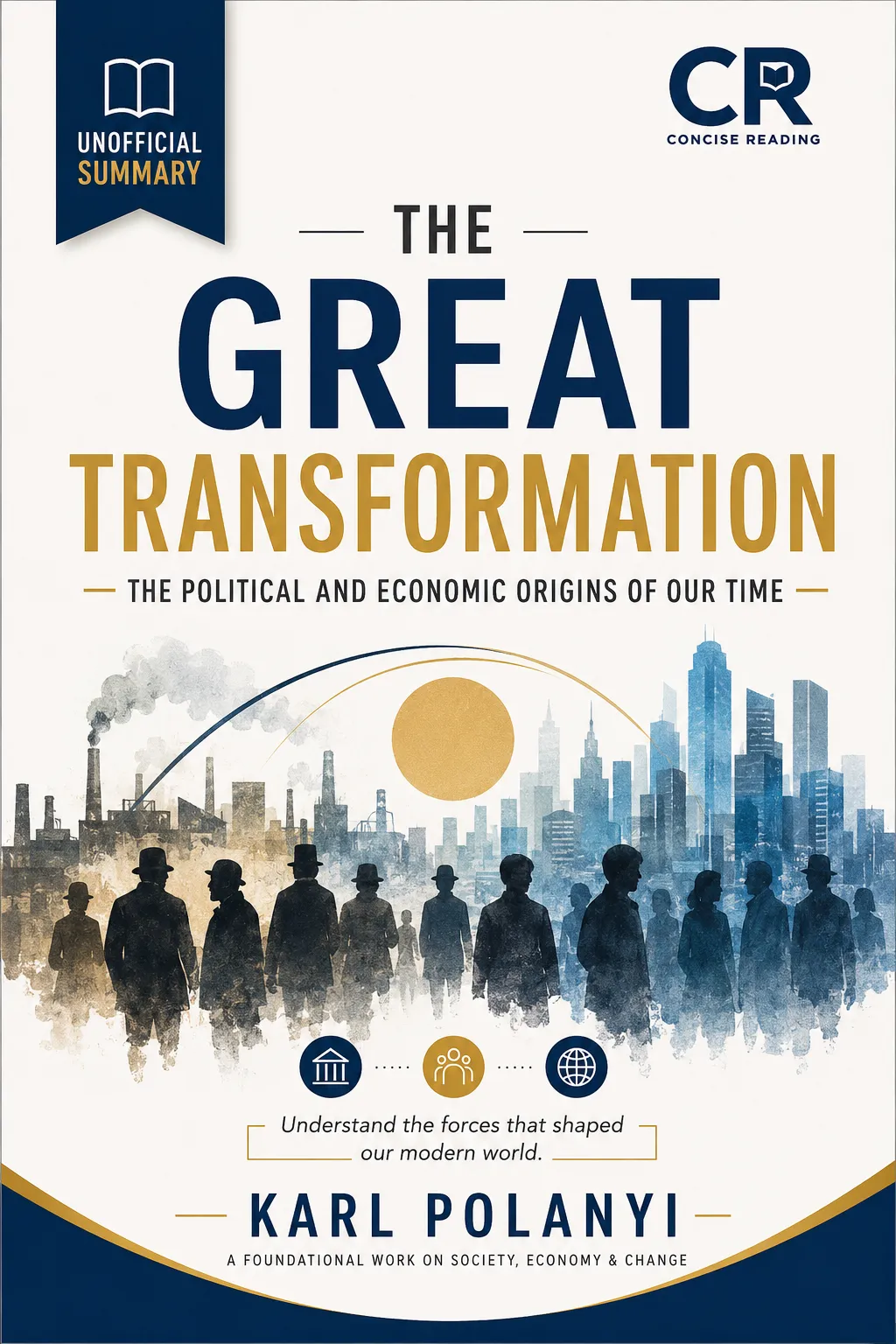
The Great Transformation by Karl Polanyi — Summary & Key Lessons
What this book will teach you in the next 10 minutes — and why it matters for understanding why markets keep producing crises that nobody predicted and everyone pays for.
Read by investors, economists, policy professionals, and entrepreneurs who want to understand economic reality — not just economic theory.
Book Snapshot
- Author – Karl Polanyi
- Category – Economic History / Political Economy / Social Theory
- Original Book – 317 pages. Average read time: 9 to 11 hours.
- Free Summary – 08 pages
- Premium Summary – 40 pages. Estimated read time: 45 to 60 minutes.
The Big Idea
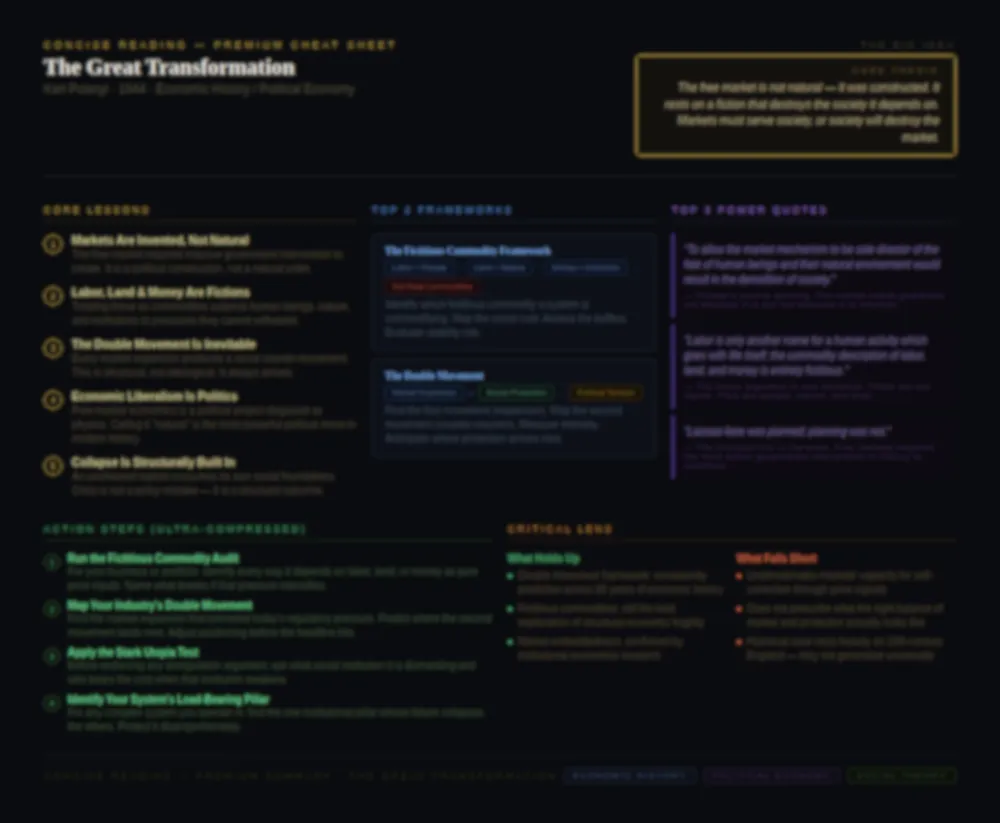
Karl Polanyi’s central argument is one of the most important ideas in modern economic thought — and one of the least known outside academic circles. He argues that the free market is not natural, not inevitable, and not self-sustaining. It was deliberately constructed through massive government intervention, and it rests on a dangerous fiction: that labor, land, and money are commodities like any other. They are not. Labor is human life. Land is nature and community. Money is a social institution. When market logic is applied to these three things without limit, it destroys the social fabric that market exchange depends on. And when societies feel that destruction, they fight back — through regulation, nationalism, or worse. That cycle, which Polanyi called the double movement, has driven every major political upheaval of the past two centuries. It is driving the ones you are watching right now.
What You’ll Learn — Key Lessons Preview
- — Why the free market was built by government, not discovered by it — and what that means for every policy debate you will encounter in your career or business.
- — How to identify which industries and business models are structurally exposed to the next wave of regulation before the regulatory pressure arrives.
- — Why economic crises are not policy mistakes or accidents — they are structural outcomes you can anticipate using a framework that has been accurate for 80 years.
- — How to read political instability — from Brexit to economic nationalism to anti-gig economy legislation — as a predictable mechanical response to market expansion, not irrational noise.
- — Why the most efficient business models are often the most politically fragile, and what to build instead if you want a position that survives the next double movement.
Free vs Premium Comparison
| Free – $0 | Premium – $4.99 (Recommended) |
| ➡ Book Snapshot ➡ The Big Idea ➡ Key Lessons ➡ Power Quotes ➡ 08 Pages | ✔ Everything in free + ✔ Full Chapter Breakdown ✔ Key frameworks & diagrams ✔ Action steps ✔ Critical analysis ✔ One-page cheat sheet ✔ 40 pages |
Premium Cheat Sheet Preview
About the Author
Karl Polanyi (1886–1964) was a Hungarian-American economic historian who taught at Columbia University and spent decades studying how economic systems shape — and destroy — the societies that house them. He lived through the collapse of the Austro-Hungarian Empire, the rise of European fascism, and two world wars — and spent his career explaining why those catastrophes were the predictable outcome of economic choices, not accidents of history. The Great Transformation, published in 1944, is his defining work and remains one of the most assigned texts in graduate programs across economics, political science, and sociology worldwide.
Power Quote From the Book:
“To allow the market mechanism to be sole director of the fate of human beings and their natural environment would result in the demolition of society.”
— Karl Polanyi, The Great Transformation (1944)
Who This Summary is For
- This is for you if…
- — You are an investor or entrepreneur trying to understand why political and regulatory risk keeps arriving in your industry without warning — and you want a structural framework for anticipating it instead of reacting to it.
- — You want to understand the economic roots of the political turbulence dominating every major economy right now — from trade wars and economic nationalism to labor regulation and financial oversight — without getting lost in ideological noise.
- — You are a serious reader who is unsatisfied with both standard free market arguments and standard criticisms of capitalism, and you want a third framework that is historically grounded and analytically precise.
- — You work in policy, finance, economics, or public affairs and want to argue with greater historical depth and structural precision than your peers.
- — You want to understand the 2008 financial crisis, the rise of economic populism, and the structural fragility of the current global economy from a single coherent framework rather than a collection of disconnected explanations.
- Skip this if…
- You are looking for a tactical business book with immediate step-by-step applications and no patience for historical argument. Polanyi is a dense, serious thinker. If you want a faster return on your reading time, our summary of The Lean Startup or $100M Offers will serve you better right now. Come back to Polanyi when you are ready to think about why the environment those businesses operate in looks the way it does.
Social Proof
We are building our reader community one summary at a time — and your voice matters more than you think.
If this summary shifted how you see markets, regulation, or economic history, leave a comment below. Which lesson landed hardest? Which framework are you already applying? Did something in Polanyi’s argument change how you are reading current events?
We read every comment. The most useful ones — the ones that say “I applied this to my business and here is what happened” or “this reframed how I understand my industry” — end up helping thousands of other readers decide whether this summary is right for them.
You do not need to write an essay. One honest sentence is worth more than a five-star rating with nothing behind it. If this summary earned your attention, tell us why.
The Great Transformation took Karl Polanyi over two decades of research to write. The premium summary gives you the complete analytical system — every framework, every chapter, every action step — in 40 focused pages.
If you have read the free summary and found yourself thinking differently about markets, regulation, and political risk, the premium version is where that thinking becomes a tool you can actually use. The full chapter-by-chapter breakdown, five visual frameworks as downloadable PNGs, five power quotes with practical interpretation, five action steps specific enough to be uncomfortable, a complete critical analysis, and a one-page cheat sheet designed to be printed and referenced — all of it, permanently yours.
The book costs $18 and takes 10 hours to read. The premium summary costs less than a coffee and takes under an hour. That is the trade. If the framework in this free version told you something useful, the premium version will make it operational.
Not sure what the premium version includes? Read our full breakdown here: What Is a Premium Book Summary? Or explore our full library of business and economics summaries at to find your next read.
Related Summaries
- Capital in the Twenty-First Century — Thomas Piketty extends Polanyi’s concern about markets and inequality into rigorous modern data. Where Polanyi explains the mechanism, Piketty shows you the numbers.
- Globalization and Its Discontents — Joseph Stiglitz applies Polanyian logic directly to the IMF and World Bank’s structural adjustment programs. Concrete, contemporary, and damning.
- The Wealth of Nations — Read this alongside Polanyi to understand what Smith actually argued versus what free market advocates claim he argued. The contrast is instructive.