The Road to Serfdom by Friedrich Hayek — Summary & Key Lessons
What this book will teach you in the next 10 minutes — and why it matters for your business, your investments, and your freedom.
Written and curated by the team at Concise Reading — part of our library of business and economics book summaries trusted by independent thinkers, entrepreneurs, and investors worldwide.
Book Snapshot
- Author – Friedrich Hayek
- Category – Economics / Political Philosophy / Classic Thought
- Original Book – ~ 274 pages. Average read time: 7 to 9 hours.
- Free Summary – 09 pages
- Premium Summary – 35 pages. Estimated read time: 45 to 60 minutes.
The Big Idea
Friedrich Hayek’s argument is simple and deeply uncomfortable: you cannot have a planned economy without a planned society. The moment a government takes control of economic decisions — what gets produced, who gets what, which industries survive — it must also control the people inside that system. And to do that, it must suppress opposition, eliminate competing ideas, and concentrate power in fewer and fewer hands. The terrifying part? This does not require villains. It only requires people who are certain they know what is best for everyone else. Good intentions plus centralized power equals the road to serfdom. Every single time.
If you are building a business, managing investments, or trying to understand why government policy shapes your life in ways you did not vote for, Hayek gives you the framework to see it clearly. This is not a book about left versus right. It is a book about power, knowledge, and the conditions that make freedom possible — or destroy it.
(Want to see how this argument fits into the broader debate about capitalism? Read our summary of Capitalism and Freedom by Milton Friedman, or compare it with The Wealth of Nations by Adam Smith — the foundational text Hayek was defending.)
What You’ll Learn — Key Lessons Preview
- You will understand exactly why economic control and political control cannot be separated — and what that means for every government policy that affects your money and your business.
- You will see why central planning fails not because planners are corrupt, but because the knowledge required to run an economy does not exist in any one place — and why markets process that knowledge in a way no government can replicate.
- You will learn how to identify when a government, institution, or organization is drifting from rule of law toward arbitrary rule of men — and what the early warning signals look like before the damage becomes irreversible.
- You will understand the difference between the kind of economic security that is compatible with freedom and the kind that requires total control to deliver — a distinction that will change how you evaluate every political promise you hear.
- You will walk away with a mental model for reading political and economic risk that most investors and entrepreneurs never develop — because they were never taught to think at this level.
- (These lessons are part of our broader Economics & Economic Thinking Pack — a premium bundle covering the most important ideas in economic history. See the full pack at concisereading.com/premium-packs.)
Free vs Premium Comparison
| Free – $0 | Premium – $4.99 (Recommended) |
| ➡ Book Snapshot ➡ The Big Idea ➡ Key Lessons ➡ Power Quotes ➡ 09 Pages | ✔ Everything in free + ✔ Full Chapter Breakdown ✔ Key frameworks & diagrams ✔ Action steps ✔ Critical analysis ✔ One-page cheat sheet ✔ 35 pages |
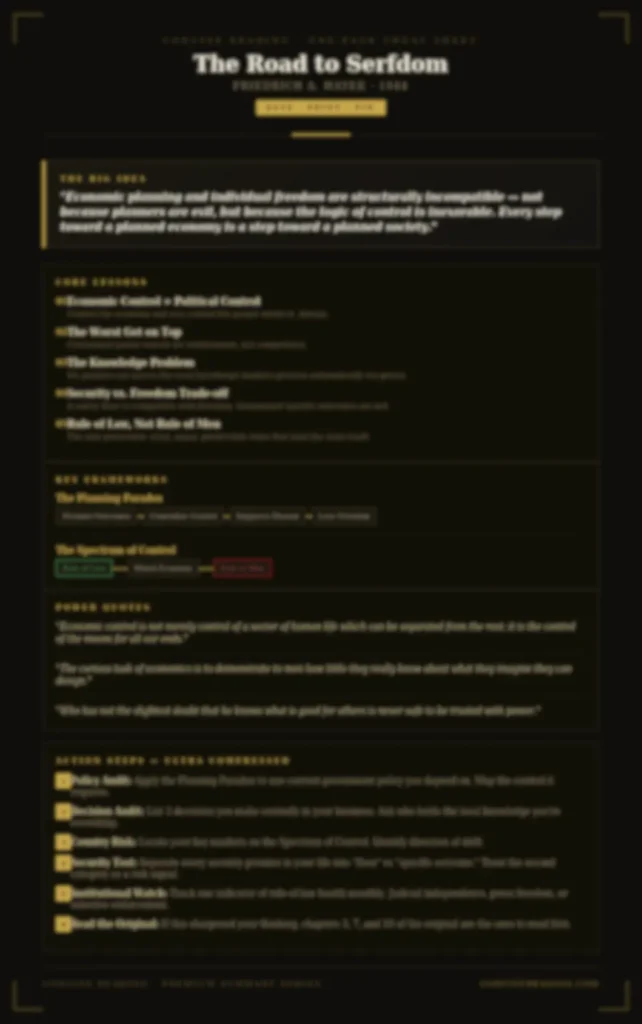
Premium Cheat Sheet Preview
About the Author
Friedrich Hayek (1899–1992) was an Austrian-British economist and political philosopher who spent decades at the London School of Economics, the University of Chicago, and the University of Freiburg. In 1974, he was awarded the Nobel Memorial Prize in Economic Sciences for his work on money, economic cycles, and the interdependence of economic and institutional systems. His ideas directly shaped the economic reforms of the 1980s in the United Kingdom and the United States, and his body of work remains among the most debated and cited in modern economic thought.
(Hayek belongs to the same intellectual tradition as Milton Friedman — whose Capitalism and Freedom summary is available here — and Henry Hazlitt, whose Economics in One Lesson summary you can read in our library.)
Power Quote From the Book:
“Economic control is not merely control of a sector of human life which can be separated from the rest; it is the control of the means for all our ends.”
— Friedrich Hayek, The Road to Serfdom
Who This Summary is For
- This is for you if…
- You are an entrepreneur or business owner who wants to understand how government policy shapes your operating environment — and why some markets stay free while others slide toward control.
- You are an investor who needs a framework for evaluating political and institutional risk, not just financial risk, across the markets you operate in.
- You are a student of economics, history, or political science who wants to engage seriously with one of the most important and controversial books of the 20th century.
- You want to think more rigorously about the real trade-offs between economic security and individual freedom — beyond slogans, beyond headlines, from first principles.
- You are a curious, independent thinker who has noticed that the same patterns keep repeating in economic history and wants to understand why.
- Skip this if…
- You are looking for a practical business book with tactical templates, step-by-step systems, or personal finance advice. The Road to Serfdom is a work of political economy and philosophy. It will sharpen your thinking over time — it will not improve your Q3 numbers by Friday. If that is what you need right now, start with our summary of The $100 Startup or $100M Offers instead.
Social Proof
This summary is newer to our library, and we want to hear from you. If you read the free summary below and found it useful — or if you picked up the premium version and it changed how you think about something — leave a comment below and tell us what landed. Your feedback helps other readers decide whether this is the right summary for them, and it helps us keep making these better. The best communities are built by readers who show up and say something. Be one of them.
(Already a fan of the Concise Reading format? You might also want to check out reader responses to our most popular summaries — including Thinking, Fast and Slow, The Psychology of Money, and Antifragile. All in the library.)
The Road to Serfdom took Friedrich Hayek a lifetime of economic research and firsthand observation of rising totalitarianism to write. The Concise Reading premium summary gives you the complete system — chapter-by-chapter breakdown, four original frameworks with visual diagrams, five curated power quotes with practical commentary, five specific action steps designed to be uncomfortable enough to actually use, a full critical analysis, and a one-page cheat sheet built to be saved, printed, and pinned — in under 60 minutes.
Hayek spent a career building this argument. You can own the entire distilled version for less than a cup of coffee. The only question is whether you are the kind of reader who stops at the free version or the kind who goes all the way.
(Not sure yet? Compare exactly what is in the free versus premium version in the table above — or browse our full library of summaries at concisereading.com/library to see the standard we hold every premium summary to.)
Related Summaries
Based on this summary, here are three books from our collection that pair directly with The Road to Serfdom:
- Capitalism and Freedom by Milton Friedman — Friedman builds on Hayek’s framework and makes the practical case for free markets and limited government in specific policy areas including education, healthcare, and monetary policy. Essential next read.
- Economics in One Lesson by Henry Hazlitt — Hazlitt’s masterpiece breaks down economic fallacies that lead governments toward interventionist policies. Simpler and more accessible than Hayek, but perfectly complementary. Great for applying these ideas to everyday economic debates.
- The Wealth of Nations by Adam Smith — The foundational text behind everything Hayek defends. Smith’s invisible hand is the mechanism Hayek argues we destroy at our peril. Reading Smith alongside Hayek gives you the full intellectual lineage of free-market thought.