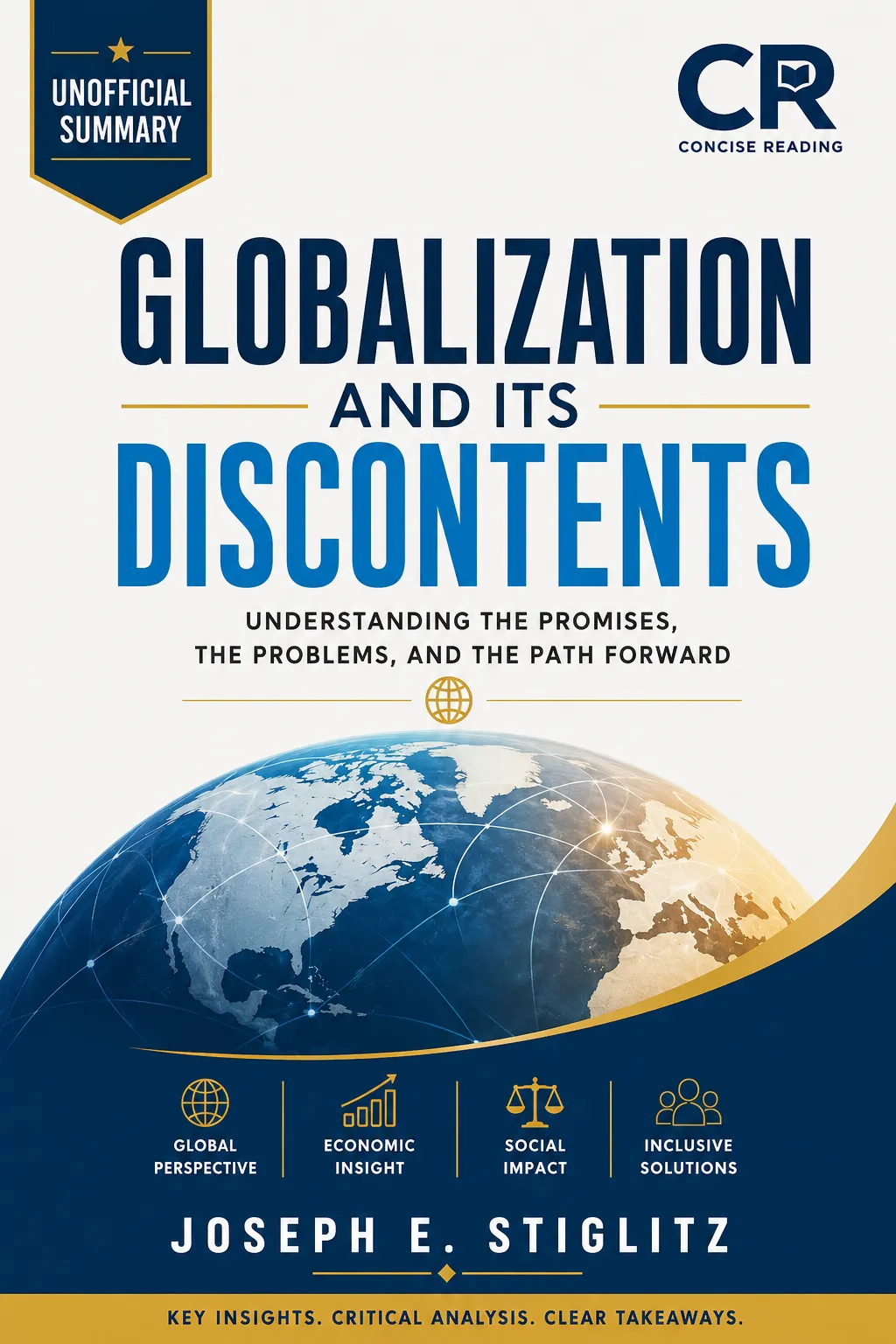
Globalization and Its Discontents by Joseph Stiglitz — Summary & Key Lessons
What this book will teach you in the next 10 minutes — and why it matters for understanding who really controls the global economy and whose interests it actually serves.
Written by a Nobel Prize-winning economist who was inside the IMF and World Bank when the decisions were made. This is not theory. This is testimony.
Book Snapshot
- Author – Joseph E. Stiglitz
- Category – Economics / Global Policy / Political Economy
- Original Book – ~ 282 pages, approximately 7 to 9 hours average read time.
- Free Summary – 09 pages
- Premium Summary – 35 pages, approximately 90 to 110 minutes estimated read time.
The Big Idea
The global economy was supposed to lift all boats. Instead, the institutions managing it — the IMF, World Bank, and WTO — imposed a rigid set of free-market policies on developing nations that had no institutional foundation to support them. The result was not development. It was crisis after crisis: currencies collapsed, poverty surged, middle classes were wiped out. Nobel laureate Joseph Stiglitz was in the room when these decisions were made. His conclusion is unambiguous — the system was built to serve creditors, not citizens. Understanding why is the first step to seeing the global economy clearly.
What You’ll Learn — Key Lessons Preview
- You will understand exactly why IMF bailout programs in countries like Indonesia, Russia, and Argentina made economic crises worse instead of better — and the structural reason this kept happening.
- You will see through the “free trade” myth — how wealthy nations demanded developing countries open their markets while quietly protecting their own agricultural sectors with hundreds of billions in subsidies.
- You will learn how premature capital market liberalization creates a predictable boom-to-crisis pipeline — and the four data points that signal a country is dangerously exposed before the crisis hits.
- You will discover why Russia’s privatization in the 1990s produced oligarchy instead of capitalism — and the universal lesson about what happens when market reforms are imposed before institutions exist to support them.
- You will develop a framework for evaluating any IMF program, trade agreement, or development policy — not from the headline, but from the actual conditions and who structurally benefits when they are met.
- If this is the kind of economic thinking you want to build, browse our full economics collection in the Concise Reading Library — we cover everything from The Wealth of Nations to Capital in the Twenty-First Century to Poor Economics.
Free vs Premium Comparison
| Free – $0 | Premium – $4.99 (Recommended) |
| ➡ Book Snapshot ➡ The Big Idea ➡ Key Lessons ➡ Power Quotes ➡ 09 Pages | ✔ Everything in free + ✔ Full Chapter Breakdown ✔ Key frameworks & diagrams ✔ Action steps ✔ Critical analysis ✔ One-page cheat sheet ✔ 35 pages |
Premium Cheat Sheet Preview

About the Author
Joseph Stiglitz is a Nobel Prize-winning economist, former Chairman of the Council of Economic Advisers under President Clinton, and Chief Economist of the World Bank from 1997 to 2000. He holds a faculty position at Columbia University and is one of the most cited economists alive. His work on information asymmetry — how unequal access to information distorts markets — forms the theoretical backbone of every critique in this book. He did not write this from the outside. He was in the room.
Power Quote From the Book:
“The IMF’s economic remedies often make things worse — turning slowdowns into recessions and recessions into depressions.”
— Joseph Stiglitz, Globalization and Its Discontents
Who This Summary is For
- This is for you if…
- You are an economics student, MBA student, or finance professional who wants to think critically about global institutions — not just operate within their assumptions.
- You are an investor or analyst tracking emerging markets and you want a rigorous framework for understanding why certain countries keep ending up in IMF programs.
- You are a policy professional, development worker, or researcher who needs an insider-sourced critique of how the donor-recipient relationship actually works.
- You are an educated general reader who has followed news about IMF bailouts in Pakistan, Sri Lanka, Egypt, or Argentina and wanted a deeper explanation than the headlines provide.
- You want to understand the intellectual roots of the anti-globalization backlash that has reshaped elections across the US, UK, France, Brazil, and India — because the anger has a specific, documentable origin.
- Skip this if…
- You are looking for a personal finance, business strategy, or investing book. Stiglitz operates at the level of nations and institutions. This summary will not help you build a portfolio or grow a business. If that is your goal right now, our Personal Finance & Wealth Building Pack or the Investing Playbook will serve you far better.
Social Proof
This summary is part of our growing economics collection at Concise Reading, where we compress the most important books in business, finance, and economics into reading-time formats that respect your intelligence and your schedule. If you read this summary — free or premium — we genuinely want to know what you thought. Did it change how you read a news headline about the IMF? Did it give you a framework you didn’t have before? Drop your experience in the comments below. We read every one. Your feedback also helps other readers decide whether this summary is right for them — and that is something no algorithm can replicate. If you found this useful, you might also want to explore our The Economics & Economic Thinking Pack which bundles the most important economics summaries in our library into one focused collection.
Globalization and Its Discontents took Joseph Stiglitz decades of institutional experience, two years of writing, and a Nobel Prize’s worth of economic framework to produce. The premium summary gives you the complete system — every chapter broken down, five diagnostic frameworks with visual diagrams, five specific action steps calibrated to cause real discomfort, and a one-page cheat sheet worth pinning above your desk — in under 40 pages. If you work in finance, economics, development, or simply want to read global economic news without being manipulated by whoever framed the story, this is one of the most valuable investments you will make for under five dollars. Not sure if premium is right for you? Read our free vs premium comparison to understand exactly what the difference is — then decide.
Related Summaries
- Poor Economics by Abhijit Banerjee and Esther Duflo — A ground-level, evidence-based examination of why conventional poverty-reduction policies fail and what actually works, making it the perfect companion to Stiglitz’s institutional critique.
- The Wealth of Nations by Adam Smith — The foundational text of free-market economics. Reading this alongside Stiglitz shows you where the ideology the IMF followed originally came from — and how far the Washington Consensus strayed from even Smith’s own nuanced arguments.
- Capital in the Twenty-First Century by Thomas Piketty — Where Stiglitz focuses on international institutions and developing nations, Piketty provides the complementary data on how wealth inequality compounds within economies, completing the picture of who globalization has truly served.