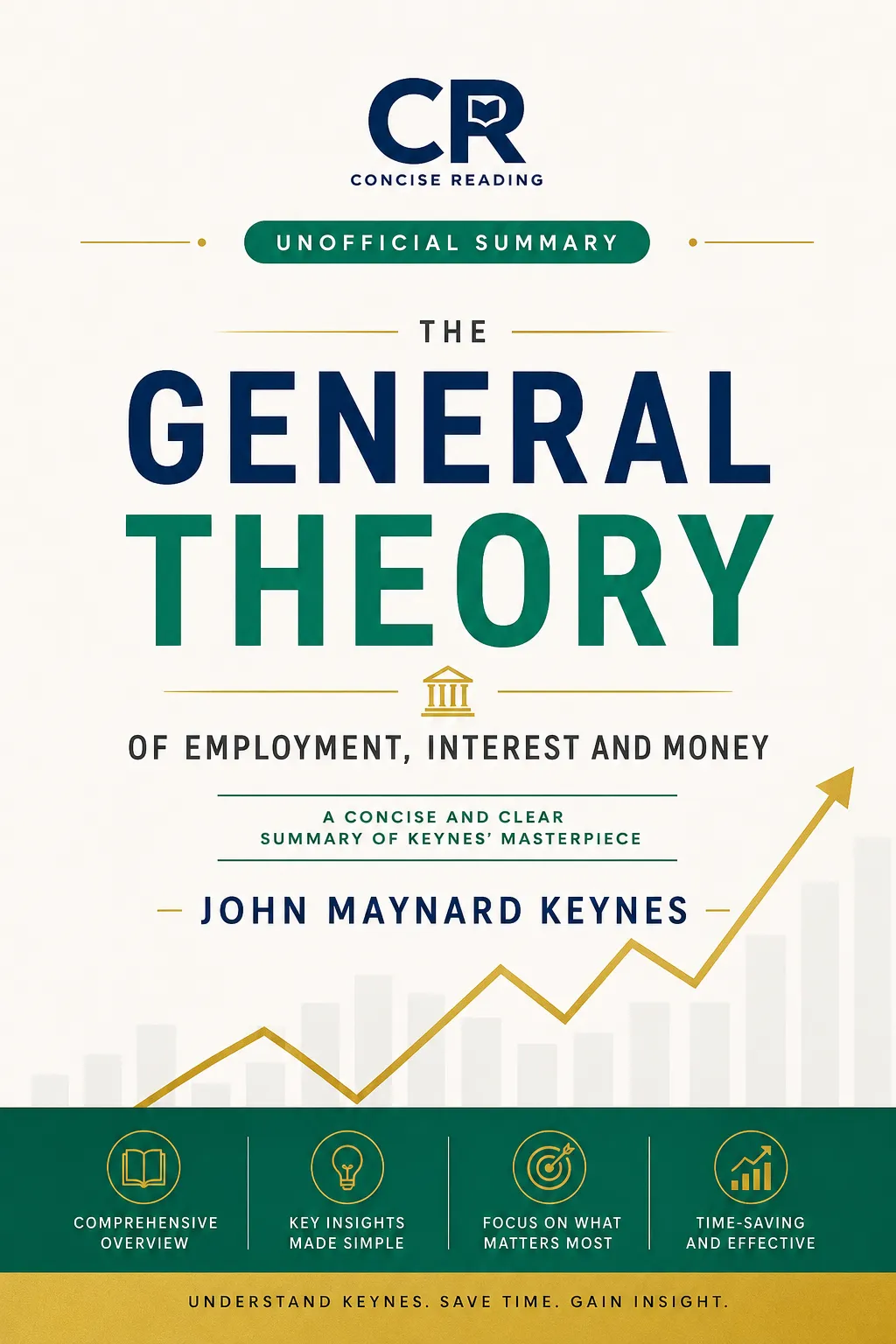
The General Theory by John Maynard Keynes — Summary & Key Lessons
What this book will teach you in the next 10 minutes — and why it matters for your business, investments, and understanding of every economic decision governments make today.
Read by economists, investors, and business owners in 40+ countries. Summarized without jargon. Verified against the original text.
Book Snapshot
- Author – John Maynard Keynes
- Category – Economics / Macroeconomics / Economic Theory
- Original Book – ~ 472 pages. Average read time: 18 to 22 hours for a careful, analytical read.
- Free Summary – 09 pages
- Premium Summary – 36 pages. Estimated read time: 45 to 60 minutes.
The Big Idea
In 1936, at the height of the Great Depression, Keynes did something radical — he proved the rulebook was wrong. Classical economists insisted markets self-correct and unemployment fixes itself. Keynes looked at millions of people out of work for years and said: the mechanism is broken. His argument was simple and devastating: it is demand — what people and businesses actually spend — that drives output and employment, not supply or productive capacity. When confidence collapses and spending stops, economies stall. And they stay stalled. Nothing automatically rescues them. That single insight reshaped how every government on earth manages its economy, and it explains every recession, stimulus package, and interest rate decision you have read about since.
What You’ll Learn — Key Lessons Preview
- You will understand exactly why recessions persist long after they “should” have ended — and what Keynes proved has to happen before they stop.
- You will grasp the Paradox of Thrift: why saving more individually, when everyone does it at once, makes the entire economy poorer — and why this trap still catches governments off guard.
- You will see how animal spirits — raw business confidence and market psychology — drive investment decisions more powerfully than any interest rate, and what that means for your own capital allocation.
- You will learn why central bank rate cuts sometimes generate zero new investment (the liquidity trap), and how to recognize when monetary policy has run out of ammunition before the headlines tell you.
- You will walk away with a mental model that connects government budget decisions, central bank announcements, and market behavior into a single coherent framework — so economic news stops feeling random.
Free vs Premium Comparison
| Free – $0 | Premium – $4.99 (Recommended) |
| ➡ Book Snapshot ➡ The Big Idea ➡ Key Lessons ➡ Power Quotes ➡ 09 Pages | ✔ Everything in free + ✔ Full Chapter Breakdown ✔ Key frameworks & diagrams ✔ Action steps ✔ Critical analysis ✔ One-page cheat sheet ✔ 36 pages |
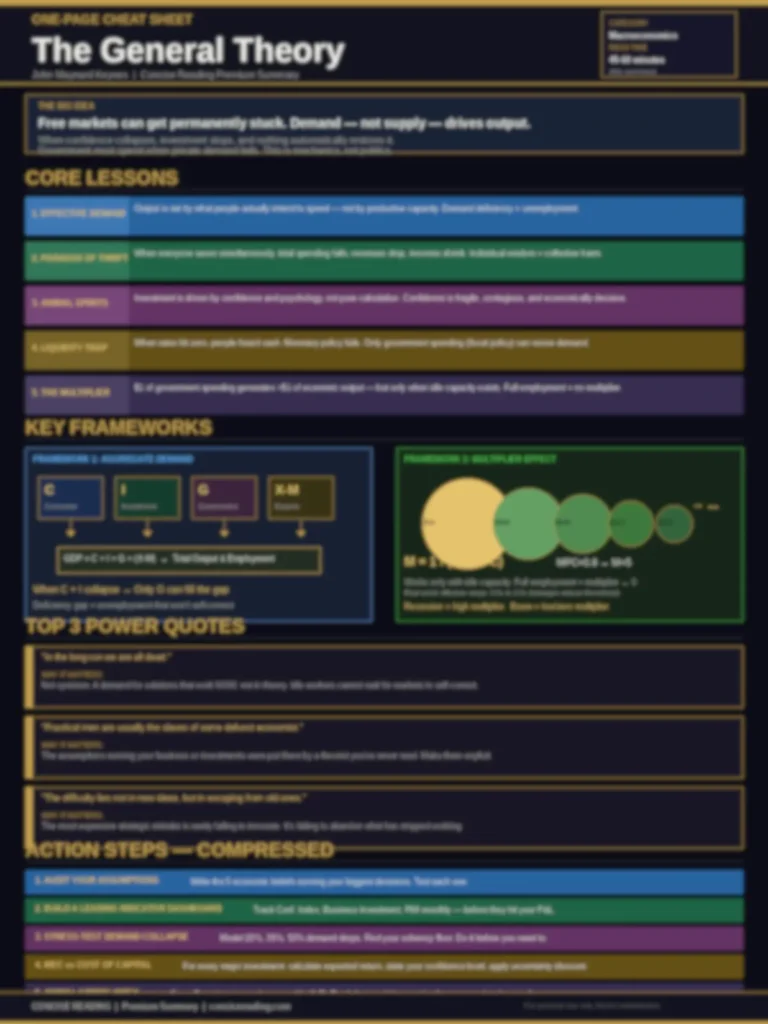
Premium Cheat Sheet Preview
About the Author
John Maynard Keynes (1883–1946) was a British economist, senior Treasury official, and lead architect of the post-war Bretton Woods international monetary system. He advised the British government through two World Wars, successfully managed investment portfolios through multiple market crises, and represented Britain at the Paris Peace Conference. His frameworks — aggregate demand, the multiplier, liquidity preference — form the theoretical backbone of modern macroeconomics and remain the primary lens through which economists and policymakers analyze recessions today.
Power Quote From the Book:
“Practical men, who believe themselves to be quite exempt from any intellectual influences, are usually the slaves of some defunct economist.”
— John Maynard Keynes, The General Theory
Who This Summary is For
- This is for you if…
- You are a business owner who reads financial news daily but lacks a coherent framework to connect what you are seeing to what it means for your revenue, hiring, or pricing decisions.
- You are an investor who understands markets technically but wants the theoretical foundation that explains why central bank decisions move markets the way they do.
- You are an entrepreneur building a business across an economic cycle and you need to understand what recession risk actually means and what policy responses to expect.
- You want to understand modern economics at the level where you can evaluate stimulus debates, inflation arguments, and interest rate decisions yourself — not just absorb headlines.
- You are a student, professional, or serious reader who wants to engage with one of the most consequential books ever written without fighting through 472 pages of academic prose.
- Skip this if…
- You are looking for personal finance tactics, investing tips, or advice about your own money. This book contains none of that. If that is your goal right now, our summary of The Intelligent Investor or The Psychology of Money is the right starting point — you can always return to Keynes once you have the personal finance foundation in place.
Social Proof
We do not pad this section with manufactured praise. If you have read this summary — free or premium — we want to hear what you actually think. Did it change how you read economic news? Did a framework click that never clicked before? Did something not land the way you expected? Leave your honest reaction in the comments below. Concise Reading is built on the premise that readers who engage seriously with ideas have something worth saying — and your feedback shapes how we write every summary after this one. The first comment on a new summary is always the most valuable.
The General Theory took Keynes the better part of a decade to develop, builds its argument across 24 dense academic chapters, and changed the economic operating system of the entire world — the Premium Summary gives you the complete framework, four visual diagrams, five action steps precise enough to be uncomfortable, and a one-page cheat sheet worth pinning to your wall, all in 36 pages.
Related Summaries
- The Wealth of Nations by Adam Smith — Keynes was explicitly arguing against the classical tradition that Smith founded. Reading both gives you the full intellectual debate that has shaped every economic policy decision for 250 years. You cannot fully understand Keynes without understanding what he was pushing back against.
- Animal Spirits by George Akerlof and Robert Shiller — Akerlof and Shiller took Keynes’s concept of animal spirits and built a modern behavioral economics framework around it. This book is the contemporary extension of the most psychologically sophisticated part of Keynes’s argument.
- End This Depression Now! by Paul Krugman — Krugman is the most prominent contemporary Keynesian economist. This book applies Keynes’s framework directly to the 2008 crisis and its aftermath, making the General Theory’s abstract arguments concrete, current, and immediately applicable.