The Strategy Playbook: How to Diagnose Your Competitive Position, Make Sharper Decisions, and Build a Strategy Your Competitors Cannot Easily Destroy
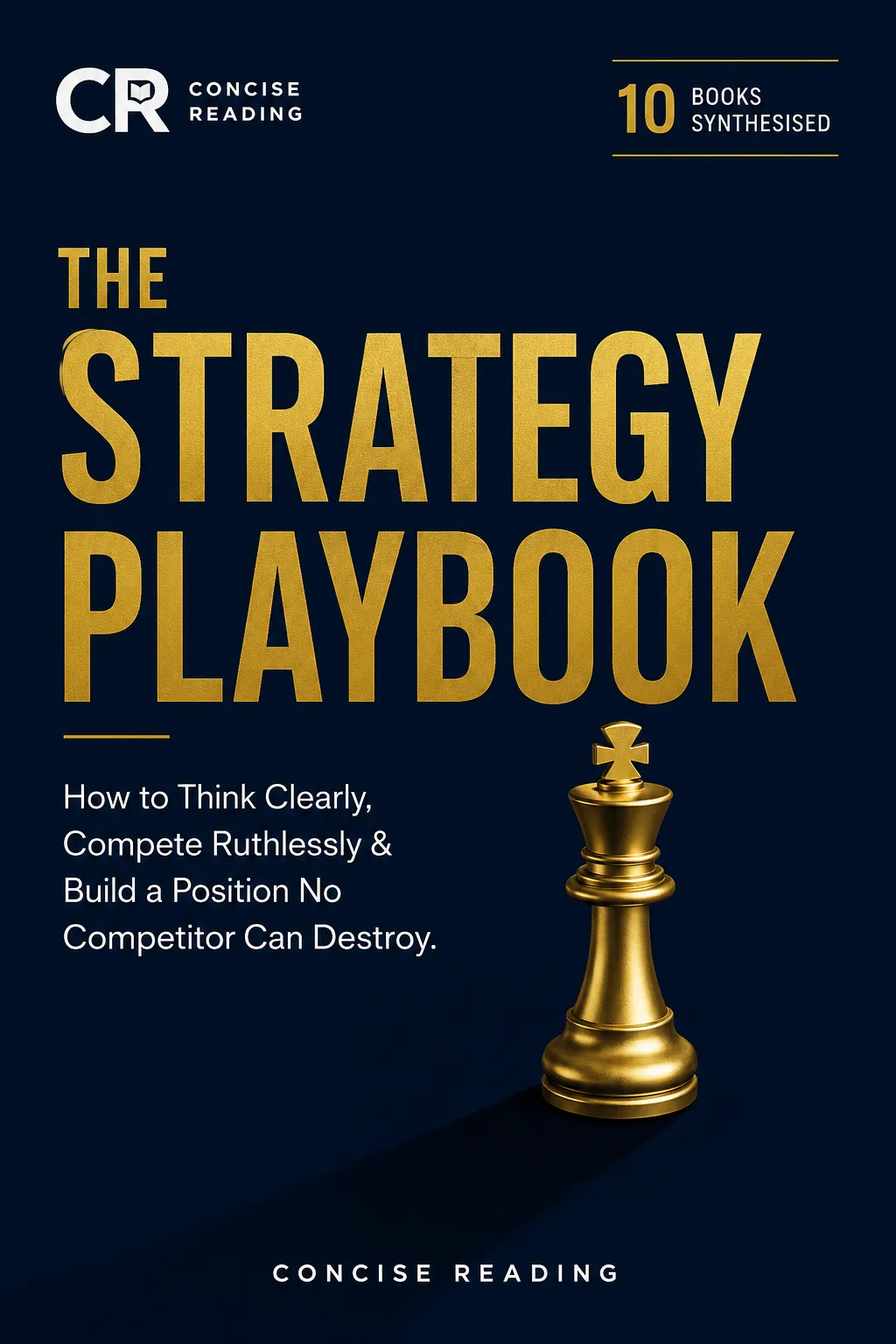
Synthesised from 10 strategy classics — Good to Great (Jim Collins) · Blue Ocean Strategy (Kim & Mauborgne) · Competitive Strategy (Michael Porter) · Good Strategy Bad Strategy (Richard Rumelt) · The Art of War (Sun Tzu) · Thinking in Bets (Annie Duke) · Built to Last (Collins & Porras) · The Innovator’s Dilemma (Clayton Christensen) · Execution (Bossidy & Charan) · Measure What Matters (John Doerr) — into one complete, executable strategy system.
- 10 books synthesized
- 90 pages
- 6 complete frameworks
- 1 master execution plan
- Instant download
- PDF + printable formats
The Problem — Agitate Before You Solve
Most people who want to think more strategically have done everything right. You have read the books — or at least started them. You know what Porter’s Five Forces are. You have heard of Blue Ocean Strategy. You understand at an intellectual level that good strategy requires diagnosis, not just goals. And yet, when you sit down on Monday morning and ask “what is our actual strategy, and is it working?” — the answer is murkier than it should be.
Here are the three specific frustrations that most strategy readers share. You have read bits of these books but never had a clear, connected system for using what you learned. You know the theory — the competitive positioning, the OKRs, the disruption frameworks — but you do not have a step-by-step process for applying any of them in sequence. And every time you finish a great strategy book, you feel temporarily energised, then slowly watch that clarity dissolve into the noise of your next week.
The problem is not that good information does not exist — 10 brilliant books cover everything you need to know about strategy. The problem is that none of them tells you how to use them all together. Porter does not hand you to Doerr. Collins does not connect to Christensen. Every great strategy book solves a piece of the problem and leaves the rest for you to figure out alone. This Playbook is what happens when all ten pieces are assembled into one system — in the right order, with the right bridges between them, and with a six-week plan to implement everything immediately.
What is a Playbook ?
A Concise Reading Playbook is not a collection of separate summaries.
It is one unified guide — written by us, powered by insights from 10 books — that takes you from the problem to a complete executable system. Every chapter synthesises multiple books around one specific strategic challenge you face. The result is a guide that replaces ten books — not just summarises them. You do not need to read any of the source books first. You do not need to have read any of them at all. Everything you need is here, in one sequence, building toward one outcome.
If you want to understand what separates a Playbook from anything else in our library, this table makes it clear:
Comparison
| Free Summary | Premium Pack | This Playbook | |
|---|---|---|---|
| Book Insights | Single Book(15–25 pp) | Multiple Books | 10 Books |
| Synthesis Across Books | No | Partial | Full |
| Unified System | No | No | Yes |
| Chapter-by-Chapter Application | No | Partial | Yes |
| 6-Week Master Action Plan | No | No | Yes |
| Master Reference Sheet | No | No | Yes |
| Price | Free | $27 – $37 | $37 |
The Playbook is priced above our individual summaries because it is a fundamentally different product. You are not paying for ten summaries bundled together. You are paying for the synthesis, the sequence, the system, and the six weeks of implementation that none of the individual books — and none of the individual summaries — provides on their own.
If you want individual deep-dives into the source books after completing this Playbook, our Business Strategy & Execution Premium Pack contains 14 detailed summaries including all ten source books, available separately at $34.
Table of Contents — Full Chapter Breakdown
Chapter 1: How to See Your Competitive Reality Clearly Before You Make a Single Strategic Move The foundation chapter. Before you can build a strategy, you must see your actual situation — not the one you wish you were in. This chapter installs the diagnostic lens every subsequent chapter depends on. Books drawn from: Good Strategy Bad Strategy — Richard Rumelt | Competitive Strategy — Michael E. Porter | The Art of War — Sun Tzu
Chapter 2: How to Build a Competitive Position So Differentiated That Price Becomes Irrelevant The first principle chapter. Once you can see clearly, the first concrete task is to design a position that makes direct comparison to competitors structurally difficult. This chapter gives you the tools to do that. Books drawn from: Blue Ocean Strategy — W. Chan Kim & Renée Mauborgne | Competitive Strategy — Michael E. Porter | Good Strategy Bad Strategy — Richard Rumelt
Chapter 3: How to Make Strategic Decisions Under Uncertainty Without Letting Luck Destroy Your Thinking Most strategies fail not because they were wrong, but because the decision-making process that created them was broken. This chapter fixes that process. Books drawn from: Thinking in Bets — Annie Duke | The Art of War — Sun Tzu | Good Strategy Bad Strategy — Richard Rumelt
Chapter 4: How to Identify What Will Make Your Organisation Great — And Build the Internal Architecture to Protect It You now have a position and a decision-making process. This chapter turns inward: what are the specific internal qualities, disciplines, and structural choices that compound into lasting greatness? Books drawn from: Good to Great — Jim Collins | Built to Last — Jim Collins & Jerry Porras | Execution — Larry Bossidy & Ram Charan
Chapter 5: How to Spot the Disruption Coming for Your Strategy Before It Arrives — and Move First The advanced threat chapter. Once you have built something good, the danger becomes the disruption you do not see. This chapter teaches you to look for what your success is making you blind to. Books drawn from: The Innovator’s Dilemma — Clayton M. Christensen | Blue Ocean Strategy — W. Chan Kim & Mauborgne | Built to Last — Jim Collins & Jerry Porras
Chapter 6: How to Execute Your Strategy with the Precision and Accountability of a World-Class Organisation Knowing and doing are different disciplines. This chapter closes the gap — giving you the specific systems, behaviours, and accountability structures that turn strategic intent into measurable results. Books drawn from: Execution — Larry Bossidy & Ram Charan | Measure What Matters — John Doerr | Good to Great — Jim Collins
Chapter 7: How to Integrate Every Layer of Strategy Into One System You Can Run, Measure, and Improve Every Quarter The synthesis chapter. All six preceding chapters have added a layer. This chapter shows you how the layers connect, where they depend on each other, and how to run the entire system as one unified operating rhythm — not six separate initiatives. Books drawn from: All 10 source books | Primary synthesis: Measure What Matters — John Doerr | Good Strategy Bad Strategy — Richard Rumelt | Execution — Larry Bossidy & Ram Charan
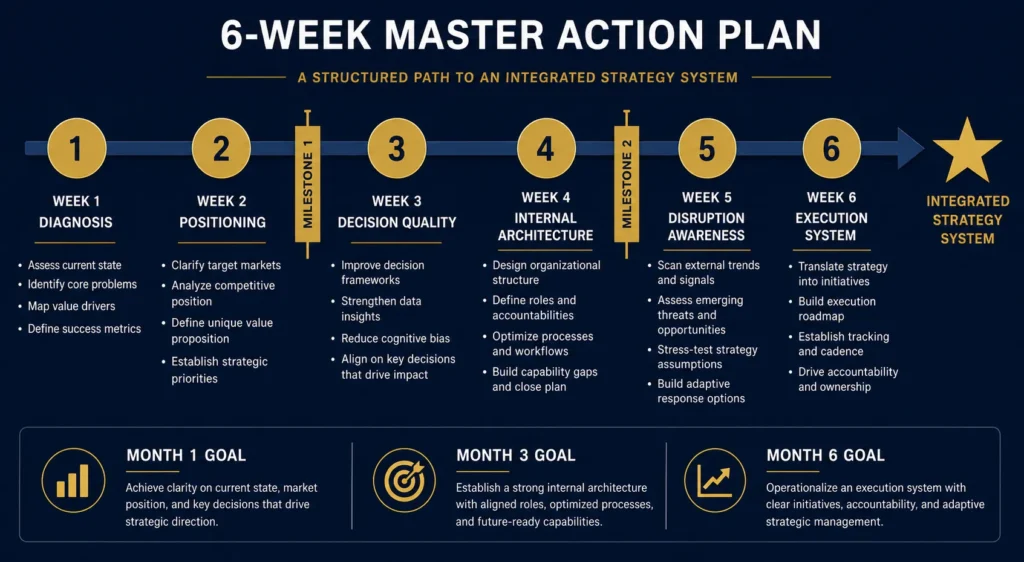
The Master Action Plan
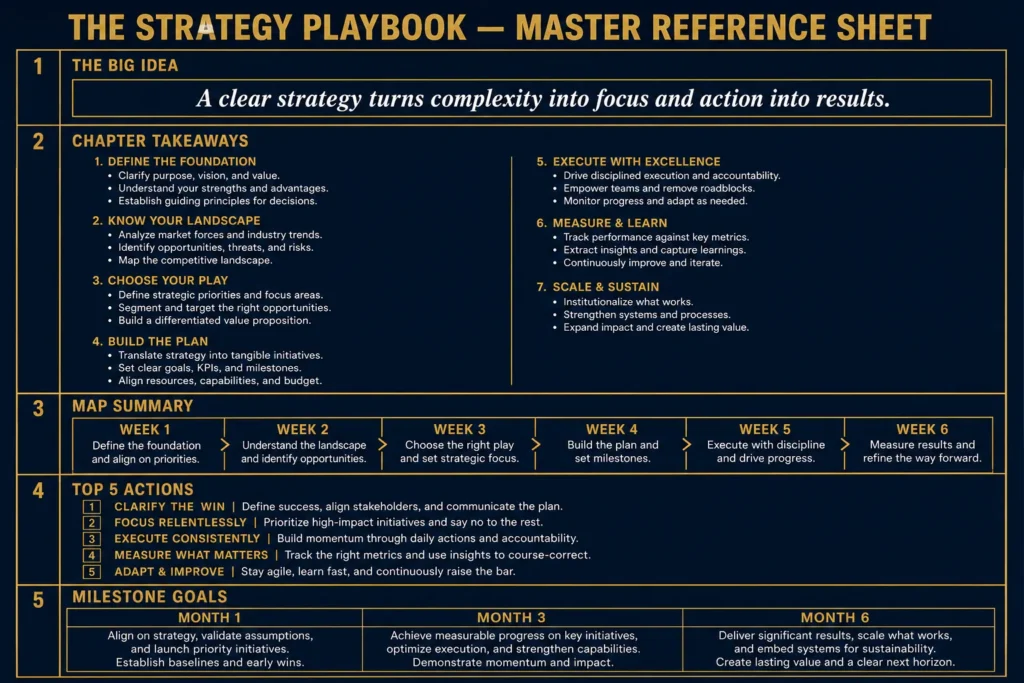
Master Reference Sheet
Books Behind This Playbook
Every book included in this Playbook was selected for a specific reason. Here is exactly what each one contributes:
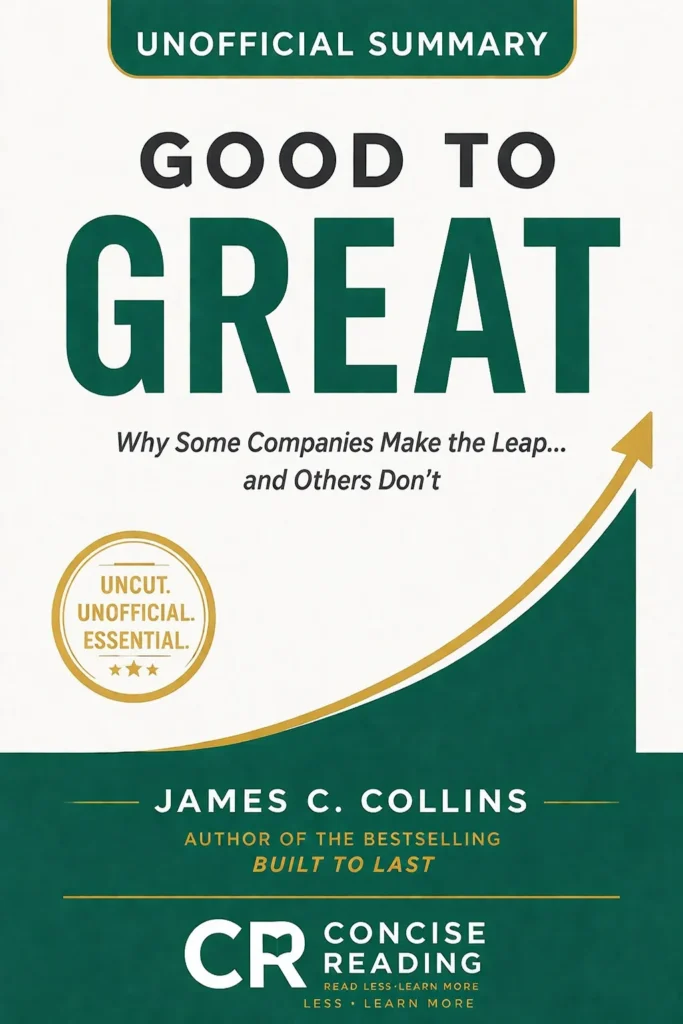
- Good to Great — Jim Collins
- Reveals the specific internal disciplines, leadership behaviours, and decision-making patterns that separate organisations producing sustained exceptional results from those that peak and plateau.
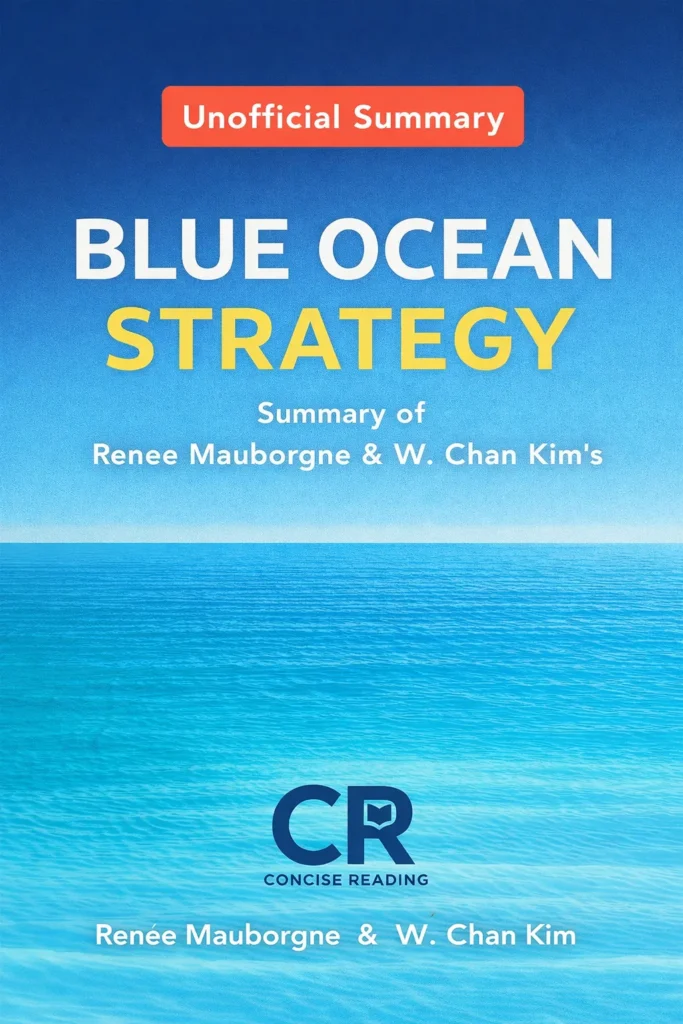
- Blue Ocean Strategy — W. Chan Kim & Renée Mauborgne
- Provides the framework for designing a competitive position so differentiated that direct price comparison with your competitors becomes structurally difficult.
- Competitive Strategy — Michael E. Porter
- Delivers the foundational architecture of how industries work and why some positions within them generate structural advantage — the Five Forces and three generic strategies that define every company’s competitive reality.
- Good Strategy Bad Strategy — Richard Rumelt
- The most honest book ever written about what strategy actually is versus what most organisations pretend it is — defines the diagnostic kernel that this entire Playbook is built around.
- The Art of War — Sun Tzu
- Installs the strategic mindset — the posture of knowing your terrain, your enemy, and yourself before a single move is made. The mental foundation everything else in this Playbook rests on.
- Thinking in Bets — Annie Duke
- Reframes strategic decision-making as a probabilistic discipline rather than an outcome-based one — the most underrated strategy book of the last decade, and the one most likely to permanently change how you judge your own decisions.
- Built to Last — Jim Collins & Jerry Porras
- Identifies the architectural principles — core ideology, BHAGs, and building the clock rather than telling the time — that distinguish visionary companies built to last from companies merely built to perform.
- The Innovator’s Dilemma — Clayton M. Christensen
- Explains with uncomfortable precision why successful companies consistently fail to respond to disruptive threats — and why your current success may be the very thing making you blind to your most dangerous competitor.
- Execution — Larry Bossidy & Ram Charan
- Provides the discipline of execution — the specific people processes, strategy processes, and operating behaviours that close the gap between what a strategy says on paper and what actually happens in the real world.
- Measure What Matters — John Doerr
- Delivers the OKR system used by Google, Intel, and dozens of world-class organisations to align entire teams around the right priorities and make progress on what actually matters measurable and visible.
You have probably been meaning to read several of these books for years. This Playbook is the faster, more structured path to the insights you were already looking for — and if any chapter makes you want to go deeper into a specific source book, the Recommended Deep Dives section tells you exactly which chapters to read next.
Specific Outcomes — What You’ll Be Able To Do
After working through The Strategy Playbook and completing the 6-Week Master Action Plan, here is what specifically changes:
You will be able to complete a full strategic implementation cycle in 6 weeks — not as a theoretical exercise but as a working system with real outputs, real OKRs, and a real review cadence you will still be running six months from now.
You will be able to diagnose your competitive position with clarity — using a structured three-part framework that identifies the actual obstacle your organisation faces, not the symptom you have been treating.
You will be able to design a differentiated market position using the Four Actions Framework and Value Curve — one specific enough that your closest competitor could not honestly copy-paste your positioning statement and have it be true for them.
You will be able to make strategic decisions using a process-based framework that separates decision quality from outcome quality — so that a run of bad luck cannot make you abandon a sound strategy, and a run of good luck cannot make you overlook a broken process.
You will be able to identify the specific internal qualities — your Hedgehog Concept, your BHAG, your execution gaps — that determine whether your organisation can actually sustain a great strategy over time, not just articulate one.
You will be able to map the disruptive threats currently below your radar — the low-end competitors and non-consumer markets that your current success is causing you to underestimate — and build a response before the window closes.
You will be able to set and run OKRs — Objectives and Key Results — at the annual and quarterly level, aligned to your strategic position, with a review cadence that makes course-correction fast and accountability unavoidable.
You will be able to build and run a complete integrated Strategy Document — a single eight-section reference that contains your diagnosis, positioning, decision framework, internal architecture, disruption map, OKRs, and review schedule in one place.
You will be able to run a quarterly strategy review using a structured agenda that tells you whether you are on track, where you are drifting, and what to do about it — before the drift becomes a crisis.
You will be able to explain your strategy in three sentences — and have every person in your organisation able to repeat it back accurately. That clarity alone is rarer than most strategy consultants will admit.
Pricing
What it would cost otherwise
$ 150 +
- 10 original books at Avg. $15 each
- Plus months of reading time
- Plus no synthesis
- Plus no action plan
This Playbook
$ 37
- One-time. Yours forever.
- All 10 books synthesized
- 6 original frameworks
- Master 6-week action plan
- Instant PDF download
Instant download · PDF & printable · Use on any device · One-time payment
Testimonials
Have you read The Strategy Playbook?
If you have worked through this Playbook — or even just completed the first few chapters — your experience is genuinely useful to other readers deciding whether to invest. What changed in how you think about your competitive position? Which chapter hit hardest? How far have you got with the Master Action Plan?
Leave a comment below. We read every one. And if you are the first person to share your honest experience with this Playbook, that matters — early feedback shapes how we improve every edition we publish. There are no planted reviews here. Only real ones, from real readers, when they are ready to share.
FAQs
- Q: What makes this different from your premium packs? → A pack is 10-15 individual summaries on the same topic. The playbook is one unified guide that synthesizes all of them into a complete system with a master action plan. Think of the pack as individual songs and the playbook as the album — one coherent journey.
- Q: Do I need to read the original books first? → No. The playbook is completely standalone.
- Q: How is this different from Blinkist? → Blinkist gives you short summaries of individual books. This playbook does not summarize books — it synthesizes them. Every chapter uses 2–4 books to answer one specific question you face. The result is an original system, not a summary service.
- Q: How long will it take to read? → The full playbook is designed to be read in one weekend and implemented over 6 weeks using the Master Action Plan.
- Q: What format? → PDF. Readable on any device. Designed for printing if preferred.
Ten of the world’s best strategy books, synthesised into one system you can start using this weekend. The 6-Week Master Action Plan gives you your first six weeks of implementation — day by day, action by action, with done-when criteria for every task so you always know exactly where you are. The diagnosis frameworks, the positioning tools, the decision-making process, the execution system — all of it is here, in sequence, ready to use. The books have been read. The system has been built. Everything else is up to you.
Not sure which product is right for you? Visit our Start Here page — we will point you to the right place in under two minutes. Want to browse the full library first? Explore all summaries, packs, and playbooks.