The Investing Playbook: How to Build a Complete Investing System, Choose the Right Assets, and Compound Wealth Intelligently — For the Long Term
Benjamin Graham + Morgan Housel + John C. Bogle + Warren Buffett + Peter Lynch + Philip Fisher + Burton Malkiel + Annie Duke — synthesised from 10 investing classics into one complete, executable system that replaces years of scattered reading.
- 10 books synthesized
- 124 pages
- 6 complete frameworks
- 1 master execution plan
- Instant download
- PDF + printable formats
The Problem — Agitate Before You Solve
You already know you should be investing. You have known for a while. The problem is not motivation — it is the fact that every time you try to build a clear investing approach, something gets in the way.
You have read bits of these books but never had a clear system to actually use what you learned. You read The Intelligent Investor and understood the concept of margin of safety, but you have never actually calculated one. You read The Psychology of Money and agreed with everything Morgan Housel said, but you still panic-checked your portfolio three times during the last market correction. You know that index funds outperform most active managers — and you still have not set up automatic contributions.
You know the theory. You do not have a step-by-step process.
The problem is not that good information does not exist. Ten of the best investing books ever written cover everything you need to know. The problem is that none of them tells you how to use them all together. Benjamin Graham does not tell you how to manage your psychology. Morgan Housel does not tell you how to build a portfolio. John Bogle does not tell you how to evaluate an individual company. The knowledge is scattered across ten separate books — each making a partial argument — and nobody has built the system they collectively point to.
Until now.
What is a Playbook ?
This is not a summary collection. It is a system.
A Concise Reading Playbook is not a set of separate summaries placed side by side. It is one unified guide — written by us, powered by insights from 10 books — that takes you from the problem to a complete, executable investing system. Every chapter synthesises multiple books around one specific challenge you face as an investor. The result is a single guide that replaces 10 books — not by cutting corners, but by extracting exactly what each book contributes and connecting those contributions into one continuous argument.
By the time you reach the final page, you will not just know more about investing. You will have a written investing philosophy, a portfolio construction model, a company research methodology, a valuation checklist, and a 6-week action plan — built from the best thinking across a decade of investing literature.
Here is how this Playbook compares to other formats on the market:
Comparison
| Free Summary | Premium Pack | This Playbook | |
|---|---|---|---|
| Book Insights | Single Book(15–25 pp) | Multiple Books | 10 Books |
| Synthesis Across Books | No | Partial | Full |
| Unified System | No | No | Yes |
| Chapter-by-Chapter Application | No | Partial | Yes |
| 6-Week Master Action Plan | No | No | Yes |
| Master Reference Sheet | No | No | Yes |
| Price | Free | $27 – $37 | $37 |
If you want deep summaries of each book individually, the Investing Fundamentals Pack gives you 12 premium summaries for $29. If you want one unified system built from all of them, you are in the right place.
Table of Contents — Full Chapter Breakdown
These chapters are not independent. They form a single argument that builds from the inside out — from how you think, to what you buy, to how you manage it over time. Here is the spine of that argument:
Chapter 1 establishes the only real edge in investing: your behaviour. Chapter 2 asks: if behaviour is your edge, what financial foundation must you build before investing at all? Chapter 3 answers: now that your foundation exists, what does the evidence actually say about how to invest? Chapter 4 asks the harder question: when does passive investing not fully serve you, and how do you build a real portfolio? Chapter 5 goes deeper: if you are going to pick individual stocks at all, how do you find the right ones? Chapter 6 asks: how do you know what a good business is actually worth? Chapter 7 brings everything together: how do you build, manage, and protect a complete long-term wealth system without making the decisions that destroy it?
Chapter 1: How to Rewire Your Relationship with Money Before You Invest a Single Dollar The foundation chapter — sets the mindset framework everything else depends on
Most investing mistakes are not analytical failures. They are behavioural ones. Before you learn how to pick a stock or build a portfolio, you need to understand why intelligent people consistently destroy wealth through panic selling, overconfidence, recency bias, and the confusion of luck with skill. This chapter installs the psychological operating system every investor needs.
Books drawn from: The Psychology of Money (Morgan Housel) | Thinking in Bets (Annie Duke)
Bridge to Chapter 2: Once you understand that behaviour is your primary risk, the next question becomes: what does your financial life actually look like right now — and is it even ready for investing?
Chapter 2: How to Build the Financial Foundation That Makes Investing Work First principle / first action — the pre-investing infrastructure
You cannot build long-term wealth by investing money you need next month. This chapter gives you the framework to assess your current financial position, establish an emergency fund, eliminate destructive debt, and calculate exactly how much you can invest — consistently and sustainably — before touching a single asset class.
Books drawn from: The Psychology of Money (Morgan Housel) | The Bogleheads’ Guide to Investing (Larimore, Lindauer & LeBoeuf)
Bridge to Chapter 3: With a financial foundation in place, the question becomes: what does the evidence say is the most reliable investing strategy for someone starting from here?
Chapter 3: How to Beat 90% of Professional Fund Managers Without Picking a Single Stock First building block — the index fund case
The data is not subtle: the majority of actively managed funds underperform their benchmark index over a 15-year period. This chapter walks you through the evidence, explains why the market is harder to beat than almost anyone admits, and shows you exactly how to build a low-cost, diversified index portfolio that compounds reliably over decades.
Books drawn from: The Little Book of Common Sense Investing (John C. Bogle) | A Random Walk Down Wall Street (Burton G. Malkiel) | The Bogleheads’ Guide to Investing (Larimore, Lindauer & LeBoeuf)
Bridge to Chapter 4: The index fund strategy is the baseline. But some investors want to go further — to find and hold exceptional individual businesses. Chapter 4 introduces the framework for doing that without abandoning discipline.
Chapter 4: How to Identify Exceptional Businesses Worth Owning for the Long Term Building block — the qualitative business analysis framework
Not all stocks are equal. Some businesses compound wealth for decades. Most do not. This chapter teaches you how to evaluate a company the way Buffett and Fisher do — by analysing its competitive moat, management quality, growth runway, and business economics — before a single number is crunched.
Books drawn from: Common Stocks and Uncommon Profits (Philip A. Fisher) | The Essays of Warren Buffett (Warren Buffett) | One Up on Wall Street (Peter Lynch)
Bridge to Chapter 5: Knowing what makes a great business is step one. Step two is knowing how to find those businesses — and how to recognize them when they are hiding in plain sight.
Chapter 5: How to Find Stocks Worth Buying Before the Market Prices Them Correctly Building block — the stock selection and research methodology
Peter Lynch built one of the greatest investment track records in history by finding great companies in everyday life before Wall Street noticed them. This chapter teaches you his observation-based research method, Fisher’s Scuttlebutt technique, and how to combine both into a personal stock research process that gives individual investors a genuine edge over institutions.
Books drawn from: One Up on Wall Street (Peter Lynch) | Common Stocks and Uncommon Profits (Philip A. Fisher) | The Warren Buffett Way (Robert G. Hagstrom)
Bridge to Chapter 6: Finding a great business is not enough. You must also know what it is worth — and refuse to pay more than that. Chapter 6 introduces the valuation frameworks that prevent you from buying right companies at wrong prices.
Chapter 6: How to Value Any Business and Know Exactly When the Price Is Right Advanced application — valuation and margin of safety
Overpaying for a great business is one of the most common and costly mistakes intelligent investors make. This chapter teaches you Graham’s margin of safety principle, Buffett’s owner earnings framework, and Lynch’s PEG ratio — giving you a practical toolkit for estimating intrinsic value and only buying when the price offers a genuine discount.
Books drawn from: The Intelligent Investor (Benjamin Graham) | The Warren Buffett Way (Robert G. Hagstrom) | The Essays of Warren Buffett (Warren Buffett)
Bridge to Chapter 7: You can now identify great businesses, find them through research, and buy them at the right price. The final question is: how do you manage everything — index funds, individual stocks, risk, taxes, and long-term decisions — as one coherent, enduring wealth system?
Chapter 7: How to Build, Protect, and Manage a Complete Wealth-Compounding Portfolio for Life Synthesis chapter — the unified long-term wealth system
This is where everything comes together. This chapter synthesises the passive and active strategies from all previous chapters into a single portfolio architecture — showing you how to allocate between index funds and individual holdings, how to rebalance without making emotionally driven errors, how to protect against catastrophic risk, and how to make high-quality decisions under uncertainty using probabilistic thinking. By the end of this chapter, you will have a complete, personal investing system.
Books drawn from: The Intelligent Investor (Benjamin Graham) | The Psychology of Money (Morgan Housel) | Thinking in Bets (Annie Duke) | The Bogleheads’ Guide to Investing (Larimore, Lindauer & LeBoeuf) | The Little Book of Common Sense Investing (John C. Bogle)
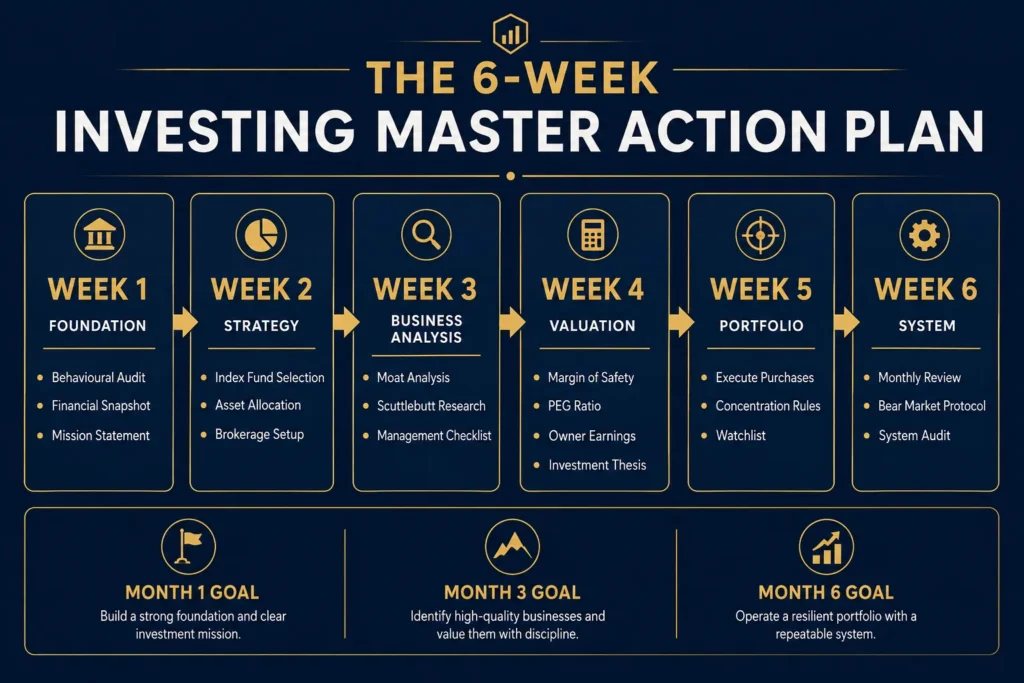
The Master Action Plan
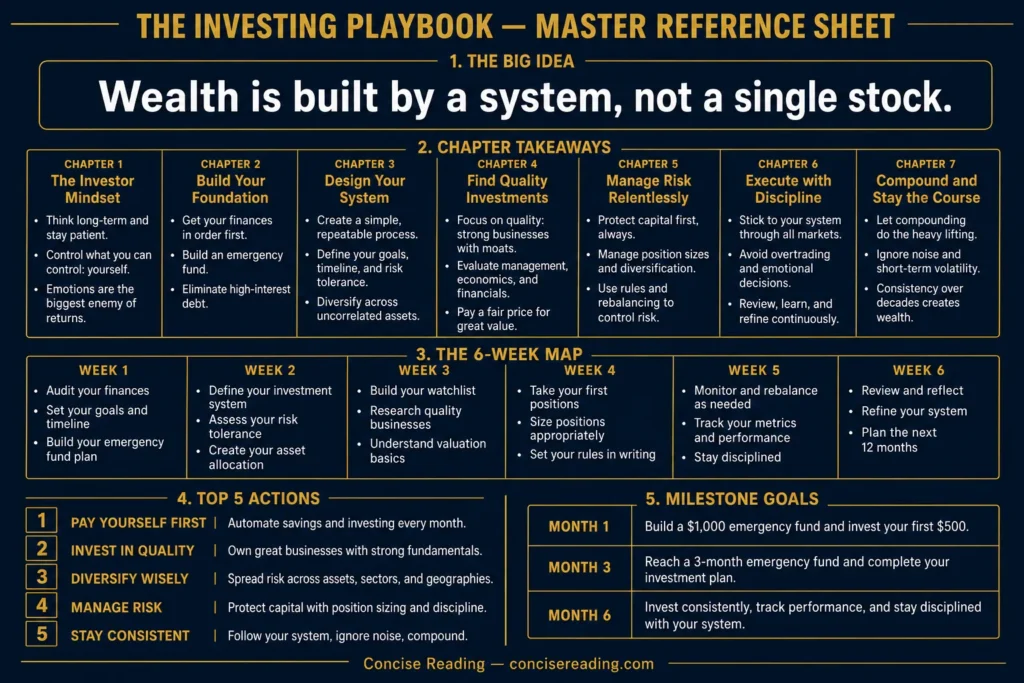
Master Reference Sheet
Books Behind This Playbook
These are the 10 books this Playbook synthesizes — and exactly what each one contributes to the system you are about to build.
- The Intelligent Investor — Benjamin Graham
- The foundational text of value investing. Graham’s concepts of intrinsic value, margin of safety, and Mr. Market form the philosophical and analytical bedrock of Chapters 6 and 7.
- The Psychology of Money — Morgan Housel
- The most important book on why intelligent people make financially destructive decisions. Housel’s behavioural framework powers Chapters 1 and 2 — the foundation everything else depends on.
- A Random Walk Down Wall Street — Burton G. Malkiel
- The academic case for market efficiency and passive investing. Malkiel’s evidence on active fund underperformance is central to the argument in Chapter 3.
- The Bogleheads’ Guide to Investing — Larimore, Lindauer & LeBoeuf
- The most practical implementation guide for Bogle’s index fund philosophy. Its three-fund portfolio model and personal finance framework are the structural backbone of Chapters 2 and 3.
- One Up on Wall Street — Peter Lynch
- Lynch’s argument that individual investors have genuine informational advantages over institutions — and his stock category taxonomy — drives the research methodology in Chapter 5.
- Common Stocks and Uncommon Profits — Philip A. Fisher
- Fisher’s Scuttlebutt method and 15-point business evaluation checklist provide the qualitative research framework used in Chapters 4 and 5.
- The Essays of Warren Buffett — Warren Buffett (ed. Lawrence Cunningham)
- Buffett’s philosophy in his own words — the clearest direct source for understanding business quality, management evaluation, and long-term capital allocation. Runs through Chapters 4, 6, and 7.
- The Warren Buffett Way — Robert G. Hagstrom
- Hagstrom reverse-engineers Buffett’s actual investment decisions into a replicable analytical framework. His treatment of owner earnings and business tenets anchors Chapter 6’s valuation methodology.
- Thinking in Bets — Annie Duke
- Duke’s probabilistic thinking framework and decision-quality analysis address the cognitive layer most investing books completely ignore. Essential to Chapters 1 and 7.
- The Little Book of Common Sense Investing — John C. Bogle
- The definitive, data-backed case for low-cost index investing. Bogle’s cost-matters hypothesis and long-term compounding data are the baseline against which every other strategy in this Playbook is measured.
These are not books selected for name recognition. Each one was chosen because it fills a specific gap the others leave open. Together, they cover investing psychology, passive strategy, business analysis, stock research, valuation, and portfolio management — the complete system. If you want deep individual summaries of each, you can find them in the Investing Fundamentals category or the Investing Fundamentals Pack.
Specific Outcomes — What You’ll Be Able To Do
These are not aspirational promises. They are the specific capabilities you will have built by the final page of this Playbook — provided you complete the Chapter Action Plans.
- You will be able to identify your own behavioural risk profile as an investor — the specific psychological patterns (panic selling, trend-chasing, overconfidence) most likely to destroy your returns — and apply a written protocol to manage them before they cost you money.
- You will be able to calculate your exact monthly investing number — the amount you can invest consistently and sustainably based on your real financial position, not an aspirational target — and build the infrastructure to make it automatic.
- You will be able to construct a globally diversified, low-cost index portfolio using the three-fund framework, select funds by expense ratio and coverage, and set up automatic contributions that do not require you to make a single emotional decision each month.
- You will be able to evaluate any business qualitatively — identifying its competitive moat, assessing management quality, and judging its long-term growth runway — before looking at a single financial metric, using Fisher’s Scuttlebutt method and Buffett’s management framework.
- You will be able to conduct a full stock research process using Peter Lynch’s observation-based method and Philip Fisher’s investigative approach — researching a company through customers, employees, competitors, and its own investor materials — and produce a formal one-page qualitative company profile.
- You will be able to estimate the intrinsic value of any publicly traded company using Graham’s margin of safety principle, Lynch’s PEG ratio, and Buffett’s owner earnings framework — and know exactly at what price that company becomes a genuinely intelligent purchase.
- You will be able to write a formal investment thesis — a structured document that records your qualitative analysis, quantitative valuation, and buy/watch/pass decision — creating a written record that allows you to review and improve your analytical accuracy over time.
- You will be able to build and manage a complete portfolio architecture — combining an index core with a disciplined individual stock allocation policy, a written rebalancing schedule, and a watchlist with price alert triggers — that runs as a system rather than a series of reactive decisions.
- You will be able to execute your bear market protocol — a written, pre-committed response plan for 20%, 30%, and 40% market drawdowns that you designed before the downturn, when you were rational — replacing panic with procedure at exactly the moment most investors destroy years of compounding.
- You will be able to articulate your own investing philosophy in writing — a mission statement that defines your goals, risk tolerance, strategy, and rules — so that every future investing decision has a framework to be tested against rather than a mood to be driven by.
These are not things most investors learn from reading any single book. They are what you get when the right 10 books are synthesised into one system designed to be used, not admired.
For a broader view of wealth-building beyond investing — covering personal finance, savings rate, and income growth — the Personal Finance & Wealth Building Pack covers 15 books for $37. And if you are newer to the ideas in this Playbook, the Start Here page will help you find the right entry point across the entire Concise Reading library.
Pricing
What it would cost otherwise
$ 150 +
- 10 original books at Avg. $15 each
- Plus months of reading time
- Plus no synthesis
- Plus no action plan
This Playbook
$ 37
- One-time. Yours forever.
- All 10 books synthesized
- 6 original frameworks
- Master 6-week action plan
- Instant PDF download
Instant download · PDF & printable · Use on any device · One-time payment
Testimonials
If you have read The Investing Playbook, your experience matters — both to us and to every future reader making the same decision you just made.
Did the 6-week Master Action Plan change how you approach your portfolio? Did a specific chapter give you a framework you had been looking for across multiple books? Was there something in the valuation section, the behavioural audit, or the bear market protocol that finally made an abstract concept click?
Share it below. A single specific sentence — “Chapter 6 gave me the first practical valuation method I’ve actually used” or “I finally set up automatic contributions after the Week 2 actions” — is more useful to the next reader than any five-star rating. We read every comment. And we update this Playbook based on what readers tell us is missing.
If you found value here, the best thing you can do is tell one other investor about it — or leave a comment below that helps the next person decide. That is how Concise Reading grows: reader by reader, recommendation by recommendation.
FAQs
- Q: What makes this different from your premium packs? → A pack is 10-15 individual summaries on the same topic. The playbook is one unified guide that synthesizes all of them into a complete system with a master action plan. Think of the pack as individual songs and the playbook as the album — one coherent journey.
- Q: Do I need to read the original books first? → No. The playbook is completely standalone.
- Q: How is this different from Blinkist? → Blinkist gives you short summaries of individual books. This playbook does not summarize books — it synthesizes them. Every chapter uses 2–4 books to answer one specific question you face. The result is an original system, not a summary service.
- Q: How long will it take to read? → The full playbook is designed to be read in one weekend and implemented over 6 weeks using the Master Action Plan.
- Q: What format? → PDF. Readable on any device. Designed for printing if preferred.
Ten of the world’s best investing books, synthesised into one system you can start using this weekend.
The gap between knowing you should invest and actually having a coherent, documented, executable investing system is not a knowledge gap. It is a synthesis gap. Every insight you need already exists — in Graham, in Housel, in Bogle, in Buffett, in Lynch. What has been missing is someone doing the work of connecting them into one continuous argument and then telling you exactly what to do, in what order, starting Monday morning.
That is what this Playbook is. The Master Action Plan gives you your first 6 weeks of implementation — from your behavioural audit and financial baseline through your first index fund purchases, your first investment thesis, and your fully constructed portfolio system. The Master Reference Sheet compresses the entire Playbook onto two printable pages you can pin to your wall. The Chapter Action Plans ensure that by the time you finish reading, you have already started building.
Everything else is up to you.
If you want to explore more of the Concise Reading library — including free summaries, premium summaries, and the full Playbooks collection — start there. If you are ready to build the investing system you have been thinking about for too long, the Playbook is here.