A Monetary History of the United States by Friedman & Schwartz — Summary & Key Lessons
What this book will teach you in the next 10 minutes — and why it matters for your ability to read the economy, protect your money, and never be blindsided by inflation or a financial crisis again.
Read by investors, economists, and policymakers. The framework that predicted the 2022 inflation surge — published in 1963.
Book Snapshot
- Author – Anna Schwartz & Milton Friedman
- Category – Economics / Monetary Policy / Financial History
- Original Book – ~ 888 pages. Average read time: 35 to 45 hours.
- Free Summary – 08 pages
- Premium Summary – 39 pages. Estimated read time: 90 to 120 minutes.
The Big Idea
The Federal Reserve was created to stabilize the American economy. Instead, it caused the greatest economic catastrophe in American history. Between 1929 and 1933, the Fed allowed the money supply to collapse by one-third, turning a painful recession into the Great Depression. Milton Friedman and Anna Schwartz spent years assembling nearly a century of U.S. monetary data to prove one thesis: money supply controls everything. When it grows at a stable rate, economies prosper. When it is disrupted — contracted sharply or expanded recklessly — ordinary people pay the price in jobs, savings, and livelihoods. This is not a history lesson. It is the analytical framework that explains every major boom, bust, and inflation episode from the Civil War to today.
What You’ll Learn — Key Lessons Preview
- You will understand exactly why the Great Depression was a policy failure, not an economic inevitability — and what that means for how you evaluate every financial crisis from 2008 to the next one.
- You will know how to read the money supply data the Federal Reserve publishes every month and use it as an early warning system for inflation — 12 to 24 months before it hits your wallet.
- You will be able to distinguish genuine monetary inflation from temporary price spikes, so you stop overreacting to headlines and start making portfolio decisions based on evidence rather than fear.
- You will understand the concept of long and variable lags — the single most important and most ignored truth in economics — and why the economy you are investing in today was shaped by decisions made 18 months ago.
- You will walk away with a mental model for evaluating central bank decisions that most investors, and most financial commentators, simply do not have.
Free vs Premium Comparison
| Free – $0 | Premium – $4.99 (Recommended) |
| ➡ Book Snapshot ➡ The Big Idea ➡ Key Lessons ➡ Power Quotes ➡ 08 Pages | ✔ Everything in free + ✔ Full Chapter Breakdown ✔ Key frameworks & diagrams ✔ Action steps ✔ Critical analysis ✔ One-page cheat sheet ✔ 39 pages |
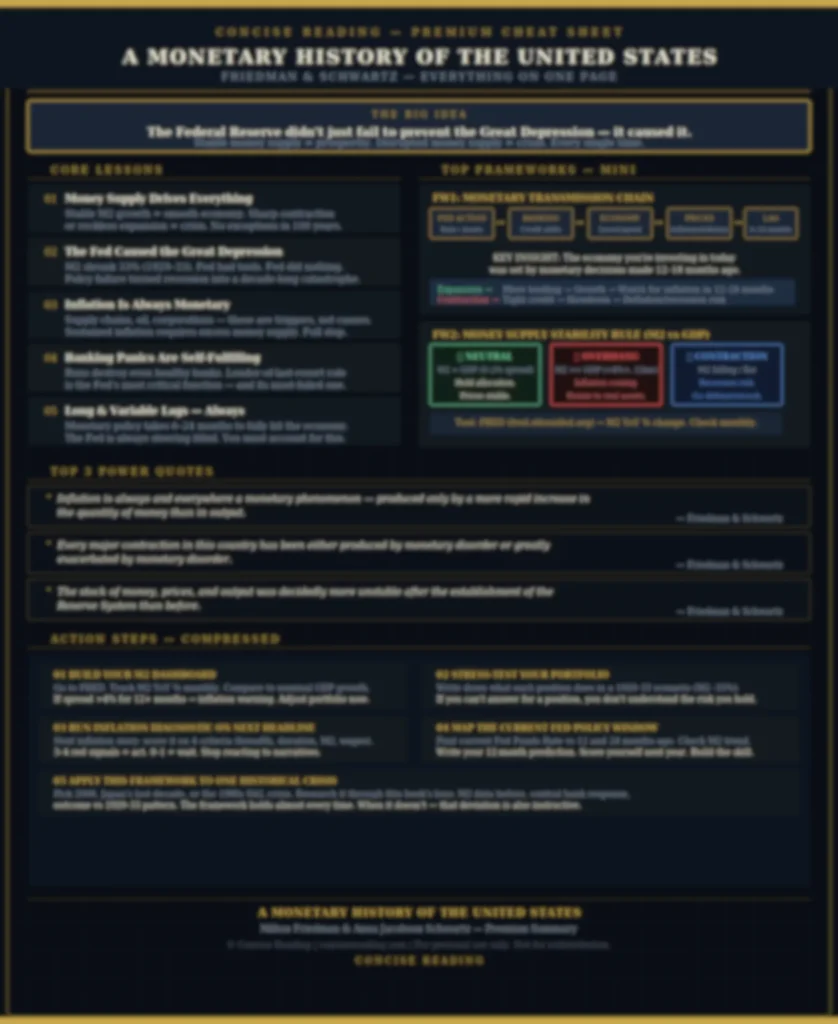
Premium Cheat Sheet Preview
About the Author
Milton Friedman was a Nobel Prize-winning economist and the intellectual architect of monetarism — the most influential school of thought in modern central banking. Anna Jacobson Schwartz spent over 70 years as a research economist at the National Bureau of Economic Research and compiled the statistical backbone of this book from nearly a century of U.S. monetary records. Together, they built the evidentiary case that changed how the world understands financial crises, inflation, and the power of central banks. If Ben Bernanke credits this book for shaping his response to the 2008 financial crisis, it is worth your next 20 minutes.
Power Quote From the Book:
“Inflation is always and everywhere a monetary phenomenon — it can be produced only by a more rapid increase in the quantity of money than in output.”
— Milton Friedman and Anna Jacobson Schwartz, A Monetary History of the United States
Who This Summary is For
- This is for you if…
- You are an investor who wants to understand why the Federal Reserve’s decisions move markets more than any earnings report, quarterly result, or political announcement.
- You are a finance professional, economics student, or policy reader who wants the deepest available case for why money supply is the engine of the entire economy — backed by 100 years of data, not theory.
- You want to understand the 2022 inflation surge, the 2008 financial crisis, and every future monetary event through the most rigorous analytical framework ever applied to U.S. economic history.
- You are building serious financial literacy and want to go beyond personal finance tips to understand the system-level forces that shape every financial decision you will ever make.
- You have read The Psychology of Money, The Intelligent Investor, or Irrational Exuberance and want to go one level deeper into how the monetary system actually works. (You can find those summaries in our library at concisereading.com/library.)
- Skip this if…
- You are looking for personal finance advice, budgeting tips, or stock-picking strategies. This book operates at the level of central banks, money supply, and institutional policy — not individual financial planning. If that is what you need right now, our Personal Finance and Wealth Building Pack is a better starting point.
Social Proof
This summary is read by people who take their financial education seriously — and we want to hear from you. If this summary sharpened how you think about inflation, the Federal Reserve, or the forces driving the economy, leave your thoughts in the comments below. What was the insight that hit hardest? What are you doing differently as a result? Your experience helps other readers decide whether this is right for them — and it makes this community better for everyone in it. Every comment gets read. The best ones get featured.
A Monetary History of the United States took Friedman and Schwartz over a decade of research to produce. The premium summary delivers the complete system — every key framework, chapter breakdown, inflation diagnostic tool, action steps, and one-page cheat sheet — in under two hours, for less than a cup of coffee.
Related Summaries
- Manias, Panics and Crashes by Charles Kindleberger — A deep-dive into the recurring psychology of financial bubbles and collapses throughout history. If Friedman and Schwartz explain the monetary mechanics, Kindleberger explains the human madness that amplifies them.
- The Big Short by Michael Lewis — The story of the 2008 financial crisis told through the investors who saw it coming. It brings the abstract forces of monetary policy and financial risk into vivid, ground-level human drama.
- Irrational Exuberance by Robert Shiller — A Nobel-winning economist’s analysis of speculative bubbles in stock and real estate markets. Pairs directly with Friedman and Schwartz’s framework by showing what happens when monetary looseness meets irrational investor behavior.