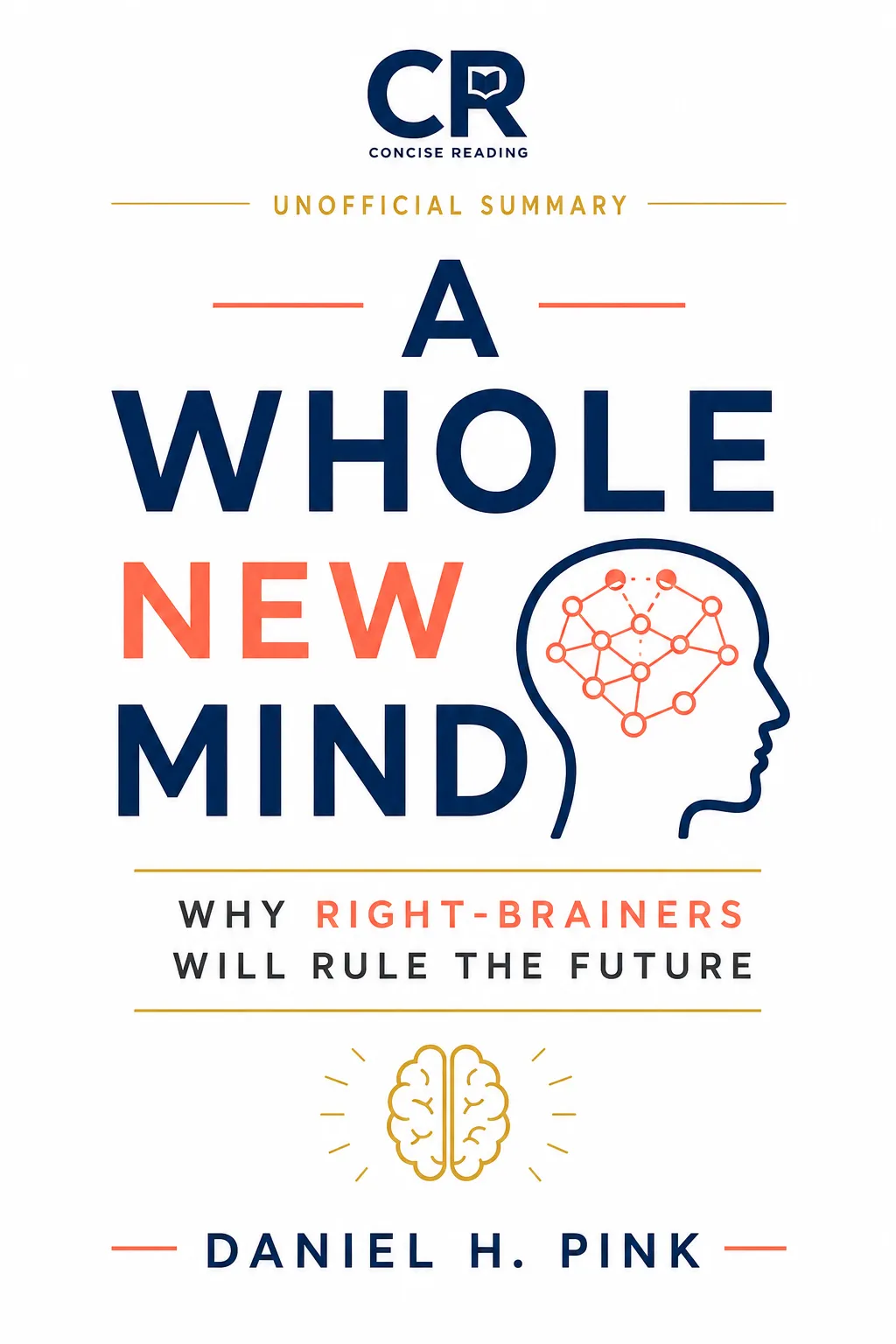
A Whole New Mind by Daniel H. Pink — Summary & Key Lessons
What this book will teach you in the next 10 minutes — and why it matters for your career, your business, and everything AI is about to change.
Part of the Mindset & High Performance collection. Trusted by readers building careers that automation can’t touch.
Book Snapshot
- Author – Daniel H. Pink
- Category – Personal Development / Future of Work / Career Strategy
- Original Book – ~ 260 pages | Average read time: 5–6 hours
- Free Summary – 08 pages
- Premium Summary – 28 pages | Estimated read time: 35–45 minutes
The Big Idea
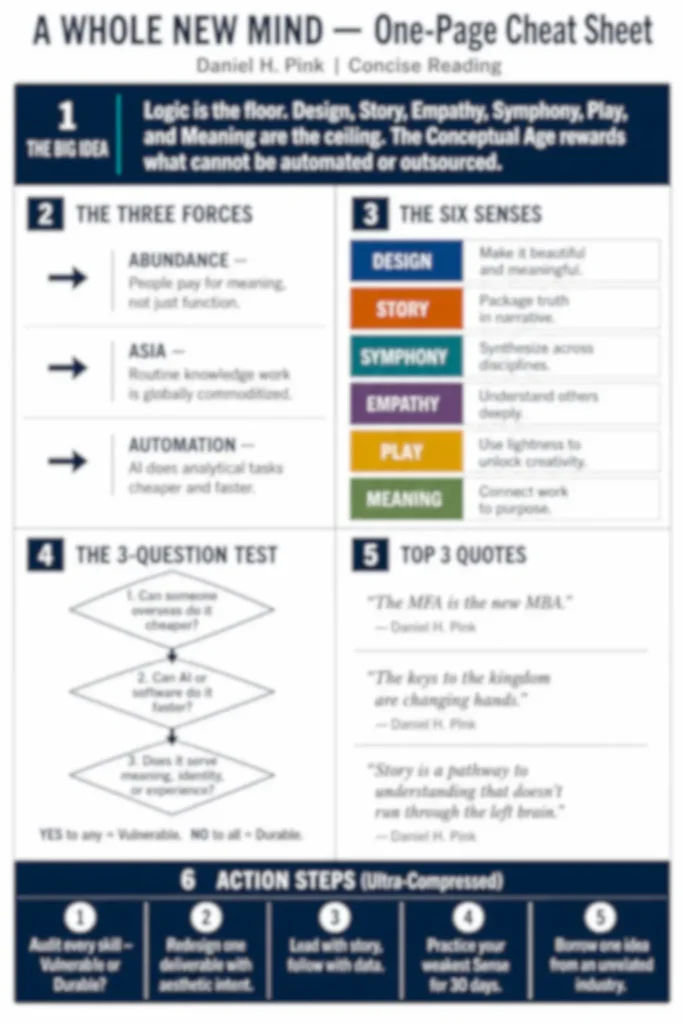
The era that rewarded lawyers, programmers, and MBAs for pure analytical skill is over — not ending, over. Three forces have permanently restructured the economy: material abundance that shifts demand from function to meaning, global labor markets that commoditize routine knowledge work, and AI that now handles logic faster than any human can. Daniel Pink’s argument is clear and uncomfortable: logic has become the floor, not the ceiling. What the market now pays a premium for — and what cannot be automated or outsourced — are six human aptitudes: Design, Story, Symphony, Empathy, Play, and Meaning. Build these on top of what you already know, or get left behind.
What You’ll Learn — Key Lessons Preview
- Why your analytical skills are becoming the minimum requirement — not the differentiator — and exactly what to build on top of them before it’s too late
- How to use Pink’s Six Senses framework to identify which of your current skills are durable and which ones AI or offshore labor will quietly replace
- Why Design is no longer a department but a decision every professional makes — and how to start making it deliberately in work you already do
- How to make data and strategy actually move people by wrapping them in Story — the cognitive mechanism that bypasses resistance and drives action
- The three-question test that tells you, with brutal honesty, whether any skill, role, or business offering will survive the next decade
Free vs Premium Comparison
| Free – $0 | Premium – $4.99 (Recommended) |
| ➡ Book Snapshot ➡ The Big Idea ➡ Key Lessons ➡ Power Quotes ➡ 08 Pages | ✔ Everything in free + ✔ Full Chapter Breakdown ✔ Key frameworks & diagrams ✔ Action steps ✔ Critical analysis ✔ One-page cheat sheet ✔ 28 pages |
Premium Cheat Sheet Preview
About the Author
Daniel H. Pink is a Yale-trained lawyer who left a career in politics — including a stint as Chief Speechwriter to Vice President Al Gore — to become one of the world’s most widely read business thinkers. His books have sold over three million copies across 35+ languages, and Thinkers50 has consistently ranked him among the top 50 business thinkers globally. When Pink argues that the economy is shifting, he has the data, the reporting, and the track record to back it up.
Power Quote From the Book:
“The last few decades have belonged to a certain kind of person with a certain kind of mind — computer programmers who could crank code, lawyers who could craft contracts, MBAs who could crunch numbers. But the keys to the kingdom are changing hands.”
— Daniel H. Pink, A Whole New Mind
Who This Summary is For
- This is for you if…
- You are a professional in a traditionally analytical field — law, finance, accounting, engineering, or tech — and you’re starting to feel that technical competence alone isn’t building the career traction it once did
- You are an entrepreneur or brand builder trying to understand why some products command premium prices while nearly identical competitors fight over margins
- You are a marketer, writer, educator, or creative who has been dismissed as a “soft skills” person and wants a rigorous intellectual framework that validates and sharpens what you do
- You want to understand AI’s economic impact not as a threat to panic about but as a map that tells you exactly where to develop next
- You are building a career or business for the long game and want your foundational thinking to be right, not just your tactics
- Skip this if…
- You are looking for a short-term productivity system or a step-by-step tactical playbook. This book — and this summary — plays the long game. If your horizon is next quarter, start with Deep Work or Atomic Habits and come back to this one when you’re ready to think bigger.
Testimonials
We don’t pad this page with fake stars or manufactured testimonials. If you read this summary — free or premium — and it shifted how you think about your career or your work, we’d genuinely like to hear it. Drop your takeaway, your biggest lesson, or even your disagreement in the comments below. Real feedback from real readers is the only social proof worth having, and it helps the next person decide whether this summary is right for them. If it changed something for you, say so. That’s how this community is built.
A Whole New Mind took Daniel Pink years of research, reporting, and writing to produce. The Premium Summary gives you the complete system — every chapter, every framework, specific action steps, and a one-page cheat sheet — in under 45 minutes for $4.99.
If you found the free version useful, the premium version is where the real work begins. It’s also worth knowing that the Mindset & High Performance Pack includes this summary alongside 11 other career-defining titles for $29 — less than the price of two paperbacks.
Not sure where to start? Visit our Library or check the Start Here page to find the right summary for where you are right now.
Related Summaries
- 1. Drive by Daniel H. Pink — Pink’s follow-up argument that intrinsic motivation (autonomy, mastery, purpose) drives performance better than rewards and punishment. Directly extends the Conceptual Age thinking into how to lead yourself and others.
- 2. Deep Work by Cal Newport — If A Whole New Mind tells you what skills matter, Deep Work tells you how to build them. The ability to focus deeply is the prerequisite for developing any of Pink’s Six Senses at a high level.
- 3. The World Is Flat by Thomas L. Friedman — The economic and geopolitical backdrop that Pink references (globalization, offshoring, the flattening of competitive advantages) is laid out in full detail here. Reading both together gives you a complete picture of why the Conceptual Age is not a theory but an inevitability.