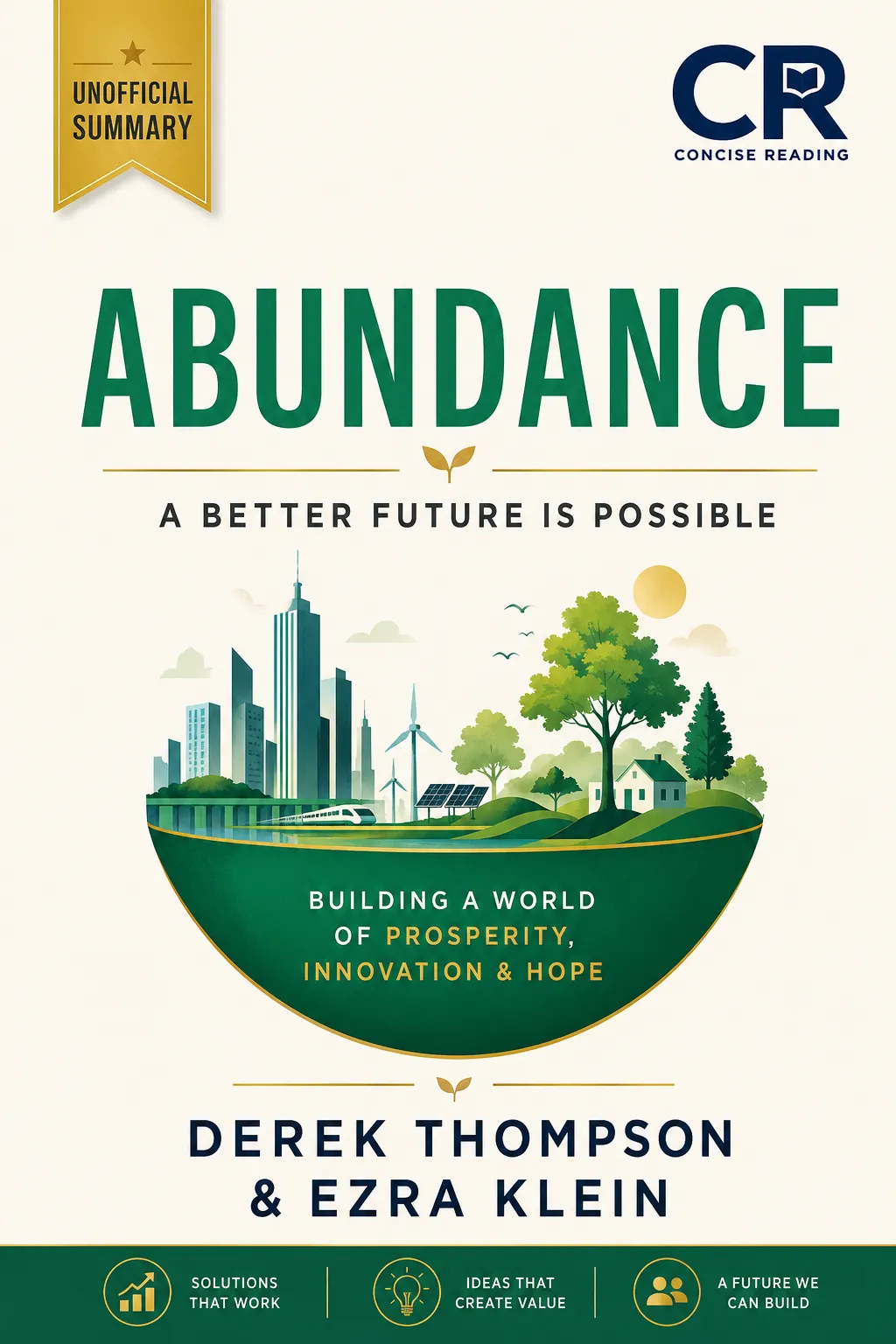
Abundance by Derek Thompson & Ezra Klein — Summary & Key Lessons
What this book will teach you in the next 10 minutes — and why it matters for understanding why your city is unaffordable, your infrastructure is broken, and what it actually takes to fix it.
Read by policy thinkers, founders, investors, and frustrated citizens who want real answers — not talking points. Part of the Economics & Economic Thinking collection at Concise Reading.
Book Snapshot
- Author – Derek Thompson & Ezra Klein
- Category – Economics / Public Policy / Social Critique
- Original Book – ~ 320 pages | Average read time: 6–8 hours
- Free Summary – 08 pages
- Premium Summary – 30 pages | Estimated read time: 45–60 minutes
The Big Idea
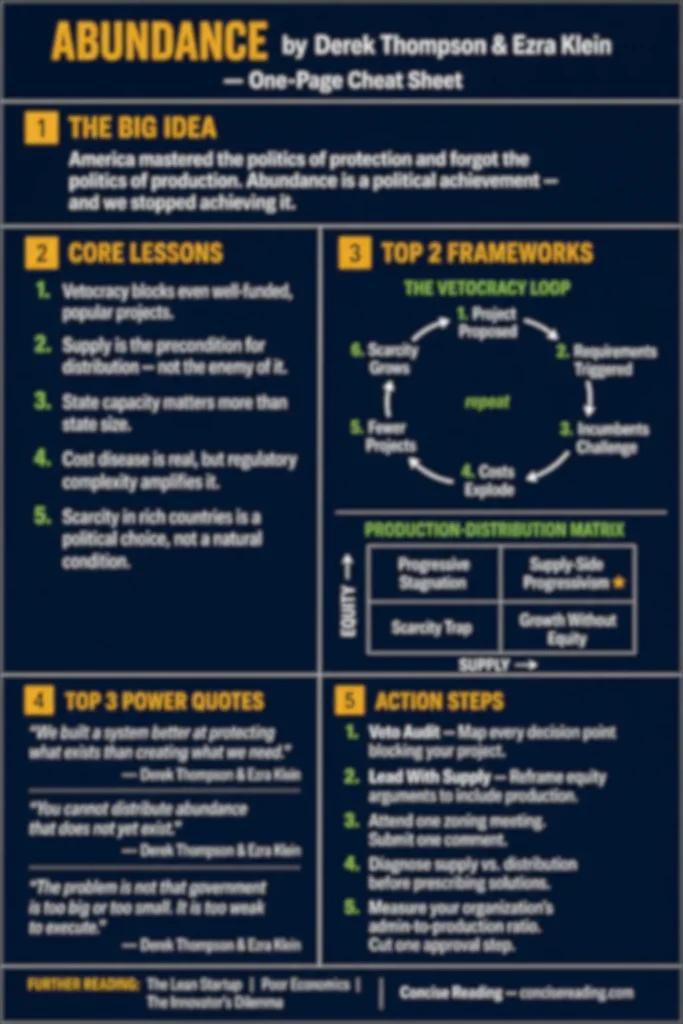
America is one of the wealthiest societies in human history — and it can’t build enough housing, can’t permit a wind farm in under a decade, and can’t construct a mile of subway for less than five times what Spain pays. Abundance argues this is not bad luck or political failure on one side. It is a structural problem: decades of well-intentioned legal reforms created a system with so many veto points that incumbents — existing homeowners, legacy industries, organized opponents — can block almost anything, while future beneficiaries have no seat at the table. The solution is not dismantling protections. It is rebuilding the government’s capacity to actually deliver — and rebuilding a politics that treats production as a progressive value, not a conservative one.
What You’ll Learn — Key Lessons Preview
- Why your city’s housing crisis is not a real estate problem — it’s a governance problem, and this summary shows you exactly which mechanisms are causing it
- How the “vetocracy” works: the precise way legal, procedural, and political veto points turn well-funded, politically popular projects into decade-long delays
- Why progressive politics consistently produces the outcomes it claims to oppose — and the supply-side reframe that changes the entire equation
- What high-performing governments in Tokyo, Seoul, and Denmark do differently — and the specific policy levers that explain the gap
- How to apply the State Capacity vs. State Size framework to your own organization, investment decisions, or advocacy strategy
Browse more summaries in Business Strategy & Execution and Economics & Economic Thinking to build out your full policy and strategy reading stack.
Free vs Premium Comparison
| Free – $0 | Premium – $4.99 (Recommended) |
| ➡ Book Snapshot ➡ The Big Idea ➡ Key Lessons ➡ Power Quotes ➡ 08 Pages | ✔ Everything in free + ✔ Full Chapter Breakdown ✔ Key frameworks & diagrams ✔ Action steps ✔ Critical analysis ✔ One-page cheat sheet ✔ 30 pages |
Premium Cheat Sheet Preview
About the Author
Derek Thompson is a staff writer at The Atlantic and author of Hit Makers, whose economic journalism has shaped mainstream debates on work, cities, and culture for over a decade. Ezra Klein co-founded Vox, writes for The New York Times, and hosts one of America’s most influential intellectual podcasts. His previous book Why We’re Polarized is standard reading in political science programs. Together, they bring rare credibility — two writers willing to challenge their own ideological coalition in the name of honest analysis.
Power Quote From the Book:
“The left built a politics of distribution without building a politics of production. You cannot distribute abundance that does not yet exist.”
— Derek Thompson & Ezra Klein, Abundance
Who This Summary is For
- This is for you if…
- You are a policy advocate, urban professional, or civic-minded reader who is frustrated by housing costs, broken infrastructure, or stalled clean energy — and wants a structural explanation, not a partisan one
- You are a founder, developer, or operator who has fought permitting systems, regulatory delays, or local opposition and never understood why the system works that way
- You are an investor in real estate, clean energy, or infrastructure who needs to understand regulatory risk at a structural level — not just project by project
- You want to understand why America’s government is large but often ineffective — and what high-capacity governance actually looks like in practice
- You are politically left-leaning and intellectually honest enough to follow an argument that challenges your own movement’s record
- Skip this if…
- You are looking for a personal finance, career, or business operations guide — Abundance operates entirely at the systems and policy level and will not give you tactical steps for your individual life. If that’s what you need right now, our Personal Finance & Wealth Building and Startup & Entrepreneurship libraries are better starting points.
Testimonials
This summary was built to be the clearest, most honest version of Abundance available anywhere — covering the core arguments without softening the uncomfortable conclusions. If you’ve read the free or premium version, we’d genuinely love to hear what landed for you — or what you’d push back on. Drop your thoughts in the comments below. Every piece of feedback directly shapes how we build the next summary, and the readers who come after you will benefit from what you share. If this summary gave you one framework or one reframe that stuck, that’s worth saying. If it didn’t deliver — that’s worth saying too. We read everything.
Abundance took Derek Thompson and Ezra Klein years of research, reporting, and political courage to write — the Premium Summary gives you the complete system: every framework, every chapter, every action step, and a one-page cheat sheet, in 30 focused pages you can finish in under an hour.
Pair this with our Economics & Economic Thinking Pack for the complete intellectual foundation — or go deeper into governance and decision-making with our summaries of Poor Economics, The Innovator’s Dilemma, and The Lean Startup. If you’re building your full strategy reading stack, the Business Strategy & Execution Pack is the most efficient path.
Not sure where to start on the site? The Start Here page will point you in the right direction based on what you’re trying to learn. Or browse the full Library across all summaries.
Related Summaries
- The Lean Startup — Eric Ries — Abundance argues institutions need to build faster and test quickly. Ries built the playbook for exactly that inside organizations. Mandatory companion read.
- Poor Economics — Abhijit Banerjee & Esther Duflo — Rigorous, evidence-based look at why well-intentioned systems produce bad outcomes for people at the bottom. Shares Abundance’s intellectual DNA without the American focus.
- The Innovator’s Dilemma — Clayton Christensen — Explains why successful, well-run institutions systematically fail to adapt. Abundance is about political vetocracy; Innovator’s Dilemma is about institutional inertia. Read them together and you’ll understand why good systems resist their own improvement.