The Essentials of Risk Management by Crouhy, Galai & Mark — Summary & Key Lessons
What this book will teach you in the next 10 minutes — and why it matters for every financial decision you make, every balance sheet you run, and every risk you think you’ve already accounted for.
Written by three of the world’s most credentialed risk professionals. Summarized by Concise Reading for finance practitioners, investors, and business leaders who think clearly about risk — or want to.
Book Snapshot
- Author – Michel Crouhy, Dan Galai, Robert Mark
- Category – Finance & Risk Management
- Original Book – Approximately 672 pages. Average read time: 20-25 hours.
- Free Summary – 08 pages
- Premium Summary – 30 pages. Estimated read time: 90-120 minutes.
The Big Idea
Risk is not the enemy. Unmanaged risk is. Every investment, every business decision, every financial position carries risk — that is not a problem, it is simply reality. The real problem is when organizations ignore risk, miscategorize it, or worse, believe they have eliminated it. Crouhy, Galai, and Mark argue that the institutions that survive crises — and the investors who outperform through them — are not the ones who take less risk. They are the ones who understand exactly what risk they are carrying, measure it honestly, and build the systems and culture to manage it before it manages them.
What You’ll Learn — Key Lessons Preview
- You will understand why most organizations are blind to the risks that actually destroy them — not market risk, but liquidity, operational, and strategic risks that operate invisibly until they don’t.
- You will learn the three-tool measurement system that professional risk managers use — VaR, stress testing, and reverse stress testing — and why using only one of them gives you a dangerously incomplete picture.
- You will discover why the gap between regulatory capital and economic capital is one of the most important numbers a financial institution can calculate — and what it reveals about hidden danger or hidden inefficiency.
- You will see exactly why risk management fails in organizations that have world-class frameworks on paper — and why incentive misalignment is the single most common cause of catastrophic risk failure.
- You will walk away with five specific action steps, from building a complete risk inventory to running a quarterly risk reset, that most organizations know they should do and consistently don’t.
Free vs Premium Comparison
| Free – $0 | Premium – $4.99 (Recommended) |
| ➡ Book Snapshot ➡ The Big Idea ➡ Key Lessons ➡ Power Quotes ➡ 08 Pages | ✔ Everything in free + ✔ Full Chapter Breakdown ✔ Key frameworks & diagrams ✔ Action steps ✔ Critical analysis ✔ One-page cheat sheet ✔ 30 pages |
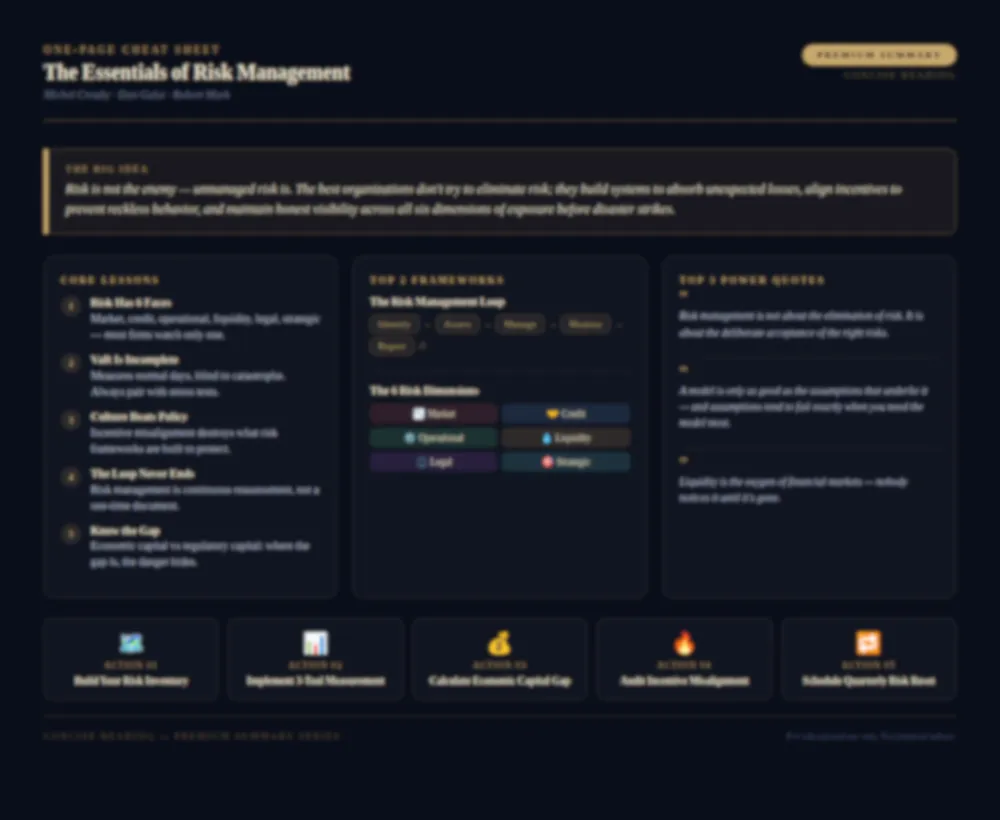
Premium Cheat Sheet Preview
About the Author
Michel Crouhy, Dan Galai, and Robert Mark are among the most credentialed risk professionals in the world. Crouhy held senior risk roles at CIBC and NATIXIS. Galai is a finance professor at Hebrew University and a contributor to the foundational mathematics of options pricing. Mark built risk management functions at two of Canada’s largest banks before founding a risk consulting firm. This is not a book written about risk from a distance — it is written by people who built the systems that major financial institutions still use today.
Power Quote From the Book:
“Risk management is not about the elimination of risk. It is about the deliberate acceptance of the right risks.”
— Michel Crouhy, Dan Galai, Robert Mark, The Essentials of Risk Management
Who This Summary is For
- This is for you if…
- You are a finance professional, risk analyst, or investment manager who needs a rigorous and practical command of risk frameworks, not just textbook theory.
- You are a CFO or senior executive who suspects your organization’s risk management program is more bureaucratic compliance than genuine protection.
- You want to understand how professional institutions measure, manage, and govern financial risk — and apply that thinking to your own decisions.
- You are an investor, portfolio manager, or serious student of finance who has read the behavioral side of risk and is ready for the structural and quantitative side.
- You want a complete summary of one of the most important risk management books ever written in the time it takes to drink a cup of coffee.
- Skip this if…
- You are looking for a beginner personal finance book or a simple guide to budgeting and saving. This summary is built for practitioners and serious students of finance. If that is not where you are yet, our summary of The Psychology of Money or The Intelligent Investor may be a better starting point.
Social Proof
This summary was read by you first. If it gave you a clearer picture of how risk actually works — or changed something in how you think about financial decisions — we would genuinely like to know. Leave a comment below with your biggest takeaway, a question the summary raised for you, or how you plan to apply one of the frameworks. Every comment helps other readers decide whether this is the right summary for them, and helps us make future summaries sharper. The first review is always the most valuable one.
The Essentials of Risk Management took three of the world’s leading risk professionals decades of institutional experience to write — and runs to over 670 pages. The premium summary gives you the complete system: every major framework, four visual diagrams, five curated power quotes, five discomfort-level action steps, a full chapter-by-chapter breakdown, a critical analysis, and a one-page cheat sheet — all in under two hours of reading.
Related Summaries
- The Black Swan by Nassim Nicholas Taleb — The philosophical counterpart to this book. Where Crouhy and team give you the framework to manage known risks, Taleb tears apart our comfortable assumption that we can model the risks we don’t yet know. Read both together for a complete picture.
- When Genius Failed by Roger Lowenstein — The collapse of Long-Term Capital Management is the single most instructive real-world case study in what happens when brilliant risk models meet the real world. Everything this book warns about, LTCM did wrong.
- Thinking in Bets by Annie Duke — A more accessible, behavioral angle on decision-making under uncertainty. Complements the quantitative framework of this book with the psychological discipline required to actually execute good risk decisions under pressure.