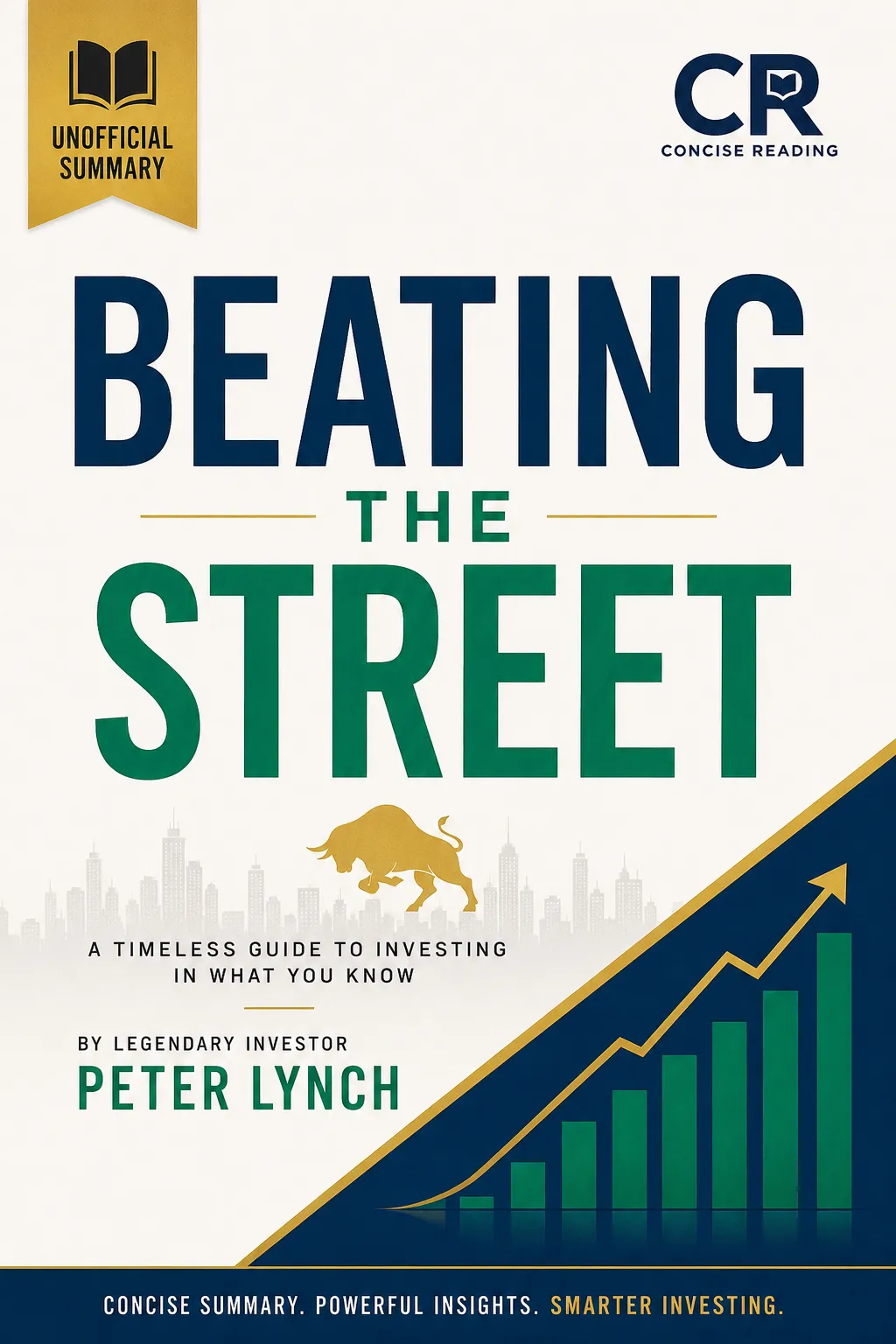
Beating the Street by Peter Lynch — Summary & Key Lessons
What this book will teach you in the next 10 minutes — and why it matters for your investment portfolio and long-term financial independence.
Used by the fund manager who turned $18 million into $14 billion — now distilled into a framework any investor can use today.
Book Snapshot
- Author – Peter Lynch
- Category – Investing & Stock Market / Personal Finance
- Original Book – ~ 318 pages — approximately 8–10 hours of reading
- Free Summary – 08 pages
- Premium Summary – 42 pages — approximately 45–60 minutes of reading
The Big Idea
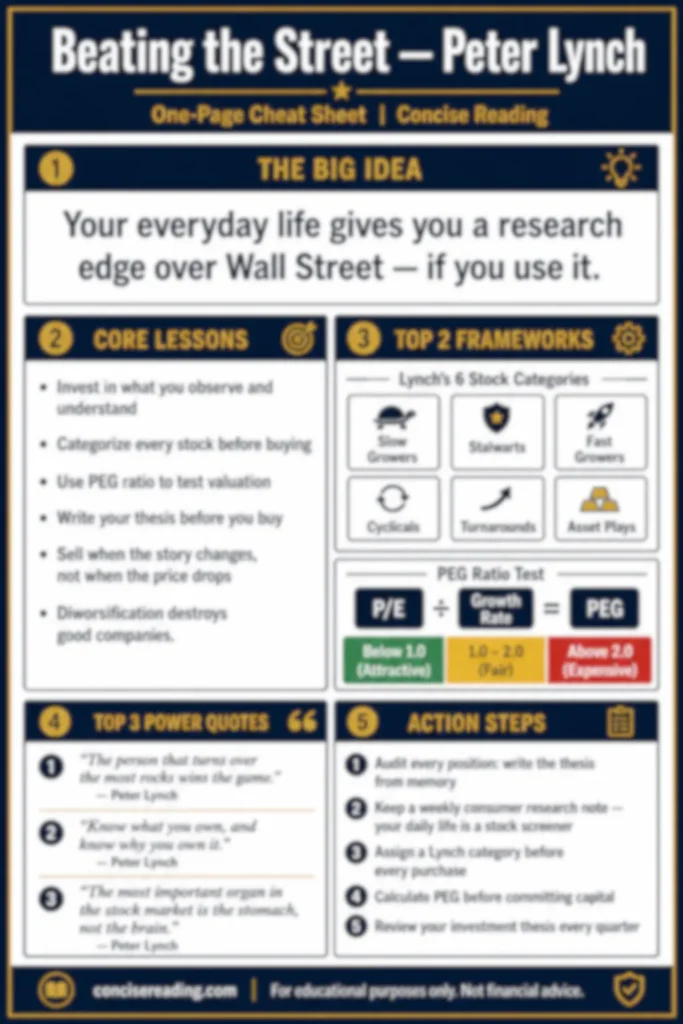
Most investors assume Wall Street professionals have an edge they can never match. Peter Lynch spent 13 years proving the opposite. His argument is simple: ordinary people encounter great investment ideas — in stores, at work, in daily life — long before analysts do. Your real edge is not information. It is observation, discipline, and the freedom to act without institutional constraints. Lynch’s entire framework teaches you to exploit that edge systematically: find what you understand, categorize it correctly, verify the valuation, write your thesis, and hold until the business — not the price — tells you otherwise. Browse our Investing Fundamentals category to see how Lynch fits into the broader canon of investment thinking.
What You’ll Learn — Key Lessons Preview
- You will know how to classify any stock into one of Lynch’s six categories — so you set the right expectations before you invest a single dollar, and never again sell a good stock too early because it didn’t do what you never defined
- You will be able to calculate and interpret the PEG ratio — Lynch’s primary valuation filter — so you stop overpaying for stories and start paying for substance
- You will have a written investment thesis framework that tells you exactly when to sell — based on business reality, not price panic or financial news
- You will recognize the early warning signs of “diworsification” — the pattern that destroys profitable companies and signals when to exit a position you’ve held for years
- You will understand why your daily consumer life is a research advantage most investors completely ignore — and how to turn that observation into a repeatable stock-screening habit
Free vs Premium Comparison
| Free – $0 | Premium – $4.99 (Recommended) |
| ➡ Book Snapshot ➡ The Big Idea ➡ Key Lessons ➡ Power Quotes ➡ 08 Pages | ✔ Everything in free + ✔ Full Chapter Breakdown ✔ Key frameworks & diagrams ✔ Action steps ✔ Critical analysis ✔ One-page cheat sheet ✔ 42 pages |
Premium Cheat Sheet Preview
About the Author
Peter Lynch managed Fidelity’s Magellan Fund from 1977 to 1990, growing it from $18 million to over $14 billion in assets with a 29.2% average annual return — one of the greatest investment track records in history. He consistently beat the S&P 500 for 13 consecutive years before retiring voluntarily at age 46. Lynch didn’t build his methods in a classroom. He built them in the market, under real pressure, with real money — which is precisely why his frameworks work when most investment theory doesn’t.
Power Quote From the Book:
“Far more money has been lost by investors preparing for corrections, or trying to anticipate corrections, than has been lost in corrections themselves.”
— Peter Lynch, Beating the Street
Who This Summary is For
- This is for you if…
- You are a self-directed investor who is tired of investing on instinct, tips, or financial news and wants a repeatable, research-based framework you can actually trust
- You are a beginner-to-intermediate investor who has the basics down and is ready to move from “what should I invest in?” to “how do I evaluate what I own?”
- You want to understand how one of history’s greatest fund managers actually thought — not the theory, but the real decision-making process behind the picks
- You are building a personal stock portfolio and need a systematic way to evaluate, buy, hold, and sell individual companies
- You have read The Intelligent Investor or One Up on Wall Street and want to go deeper into Lynch’s applied methodology
- Skip this if…
- You are a complete beginner who hasn’t yet grasped what stocks, earnings, or P/E ratios are — build that foundation first with our Investing Fundamentals library, then come back. This summary also won’t serve you if you’re exclusively focused on index funds, crypto, or short-term trading — Lynch’s framework is built for long-term, business-focused stock picking.
Testimonials
We don’t believe in fake reviews. Every summary at Concise Reading is built to earn honest feedback — and we’d rather have ten real readers tell us what they found useful than a hundred stars that mean nothing. If you’ve read this summary — free or premium — we’d genuinely love to know what you took from it. Did a framework change how you look at a stock you already own? Did an action step push you to do something you’d been avoiding? Leave your experience in the comments below. Your feedback helps other readers decide whether this summary is right for them — and it helps us make every future summary sharper. If this is your first time here, explore our Wall Street & Financial Markets summaries or check the Start Here page to find the right starting point for your reading goals.
Beating the Street took Peter Lynch 13 years of managing the world’s top-performing fund to write — the premium summary gives you his complete system, every framework, a full chapter-by-chapter breakdown, specific action steps, and a one-page cheat sheet, in under 42 pages. If you want more depth before deciding, browse The Investing Playbook — which synthesizes Lynch alongside Graham, Buffett, and Fisher into one unified investing system — or explore The Investing Fundamentals Pack for the complete library. For a single investor’s decision-making framework that has held up for over 30 years, $4.99 is not a cost. It is a very small bet on yourself.
Related Summaries
- One Up on Wall Street — Peter Lynch — Lynch’s first book and the essential companion to Beating the Street. Where Beating the Street shows Lynch’s methods through the lens of real fund management, One Up on Wall Street is the foundational playbook for individual investors. Start here if you haven’t already.
- The Intelligent Investor — Benjamin Graham — The philosophical backbone behind Lynch’s entire approach. Graham’s concept of margin of safety and Mr. Market’s irrational mood swings explains why Lynch’s patient, fundamentals-first method works. Essential reading for anyone serious about long-term investing.
- Common Stocks and Uncommon Profits — Philip Fisher — Fisher’s framework for evaluating business quality — management integrity, competitive moats, long-term growth potential — directly influenced how Lynch thought about fast growers. If Lynch tells you what to look for, Fisher tells you how to evaluate it deeply.