Bookkeeping and Accounts by Frank Wood & Sheila I. Robinson — Summary & Key Lessons
What this book will teach you in the next 10 minutes — and why it matters for your business finances and long-term financial control.
Part of the Accounting & Bookkeeping summary collection at Concise Reading — where we turn dense financial textbooks into clear, actionable reads.
Book Snapshot
- Author – Frank Wood & Sheila I. Robinson
- Category – Accounting & Financial Literacy
- Original Book – ~ 640 pages | Average read time: 18–22 hours
- Free Summary – 08 pages
- Premium Summary – 49 pages | Estimated read time: 35–45 minutes
The Big Idea
Most business owners know their product. Almost none know their numbers — not really. Bookkeeping and Accounts by Frank Wood and Sheila I. Robinson is the foundational text behind some of the world’s most rigorous accounting qualifications, and for good reason: it teaches you exactly how money moves through a business, how to record every transaction correctly, and how to produce financial statements you can actually trust. This is not theory for the sake of theory. This is the operating system behind every profitable, audit-ready business on the planet.
What You’ll Learn — Key Lessons Preview
- You will understand the double-entry bookkeeping system well enough to record any transaction correctly — and catch errors before they compound into expensive problems
- You will know exactly how to read a balance sheet, income statement, and cash flow statement together — and stop making decisions based on incomplete financial data
- You will learn why profitable businesses go bankrupt — and how to use the accounting cycle to ensure your business is never caught by surprise
- You will be able to set up a clean, audit-ready chart of accounts from scratch — whether you are starting a new business or fixing a messy one
- You will grasp what depreciation, accruals, and prepayments actually mean — and how ignoring them is silently distorting your profit figures right now
Already exploring the financial side of business? These summaries from our Financial Intelligence & Analysis and Accounting & Bookkeeping categories go well together with this one.
Free vs Premium Comparison
| Free – $0 | Premium – $4.99 (Recommended) |
| ➡ Book Snapshot ➡ The Big Idea ➡ Key Lessons ➡ Power Quotes ➡ 08 Pages | ✔ Everything in free + ✔ Full Chapter Breakdown ✔ Key frameworks & diagrams ✔ Action steps ✔ Critical analysis ✔ One-page cheat sheet ✔ 49 pages |
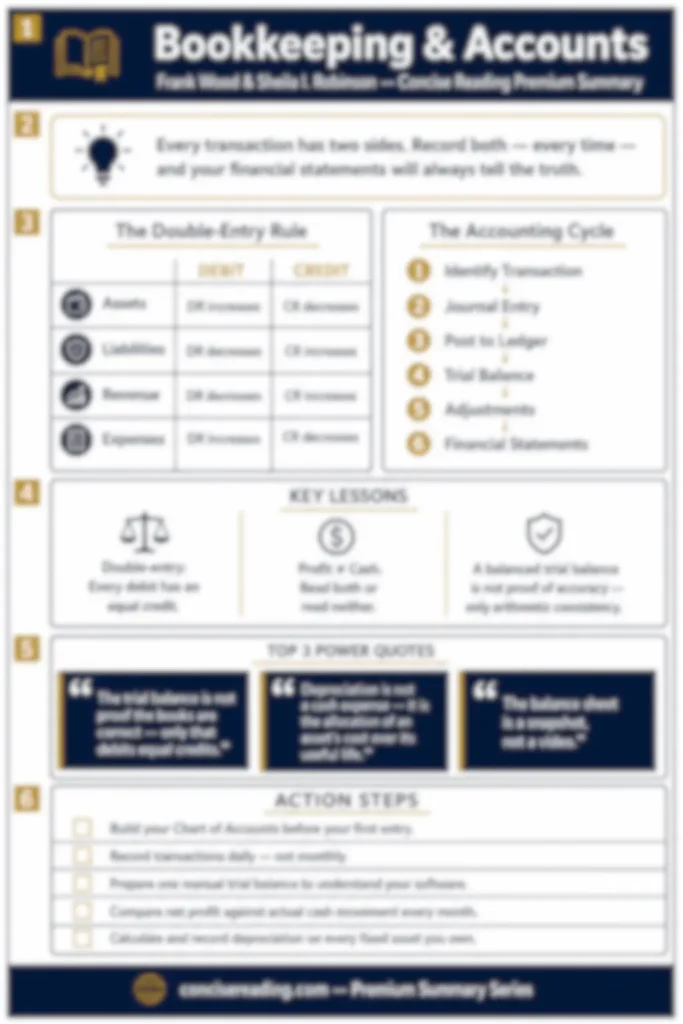
Premium Cheat Sheet Preview
About the Author
Frank Wood (1926–2000) was one of the most respected accounting educators of the 20th century, whose textbooks became the standard reference for bookkeeping training across the UK, Commonwealth countries, and professional qualification programmes including AAT and ACCA. His series has sold millions of copies globally and continues to be updated and used in classrooms decades after his death. Sheila I. Robinson co-authored and modernized the series to keep it aligned with contemporary standards and examination syllabi.
Power Quote From the Book:
“A trial balance is not proof that the books are correct — only that debits equal credits.”
Who This Summary is For
- This is for you if…
- You are a small business owner or freelancer who has been avoiding your books and knows it is a problem
- You are a student preparing for an accounting qualification and need a clear, navigable overview before going deep
- You want to understand what your accountant is telling you — rather than nodding along and hoping for the best
- You are setting up a new business and want to build your financial records correctly from day one
- You are someone who has tried accounting software and realized you have no idea what is happening underneath it
- Skip this if you are a practicing accountant or CPA looking for advanced technical material — this summary is built for people building their foundation, not refining an existing professional skillset. If that is you, explore our Wall Street & Financial Markets or Financial Intelligence & Analysis collections instead.
Testimonials
We are building the Concise Reading community one reader at a time — and the most valuable thing you can do after reading this summary is tell us what landed for you. Did a specific framework change how you think about your books? Did something finally click that had confused you for years? Drop your thoughts in the comments below. Real feedback from real readers is what helps other people decide whether this summary is right for them — and it helps us make every future summary sharper. If this was useful, say so. If something was missing, say that too. We read every comment.
Frank Wood spent decades in the classroom developing this system into one of the most comprehensive bookkeeping textbooks ever written — the premium summary gives you the complete framework in under 45 minutes.
At $4.99, this is not a question of affordability. It is a question of whether you want to keep guessing about your finances or finally understand them. The premium version includes a full chapter-by-chapter breakdown, five key frameworks with image-generation-ready diagram prompts, five curated power quotes with context, specific action steps written to be uncomfortable enough to actually use, a critical analysis of the book’s strengths and limitations, and a one-page cheat sheet designed to be saved, printed, and referenced permanently.
If you have found value in the free summary, the premium version is where the real work begins. Browse the full Accounting & Bookkeeping Pack if you want to go deeper across the entire category — or visit our Library to see every title we cover. Not sure where to start? Start Here.
Related Summaries
Based on your interest in this book, these three summaries from the Concise Reading library are worth your time:
- Accounting Made Simple — Strips accounting down to its absolute essentials. Ideal if you want to go one level deeper than this book without committing to a full textbook.
- Financial Intelligence — Translates financial statements into business decision-making language. Perfect for owners who now understand the numbers but want to know what to do with them.
- Profit First — A practical cash management system built specifically for small business owners. A natural next step once you understand how money is recorded and reported.