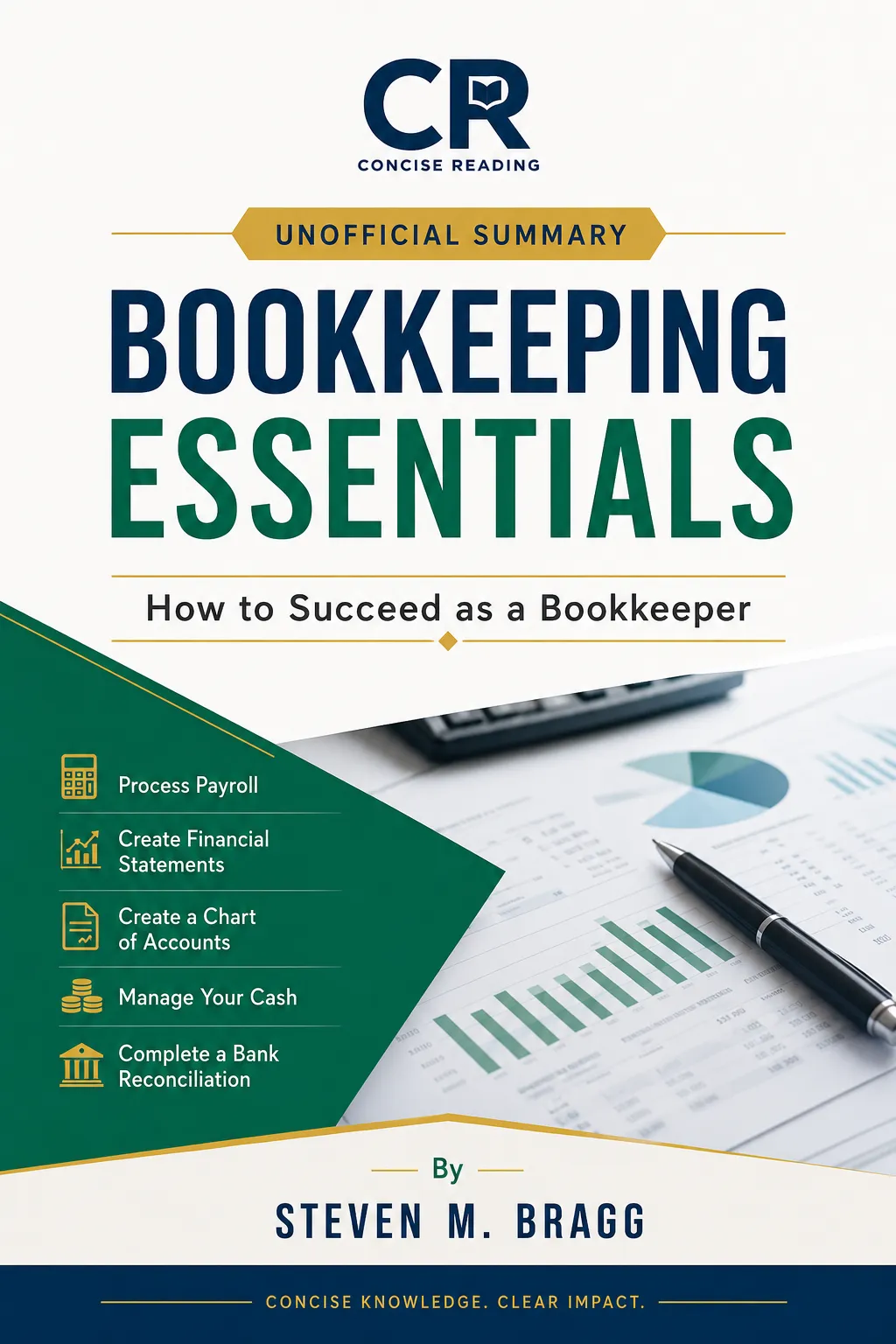
Bookkeeping Essentials by Steven M. Bragg — Summary & Key Lessons
What this book will teach you in the next 10 minutes — and why it matters for your business finances and every decision you make with money.
Part of the Accounting & Bookkeeping category — summaries written for entrepreneurs, not accountants.
Book Snapshot
- Author – Steven M. Bragg
- Category – Accounting & Finance / Small Business Operations
- Original Book – ~ 312 pages | Average read time: 9–11 hours
- Free Summary – 08 pages
- Premium Summary – 33 pages | Estimated read time: 35–45 minutes
The Big Idea
Most business owners treat bookkeeping as a tax obligation. Bragg argues it is something far more valuable — a real-time operating system for your business. When your records are accurate, you can see which parts of your business make money, which drain it, and where your cash is heading before a crisis hits. The book’s deepest insight is one most entrepreneurs resist: financial clarity is not your accountant’s job. It is yours first. You can outsource the execution, but not the understanding. The moment you stop comprehending your own numbers, the numbers start running your business instead of you.
What You’ll Learn — Key Lessons Preview
- How double-entry bookkeeping actually works — and why getting this one rule right means your books will never silently break without warning
- Why your bank balance is lying to you — and how cash vs. accrual accounting changes every financial decision you make as a business owner
- How to build a chart of accounts that produces reports you can actually act on — instead of vague summaries that tell you nothing useful
- The monthly reconciliation habit that catches errors, exposes fraud, and keeps your financial records trustworthy year-round
- How to read all three financial statements together — and why profitable businesses still go bankrupt when they only look at one
Free vs Premium Comparison
| Free – $0 | Premium – $4.99 (Recommended) |
| ➡ Book Snapshot ➡ The Big Idea ➡ Key Lessons ➡ Power Quotes ➡ 08 Pages | ✔ Everything in free + ✔ Full Chapter Breakdown ✔ Key frameworks & diagrams ✔ Action steps ✔ Critical analysis ✔ One-page cheat sheet ✔ 33 pages |
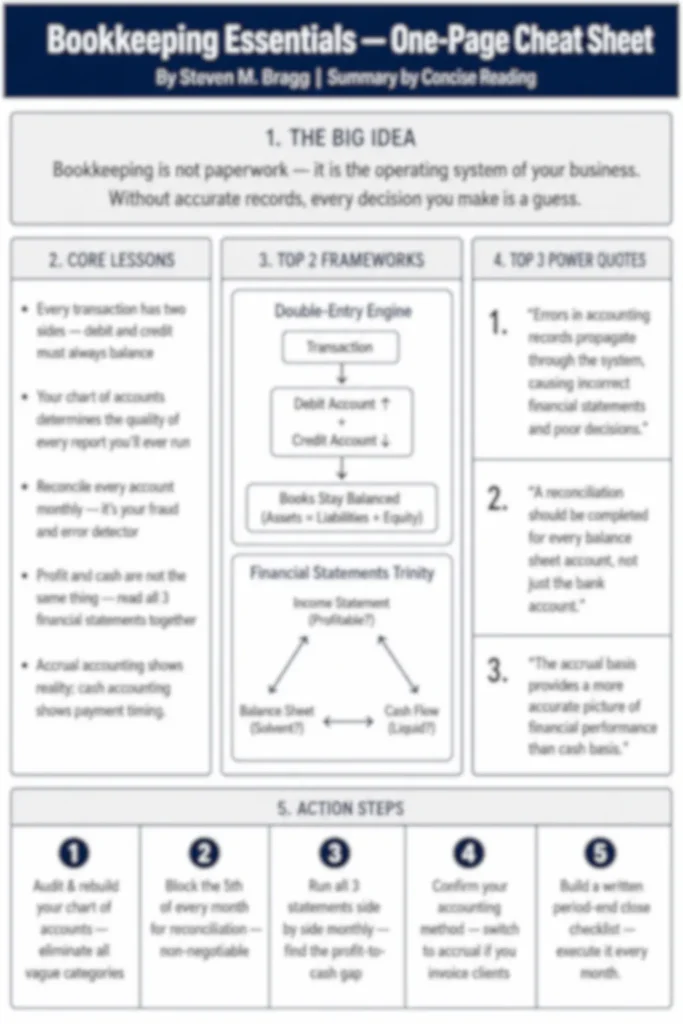
Premium Cheat Sheet Preview
About the Author
Steven M. Bragg is a CPA and former CFO with over 30 years of hands-on financial leadership across manufacturing, technology, and services industries. He has authored more than 80 books on accounting and finance — making him one of the most comprehensive individual contributors to accounting education in the English language. His writing is trusted by business owners, finance professionals, and accounting students worldwide precisely because it is built on operational experience, not theory. If you want to understand money the way people who manage it for a living actually think, Bragg is one of the most reliable guides you will find. Explore more summaries in the Accounting & Bookkeeping and Financial Intelligence & Analysis categories.
Power Quote From the Book:
“Errors in the accounting records can propagate through the system, causing incorrect financial statements and poor management decisions.”
— Steven M. Bragg, Bookkeeping Essentials
Who This Summary is For
- This is for you if…
- You are a small business owner, solopreneur, or freelancer who handles your own finances but never formally learned how bookkeeping works
- You are an entrepreneur who nods along when your accountant talks but privately has no idea what you’re looking at on a balance sheet
- You want to stop running your business on your bank balance and start using actual financial data to make decisions
- You are building a bookkeeping system from scratch — or inheriting one that produces reports too vague to be useful
- You are a first-year bookkeeper, accounting student, or career-changer who wants a thorough, readable foundation before tackling formal credentials
Not the right fit? Skip this if you are a credentialed accountant or CPA already working in practice — the fundamentals covered here are territory you know well. For more advanced material, explore our Financial Intelligence & Analysis summaries, including Financial Intelligence and Financial Statement Analysis.
Testimonials
We are building something here together. Every summary at Concise Reading is written to be worth more than the time it takes to read — and the best way we can improve is through honest feedback from readers like you.
If this summary helped you understand bookkeeping more clearly, clarified something you had been confused about, or changed how you think about your business finances — drop a comment below. Tell us which lesson hit hardest, which framework you are going to apply first, or what you wish had gone deeper. Your experience helps other readers decide whether this summary is right for them, and it helps us make every future summary sharper. We read every comment.
Bookkeeping Essentials took Steven M. Bragg decades of CFO-level experience to distill into a complete system — the premium summary gives you the full chapter-by-chapter breakdown, five actionable frameworks with visual diagrams, discomfort-level action steps, and a one-page cheat sheet worth pinning above your desk, all in 20 focused pages for $4.99.
If you found the free summary useful, the premium version is where the real work gets done. It is not more of the same — it is the operational layer underneath everything you just read. For readers who also want the full accounting picture, consider the Accounting & Bookkeeping Premium Pack — 12 summaries including Profit First, Financial Intelligence, and Accounting Made Simple — at a fraction of what the books cost individually. Or if you want the complete financial operating system for your business in one place, the Financial Intelligence Playbook synthesizes 10 finance classics into one unified guide. Browse the full Library to find your next read.
Related Summaries
- Profit First by Mike Michalowicz — Restructures how you allocate business income so profitability is built into your system from day one, not something you hope is left over at the end.
- Financial Intelligence by Karen Berman & Joe Knight — Teaches non-financial managers and business owners how to read and interpret financial statements with real confidence, not just surface-level familiarity.
- Accounting Made Simple by Mike Piper — A concise, plain-language breakdown of core accounting principles that pairs directly with the bookkeeping mechanics covered in Bragg’s book.