
Emotional Intelligence by Daniel Goleman — Summary & Key Lessons
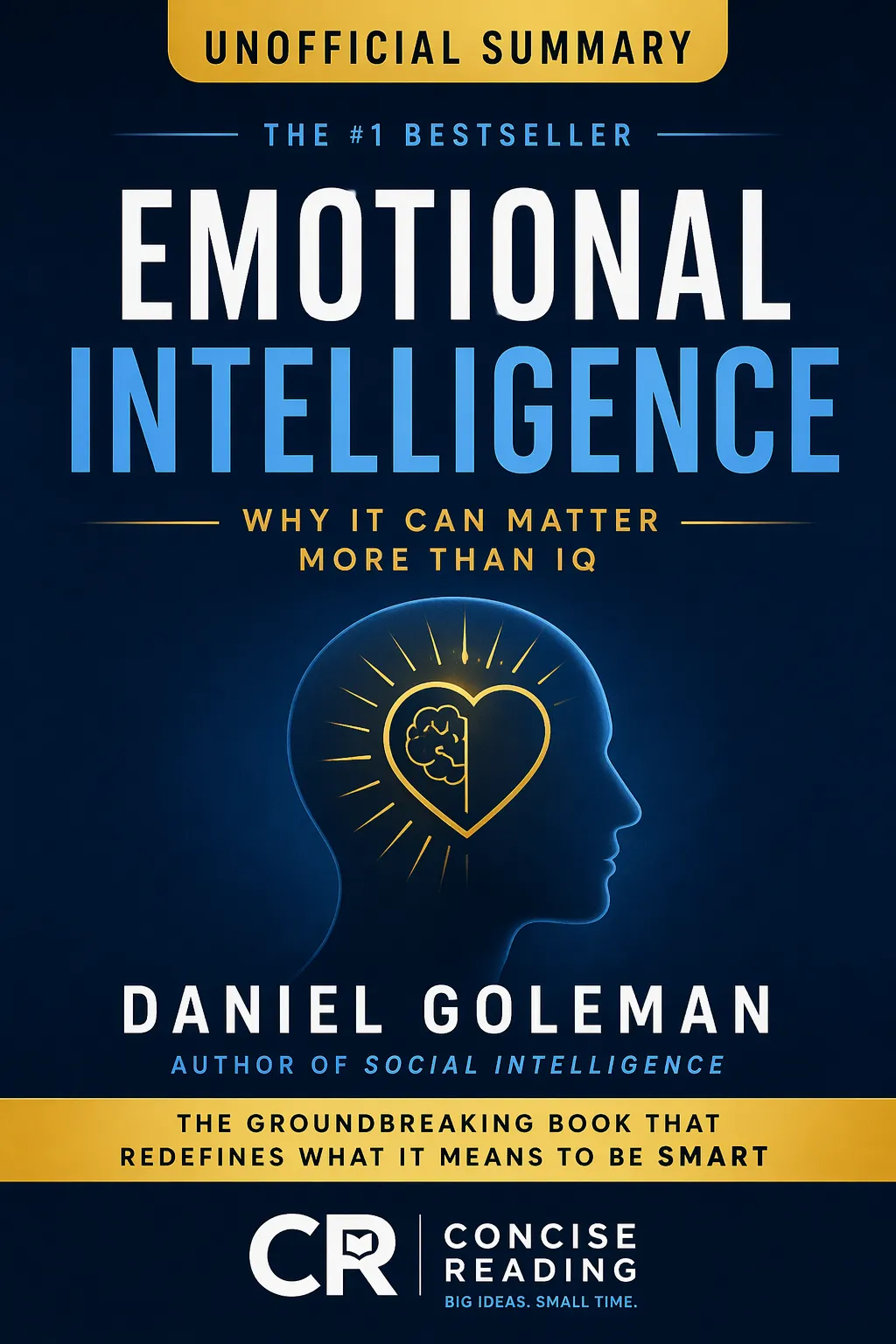
What this book will teach you in the next 10 minutes — and why it matters for your career, your leadership, and every high-stakes relationship in your life.
Trusted by professionals who read to grow, not just to say they read. Part of the Concise Reading Library — summaries built for people who apply what they learn.
Book Snapshot
- Author – Daniel Goleman
- Category – Psychology, Behavioral Science, Leadership & Professional Development
- Original Book – ~ 352 pages | ~ 7–9 hours average read time
- Free Summary – 07 pages
- Premium Summary – 28 pages | ~ 45–55 minutes read time
The Big Idea
Your IQ got you in the room. Your emotional intelligence will determine whether you stay, lead, and win. Daniel Goleman’s landmark research — drawing on two decades of psychology and neuroscience — makes a blunt case: above a basic intelligence threshold, EQ predicts career success, leadership effectiveness, and life satisfaction far more reliably than raw intellect. The brain’s emotional circuitry runs faster than rational thought. People who learn to work with it — rather than against it or around it — make better decisions, build stronger relationships, and recover faster from setbacks. The five skills at the core of emotional intelligence are not personality traits you are born with. They are trainable competencies. And this book shows you exactly why they matter and how they work.
What You’ll Learn — Key Lessons Preview
- Why brilliant people plateau — and the specific emotional blind spot that quietly caps careers more than any skill gap ever could
- How to stop reacting and start responding — the neuroscience of the amygdala hijack, and the single behavioral shift that separates emotionally intelligent people from reactive ones
- What empathy actually is at work — not softness, not agreement, but a precise and trainable skill that predicts who gets promoted, who builds loyal teams, and who earns trust in rooms where stakes are high
- The five-component EQ model in full — self-awareness, self-regulation, motivation, empathy, and social skills, explained in the order they must be built and why skipping any level costs you the ones above it
- Why your brain can be retrained — and what the latest neuroscience says about building emotional intelligence as an adult, long after the habits of a lifetime have already formed
Free vs Premium Comparison
| Free – $0 | Premium – $4.99 (Recommended) |
| ➡ Book Snapshot ➡ The Big Idea ➡ Key Lessons ➡ Power Quotes ➡ 07 Pages | ✔ Everything in free + ✔ Full Chapter Breakdown ✔ Key frameworks & diagrams ✔ Action steps ✔ Critical analysis ✔ One-page cheat sheet ✔ 28 pages |
Premium Cheat Sheet Preview
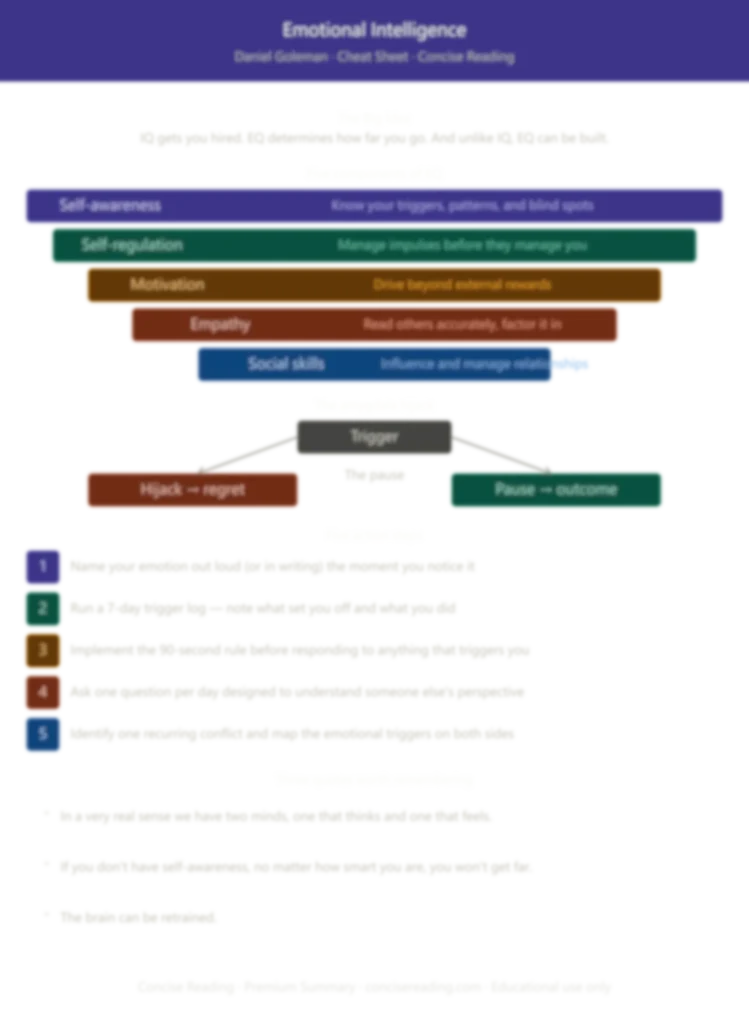
About the Author
Daniel Goleman is a Harvard-trained psychologist and science journalist who spent over a decade reporting on behavioral and brain sciences for The New York Times before publishing Emotional Intelligence in 1995. He holds a PhD from Harvard, trained under leading motivation researcher David McClelland, and synthesized the work of neuroscientists including Antonio Damasio to build the framework this book is based on. A two-time Pulitzer Prize nominee, Goleman is among the most cited psychologists writing for general audiences.
Power Quote From the Book:
“If your emotional abilities aren’t in hand — if you don’t have self-awareness, if you are not able to manage your distressing emotions, if you can’t have empathy and have effective relationships — then no matter how smart you are, you are not going to get very far.”
— Daniel Goleman, Emotional Intelligence
Who This Summary is For
- This is for you if…
- You are a manager, team lead, or founder who is technically strong but keeps running into friction — with people, in rooms, in conversations that should be simple but somehow aren’t
- You are a high performer who has hit an invisible ceiling and suspects the bottleneck is relational, not technical — but you have never had language for it
- You want to lead with more authority and less conflict, without sacrificing directness or results
- You are someone who has said or done something in a high-pressure moment and spent days wishing you had handled it differently — and you want a framework, not just better intentions
- You want to understand how the people around you think and feel well enough to actually influence outcomes, not just manage surface behavior
- Skip this if…
- This is not a quick-fix tactics guide or a negotiation playbook. If you are looking for scripts and closing techniques, you want our Never Split the Difference summary instead. Emotional Intelligence is foundational — it builds the internal architecture that makes every other interpersonal skill actually work.
Social Proof
We are building something here together. This summary is part of the Concise Reading Library — a growing collection of 231 summaries across business, money, psychology, and leadership. If this summary shifted how you think about your own emotional patterns, helped you recognize a blind spot, or gave you language for something you have been experiencing at work — we want to hear it. Leave a comment below. Real reactions from real readers are how others decide whether something is worth their time, and your honest experience matters more than any marketing copy we could write. If you got value, share it.
Emotional Intelligence took Daniel Goleman over two decades of research to write. The Premium Summary gives you the complete system — every chapter, every framework, the amygdala hijack model, five specific action steps, and the one-page cheat sheet — in under an hour. If you are serious about leading better, reacting less, and building the kind of presence that earns real respect, this is the most efficient investment you will make this week.
Related Summaries
- Emotional Intelligence 2.0 — Travis Bradberry & Jean Greaves. Where Goleman explains the why, this book gives you the how with a direct, test-and-improve approach to building your EQ score across four domains.
- Dare to Lead — Brené Brown. Extends the emotional intelligence conversation into leadership and courage. Particularly strong on vulnerability, difficult conversations, and building psychologically safe teams.
- Crucial Conversations — Kerry Patterson et al. The practical application layer for everything Goleman teaches. Specifically addresses what to do emotionally and verbally when the stakes are high, opinions differ, and emotions run hot.
[…] Emotional Intelligence […]
[…] deeper insights into behavioral finance, you may also enjoy Thinking-related books like Blink and Emotional Intelligence, which explore how psychology influences […]