End This Depression Now! by Paul Krugman — Summary & Key Lessons
What this book will teach you in the next 10 minutes — and why it matters for how you read economic news, invest your money, and understand why governments make the decisions they make.
Written by a Nobel Prize-winning economist. Summarized so you actually understand it.
Book Snapshot
- Author – Paul Robin Krugman
- Category – Economics / Macroeconomic Policy / Political Economy
- Original Book – ~ 320 pages. Average read time: 6 to 8 hours.
- Free Summary – 08 pages
- Premium Summary – 33 pages. Estimated read time: 35 to 45 minutes.
The Big Idea
The Great Recession did not have to last as long as it did. Paul Krugman’s central argument is blunt: governments across the developed world chose to impose austerity — cutting spending, reducing deficits — at the exact moment that spending was the only tool capable of ending mass unemployment. The result was years of unnecessary suffering. The tools to fix a depression have existed since the 1930s. They were available. They were affordable. The only thing missing was the political will to use them. This book is Krugman’s case for why that was a choice, not a fate — and what a better choice looks like.
What You’ll Learn — Key Lessons Preview
- You will understand exactly why cutting government spending during a recession makes unemployment worse, not better — and why intelligent people keep making this mistake anyway.
- You will be able to explain the paradox of thrift: why millions of individuals doing the financially responsible thing simultaneously destroys the economy around them.
- You will recognize the difference between monetary policy and fiscal policy — and know which one actually works when interest rates hit zero.
- You will learn to identify the creditor-debtor political dynamic that drives austerity decisions and apply it to every economic policy debate you follow from now on.
- You will walk away with five immediately usable frameworks — including the Confidence Fairy Test — that make you a sharper reader of economic news, government announcements, and market conditions.
- (For more frameworks on how money, psychology, and markets interact, explore our summaries of Animal Spirits and The Psychology of Money — both available in the Concise Reading Library.)
Free vs Premium Comparison
| Free – $0 | Premium – $4.99 (Recommended) |
| ➡ Book Snapshot ➡ The Big Idea ➡ Key Lessons ➡ Power Quotes ➡ 08 Pages | ✔ Everything in free + ✔ Full Chapter Breakdown ✔ Key frameworks & diagrams ✔ Action steps ✔ Critical analysis ✔ One-page cheat sheet ✔ 33 pages |
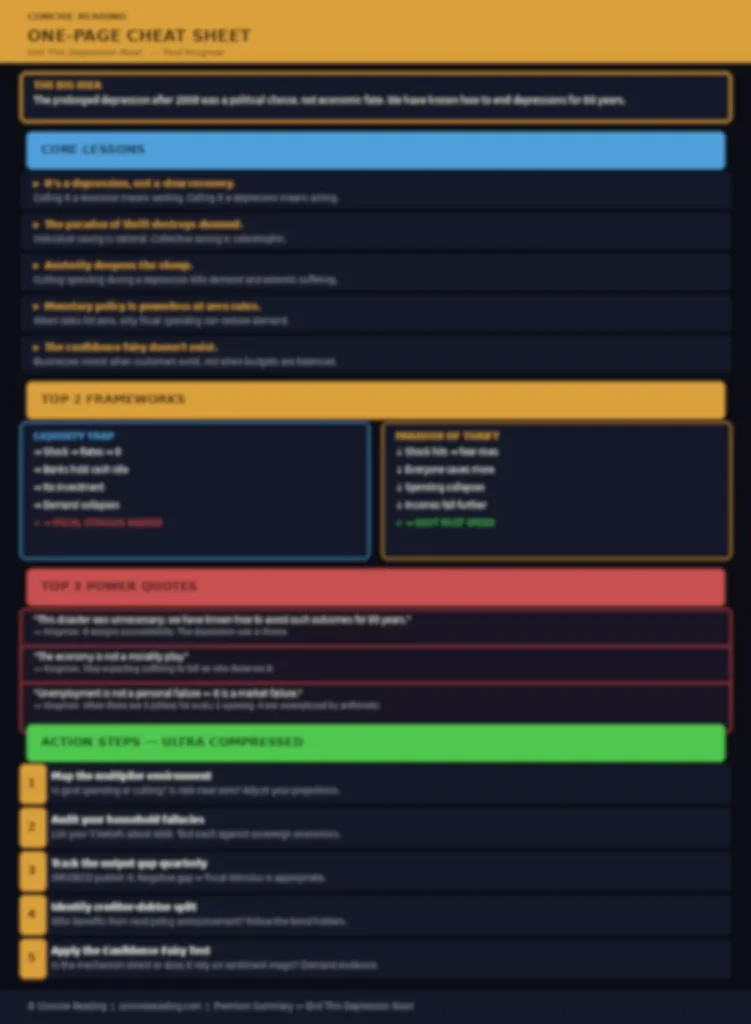
Premium Cheat Sheet Preview
About the Author
Paul Krugman is a Nobel Prize-winning economist and former Princeton University professor who spent two decades writing the most-read economics column in American journalism at The New York Times. He won the Nobel Memorial Prize in Economic Sciences in 2008 — the same year the financial crisis proved the warnings he had been publishing for a decade entirely correct. When Krugman writes about economic crises, he is not observing from a distance. He predicted this one before it happened.
Power Quote From the Book:
“The years since 2008 have been a disaster for millions of Americans and for tens of millions of workers across the advanced world. This disaster was unnecessary; we have known how to avoid such outcomes for 80 years.”
— Paul Krugman, End This Depression Now!
Who This Summary is For
- This is for you if…
- You lived through the 2008 recession and felt that the official explanations never quite added up — that “recovery takes time” always sounded more like an excuse than an analysis.
- You want to understand macroeconomics without reading a 400-page textbook, and you want the actual debate, not the sanitized version.
- You are an investor, entrepreneur, or business owner who wants a working framework for reading government fiscal policy and understanding what it means for real economic conditions in your market.
- You follow economic and political news and are tired of absorbing the conventional wisdom of whoever is currently in power without the analytical tools to push back.
- You want to understand why well-educated people keep making the same policy mistakes and how to recognize when it is happening again.
- (If you want to go deeper into how irrational psychology drives economic decisions at the market level, our summary of Thinking, Fast and Slow is a natural companion to this one. You can also find both titles and many more in the Economics and Economic Thinking Premium Pack.)
- Skip this if…
- You are looking for personal finance or investing advice — this book has nothing to say about your individual portfolio. Browse our Personal Finance and Wealth Building Pack instead.
- You are not open to engaging with Keynesian economics on its own terms — Krugman is an open advocate, not a neutral referee, and the book will frustrate rather than persuade a closed mind.
Social Proof
This summary is newer, and we are still collecting reader experiences. If you read this — free or premium — we would genuinely like to know what you took away from it. Did a framework land differently than you expected? Did it change how you read a piece of economic news? Did it confirm something you already suspected? Leave a comment below. Real reader responses, even the critical ones, help every person who lands on this page after you. And if you have already explored other summaries on Concise Reading, we always appreciate hearing which ones have been most useful and why. Your feedback shapes what we build next.
End This Depression Now! took Paul Krugman four decades of research, two economic crises, and a Nobel Prize to write. The Concise Reading premium summary gives you the complete system — five visual frameworks, five power quotes with practical commentary, five uncomfortable action steps, a full critical analysis, and a one-page cheat sheet worth pinning to your wall — in 33 pages.
If you want to understand the economics of crisis at the level where it actually changes how you think, the premium version is where that happens.
(Looking for more depth across multiple books? The Economics and Economic Thinking Premium Pack bundles this summary with our full coverage of the most important economics titles in the library — including Capital in the Twenty-First Century, Animal Spirits, The General Theory, and more. Or explore The Wealth Playbook and The Financial Intelligence Playbook for synthesis across the entire financial canon.)
Related Summaries
- Capital in the Twenty-First Century — Thomas Piketty If Krugman explains the short-term crisis, Piketty explains the long-term structural force behind inequality and why wealth concentrates over time. Together they give you a comprehensive picture of what is wrong with modern capitalism at both the cycle level and the structural level.
- Animal Spirits — George Akerlof and Robert Shiller Krugman leans heavily on the idea that psychology and expectations drive economic outcomes. Animal Spirits is the systematic academic treatment of exactly that argument — how confidence, fairness, money illusion, and narrative shape real economic behavior far more than standard models predict.
- The Big Short — Michael Lewis Where Krugman gives you the policy argument for why the post-2008 slump was unnecessary, Lewis gives you the human story of how the financial crisis actually happened — who knew, who ignored warnings, and how the system failed from the inside. The two books together make the crisis three-dimensional.