Market Risk Analysis by Carol Alexander — Summary & Key Lessons
What this book will teach you in the next 10 minutes — and why it matters for your ability to measure, manage, and survive financial risk like a professional.
Used as graduate curriculum in top finance programs worldwide. Trusted by risk managers, quants, and serious investors who need more than intuition.
Book Snapshot
- Author – Carol Alexander
- Category – Quantitative Finance / Risk Management
- Original Book – ~ 2,400 pages across four volumes / Average read time: 60–80 hours
- Free Summary – 08 pages
- Premium Summary – 40 pages / Estimated read time: 35–45 minutes
The Big Idea
Most people treat risk as a feeling. Carol Alexander treats it as a quantity — one that can be measured, decomposed, and managed with mathematical precision. But her deeper argument is not that models solve risk. It is that rigorous modeling forces you to make your assumptions explicit, and explicit assumptions can be challenged before they cost you capital. The 2008 financial crisis was not a failure of mathematics. It was a failure of people using mathematics while forgetting it was built on assumptions. This book gives you the framework to avoid that failure — and the intellectual honesty to know when your framework is breaking down.
What You’ll Learn — Key Lessons Preview
- Why your current volatility estimate is almost certainly wrong — and the GARCH model that fixes it before your next position sizing decision
- How to identify the two or three real risk factors driving your entire portfolio, so you stop calling concentration “diversification”
- What Value at Risk actually measures, what it deliberately ignores, and why Expected Shortfall is the number that determines whether a firm survives a crisis
- How professional risk managers decompose portfolio risk into factor exposures — and how to use the same framework on any portfolio you manage
- Why model risk is a legitimate category of financial risk, and the five-step audit that tells you whether your risk system is measuring reality or manufacturing false confidence
Free vs Premium Comparison
| Free – $0 | Premium – $4.99 (Recommended) |
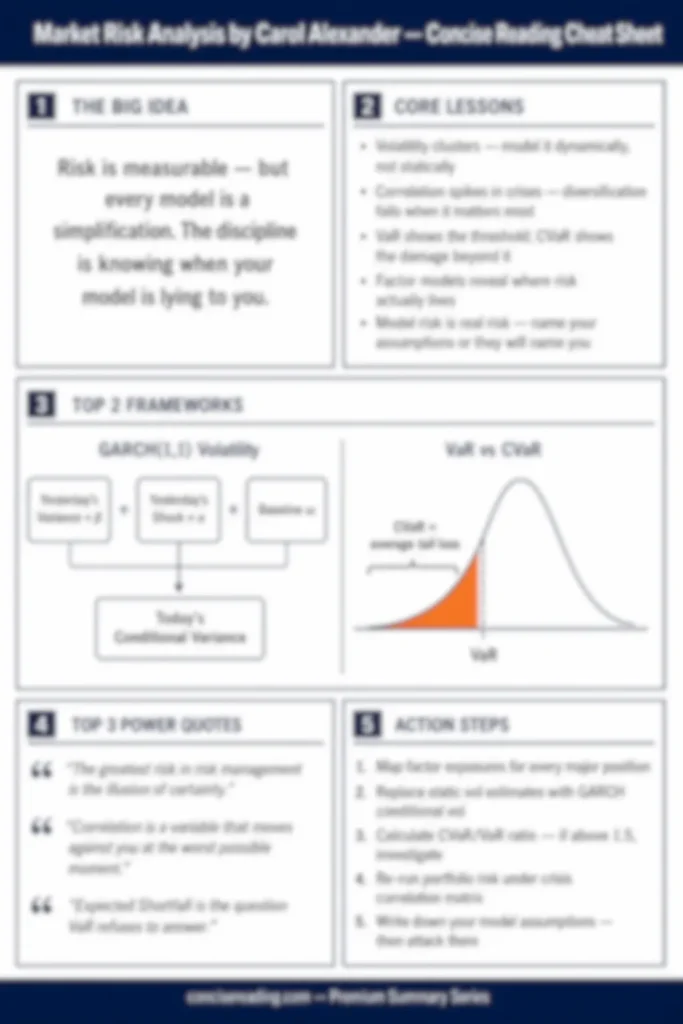
| ➡ Book Snapshot ➡ The Big Idea ➡ Key Lessons ➡ Power Quotes ➡ 08 Pages | ✔ Everything in free + ✔ Full Chapter Breakdown ✔ Key frameworks & diagrams ✔ Action steps ✔ Critical analysis ✔ One-page cheat sheet ✔ 40 pages |
Premium Cheat Sheet Preview
About the Author
Carol Alexander is Professor of Finance at the University of Sussex, former Chair of the Academic Advisory Council of PRMIA, and one of the most cited quantitative finance academics in the world. She built institutional risk models at Algorithmics before returning to academia, giving her the rare combination of mathematical rigor and real-world systems experience. Her work is not theory disconnected from markets — it is the architecture that serious risk practitioners actually use.
Power Quote From the Book:
“The greatest risk in risk management is the illusion of certainty.”
— Carol Alexander, Market Risk Analysis
Who This Summary is For
- This is for you if…
- You are a risk manager, quantitative analyst, or derivatives professional who wants to deepen your technical foundations without re-reading 2,400 pages
- You are preparing for the FRM or CFA and want conceptual clarity on volatility modeling, VaR, and factor risk — not just formula memorization
- You are a serious investor who wants to understand how institutions actually measure portfolio risk and why their models still fail
- You are a finance student or graduate in financial engineering who wants the frameworks and mental models distilled before diving into the full text
- You want to understand what went wrong in 2008 at the level of risk models and assumptions, not just narrative
- Skip this if…
- You are a beginner investor looking for personal finance or budgeting guidance — this is institutional-grade risk management and it assumes you are comfortable with statistical concepts. If that is where you are starting, our Investing Fundamentals category is the better first step.
Testimonials
This summary has been read by risk professionals, finance students, and serious investors who wanted the substance of Alexander’s framework without the four-volume commitment. If you have read it — free or premium — we want to hear what you took away. Did a specific framework change how you think about your portfolio? Did the VaR versus Expected Shortfall distinction shift how you read risk reports? Leave your experience in the comments below. Your feedback helps other readers decide whether this is the right summary for them, and it helps us make the next one sharper. Every comment, honest rating, and critical note is read.
Carol Alexander spent the better part of a decade writing 2,400 pages across four volumes to build the most rigorous treatment of market risk in financial literature. The premium summary gives you the complete conceptual system — every major framework, specific action steps calibrated for practitioners, and a one-page cheat sheet worth pinning — in 40 pages and under an hour. That is the value ratio. $4.99.
Related Summaries
- Value at Risk — Philippe Jorion — The definitive practitioner’s guide to VaR: its construction, application, limitations, and how it is actually used inside financial institutions. A natural companion to Alexander’s more theoretical treatment.
- Quantitative Risk Management — McNeil, Frey & Embrechts — Deeper mathematical treatment of risk modeling, covering copulas, extreme value theory, and credit risk. For readers who want to go further into the technical machinery.
- The Misbehavior of Markets — Benoit Mandelbrot — A powerful argument that standard financial models badly underestimate tail risk, delivered accessibly. Provides the philosophical counterpoint to the quantitative toolkit — essential reading for understanding why models fail.