One Click by Richard L. Brandt — Summary & Key Lessons
What this book will teach you in the next 10 minutes — and why it matters for your online business and every sale you are losing to friction right now.
Part of the Digital Marketing & Online Business library at Concise Reading — where business and money books are summarized so you get the insight without the time cost.
Book Snapshot
- Author – Richard L. Brandt
- Category – Business Biography / Entrepreneurship / E-Commerce Strategy
- Original Book – ~ 256 pages | Average read time: 5–6 hours
- Free Summary – 08 pages
- Premium Summary – 30 pages | Estimated read time: 35–45 minutes
The Big Idea
Jeff Bezos did not build Amazon by being smarter than everyone else. He built it by being more obsessed with one idea: that every unnecessary step between a customer and a purchase is a failure, and every failure is an opportunity for someone else to win. The One-Click patent — a button that removes the need to re-enter payment and address information — sounds like a minor convenience. It was actually a philosophy made tangible. Bezos structured Amazon’s entire culture, hiring process, product decisions, and financial model around the conviction that the customer’s time and trust are sacred. That conviction, held longer and more stubbornly than any competitor was willing to hold it, is what Amazon actually is.
What You’ll Learn — Key Lessons Preview
- Why your conversion rate is lower than it should be — and the specific philosophy that fixes it permanently, not just tactically
- How Bezos used long-term thinking as a weapon that competitors with quarterly targets literally could not respond to
- The Working Backwards process Amazon uses before building any product — and how to apply it to your next launch before you write a single word of copy
- Why the internal capabilities you’ve already built may be your most undervalued business asset — and how Amazon discovered this with AWS
- How customer obsession, when it is structurally embedded rather than just declared, creates a compounding moat that price and marketing alone cannot break
Free vs Premium Comparison
| Free – $0 | Premium – $4.99 (Recommended) |
| ➡ Book Snapshot ➡ The Big Idea ➡ Key Lessons ➡ Power Quotes ➡ 08 Pages | ✔ Everything in free + ✔ Full Chapter Breakdown ✔ Key frameworks & diagrams ✔ Action steps ✔ Critical analysis ✔ One-page cheat sheet ✔ 30 pages |
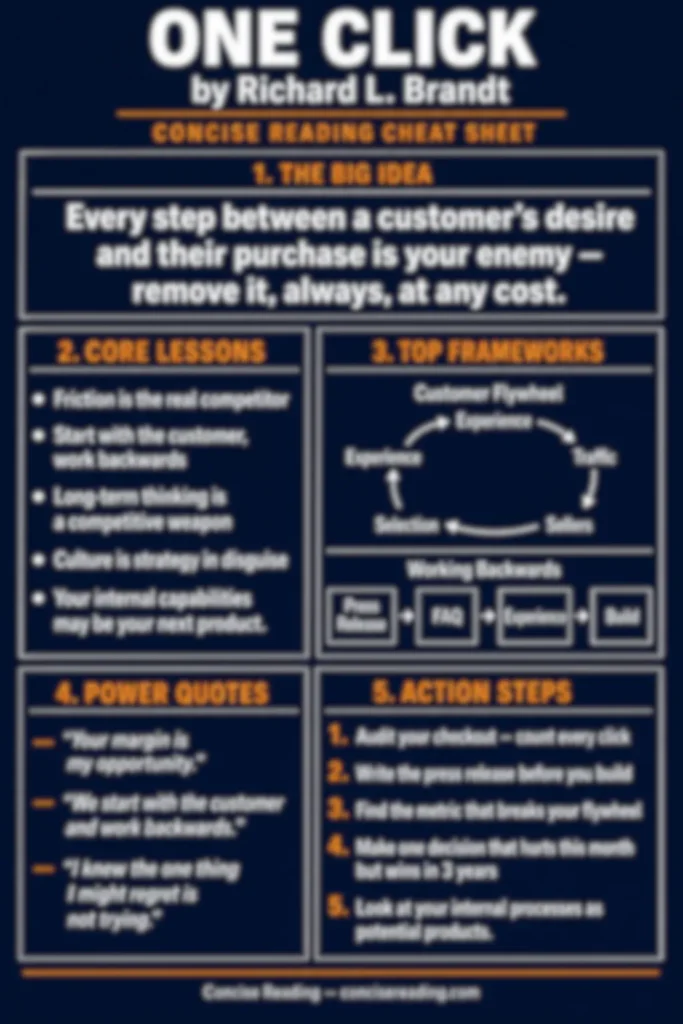
Premium Cheat Sheet Preview
About the Author
Richard L. Brandt spent over three decades as a technology journalist, most prominently at BusinessWeek, where he interviewed Jeff Bezos at multiple points in Amazon’s history — from garage startup to global infrastructure. That sustained, direct access is what separates this book from most Amazon analysis. Brandt is also the author of works profiling Google’s founders, and his expertise is translating the psychology of technology builders into practical business lessons for operators who want to understand not just what was built, but why.
Power Quote From the Book:
“Your margin is my opportunity.”
— Jeff Bezos
Who This Summary is For
- This is for you if…
- You are an e-commerce founder or digital product seller trying to understand why customers are dropping off before they buy — and what philosophy actually solves it
- You are building an online business and want a mental model for customer experience that goes deeper than “be helpful” or “add value”
- You are a marketer, product builder, or startup operator who wants to understand how one idea, held obsessively, becomes a trillion-dollar competitive advantage
- You want to understand the real Amazon story — not the logistics and scale, but the founder psychology and strategic thinking that made everything else possible
- You have read summaries of Zero to One, The Lean Startup, or DotCom Secrets and want a book that shows what that thinking looks like at full execution
- Skip this if…
- You are looking for a critical investigation of Amazon’s labor practices and market power, or a deep technical breakdown of its logistics operations. This book is a philosophy primer, not an exposé — and the premium summary is built for operators who want to extract and apply the strategy, not relitigate Amazon’s politics.
Testimonials
This summary was built for people who read with a purpose. If One Click changed how you think about your business, your checkout process, or your approach to the customer experience, share it below — your comment helps other readers decide whether this is the right read for them next. Concise Reading is built on the idea that the right book at the right moment changes how you operate. If this was that book for you, we want to hear it.
Richard L. Brandt spent years tracking Jeff Bezos across multiple phases of Amazon’s history to write this book. The premium summary gives you the complete strategic system — five frameworks with visual diagrams, five curated power quotes, five specific action steps, a full chapter-by-chapter breakdown, and a one-page cheat sheet — in 30 pages, for $4.99.
If the ideas in this free summary are relevant to how you build and sell, the premium version is where they become usable. Browse the full Digital Marketing & Online Business library, or see everything available in the Concise Reading Library to find what to read next.
Related Summaries
- The Everything Store — Brad Stone’s deep-dive into Amazon’s full history is the definitive companion to this book. Where One Click focuses on Bezos’s psychology and founding philosophy, The Everything Store documents the operational and political story of Amazon’s growth in exhaustive detail.
- DotCom Secrets — Russell Brunson’s framework for online sales funnels is essentially the practitioner’s version of what Bezos intuited. If One Click is the philosophy of friction removal, DotCom Secrets is the tactical playbook for applying it in a digital business today.
- Zero to One — Peter Thiel’s argument for building monopolies through unique insight pairs directly with Bezos’s long-term thinking. Both books make the same underlying claim: competing on existing terms is a trap. Build something that redefines the terms entirely.