What Every Real Estate Investor Needs to Know About Cash Flow by Frank Gallinelli — Summary & Key Lessons
What this book will teach you in the next 10 minutes — and why it matters for every real estate deal you evaluate from this point forward.
Used by investors who are done guessing and ready to run real numbers. Part of the Real Estate Investing collection at Concise Reading — where every summary is built for people who act on what they read.
Book Snapshot
- Author – Frank Gallinelli
- Category – Real Estate Investing / Financial Analysis
- Original Book – ~ 320 pages | Average read time: 7–9 hours
- Free Summary – 08 pages
- Premium Summary – 32 pages | Estimated read time: 35–45 minutes
The Big Idea
Most real estate investors calculate profit the wrong way. They look at rent, subtract the mortgage, see a positive number, and call it a deal. Frank Gallinelli dismantles that entirely. His argument is that every property is a financial instrument, and every decision about it must be driven by specific, measurable metrics — NOI, Cap Rate, Cash-on-Cash Return, IRR. These aren’t tools reserved for institutions. They’re learnable frameworks that change how you evaluate every deal, negotiate every price, and protect every dollar you invest. Once you think in metrics, you stop being sold to. You become the one who decides.
What You’ll Learn — Key Lessons Preview
- How to calculate what a property is actually worth — using its income, not the seller’s asking price, so you can negotiate from a position of strength instead of hope
- Why “rent minus mortgage” is the most dangerous math in real estate — and the full expense framework that professional investors use instead
- How to use Cap Rate in two directions — to evaluate any deal in seconds and to independently calculate what any property should sell for based on market data
- How to stress-test a deal before you commit a dollar — by running Cash-on-Cash Return under worst-case conditions so no vacancy or repair ever blindsides you
- How to compare two deals with completely different timelines — using IRR, the single metric institutional investors use to make every long-term decision
Free vs Premium Comparison
| Free – $0 | Premium – $4.99 (Recommended) |
| ➡ Book Snapshot ➡ The Big Idea ➡ Key Lessons ➡ Power Quotes ➡ 08 Pages | ✔ Everything in free + ✔ Full Chapter Breakdown ✔ Key frameworks & diagrams ✔ Action steps ✔ Critical analysis ✔ One-page cheat sheet ✔ 32 pages |
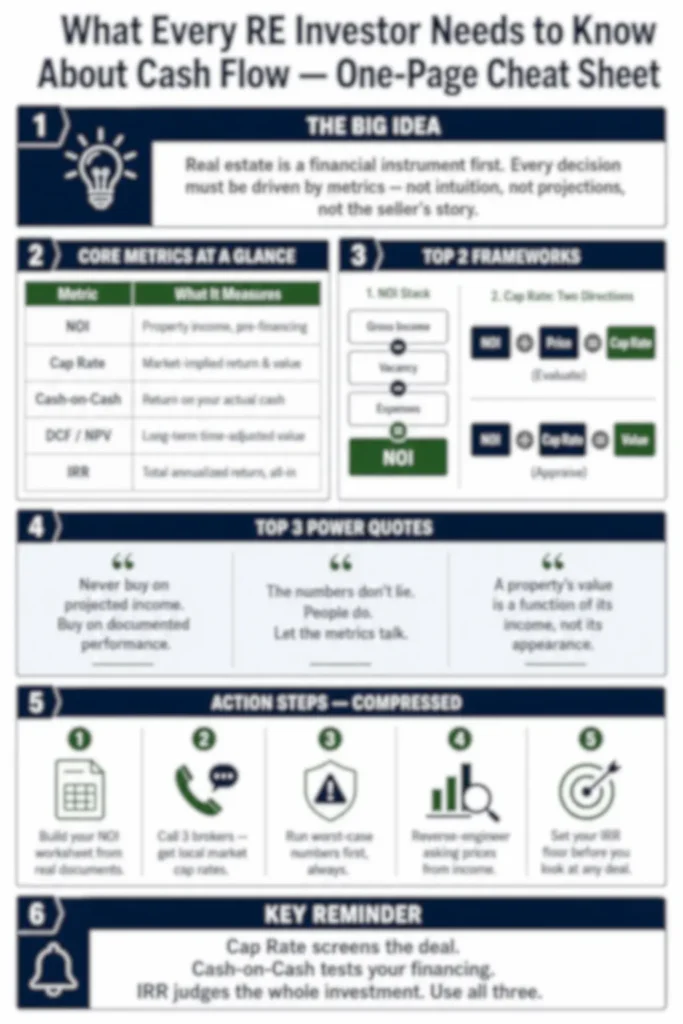
Premium Cheat Sheet Preview
About the Author
Frank Gallinelli is the founder of RealData Inc., a real estate investment analysis software company he has run since 1982, and a former faculty member at Columbia University where he taught real estate investment analysis. His frameworks have been used by tens of thousands of investors and professionals across four decades of market cycles. He is one of the most trusted translators of professional-grade real estate finance for individual investors. If you want to understand how serious investors actually think about numbers, Gallinelli is the source.
Power Quote From the Book:
“Never buy a property based on projected income. Buy it based on its current, documented performance.”
— Frank Gallinelli
Who This Summary is For
- This is for you if…
- You are a first-time rental property buyer who wants to analyze deals with real math before making an offer — not after regretting one
- You are an investor with one or two properties who has been running on instinct and knows it’s time to professionalize the process
- You want to understand what brokers and institutional investors actually mean when they talk about cap rates, NOI, and IRR — so you’re never the least informed person in a deal conversation again
- You are a finance-minded professional entering real estate from stocks or business and want the same analytical rigor applied to property
- You want a framework you can use on every deal, in any market, regardless of what interest rates or prices are doing
- Skip this if…
- This summary — and the book itself — is almost entirely analytical. If you’re looking for deal-finding strategies, market selection advice, or a motivational push to get started in real estate, this isn’t that. Start with The Millionaire Real Estate Investor summary or Rich Dad Poor Dad first, then come back here when you’re ready to run numbers.
Testimonials
This summary was built for investors who want to act, not just read. If you’ve gone through it — free or premium — we’d genuinely like to know what landed for you. Did a metric click that hadn’t before? Did you run the numbers on a deal differently after reading it? Leave a comment below. Real feedback from real readers is what helps the next investor decide whether this is worth their time — and your experience is the most honest thing we can offer them. No incentives, no scripts. Just tell us what was useful.
What Every Real Estate Investor Needs to Know About Cash Flow took Frank Gallinelli decades of investing, teaching at Columbia, and building professional-grade software to write. The premium summary gives you the complete analytical system — every metric, every framework, five power quotes with context, five action steps designed to cause real discomfort, a full critical analysis, and a one-page cheat sheet worth pinning above your desk — in under 45 minutes. For $4.99, that’s the cheapest due diligence you’ll ever do on a real estate deal.
Related Summaries
- The Millionaire Real Estate Investor — Gary Keller — Goes deeper into the mindset and systems behind building a real estate portfolio from zero, complementing Gallinelli’s analytical framework with a strategic roadmap.
- The Book on Rental Property Investing — Brandon Turner — A practical, hands-on guide to finding, financing, and managing rental properties. Pairs directly with Gallinelli’s metrics to give you both the numbers side and the operational side.
- Rich Dad Poor Dad — Robert Kiyosaki — The foundational mindset shift that explains why cash-flowing assets matter in the first place. If Gallinelli teaches you how to measure cash flow, Kiyosaki teaches you why chasing it should be the goal.