Stocks for the Long Run by Jeremy J. Siegel — Summary & Key Lessons
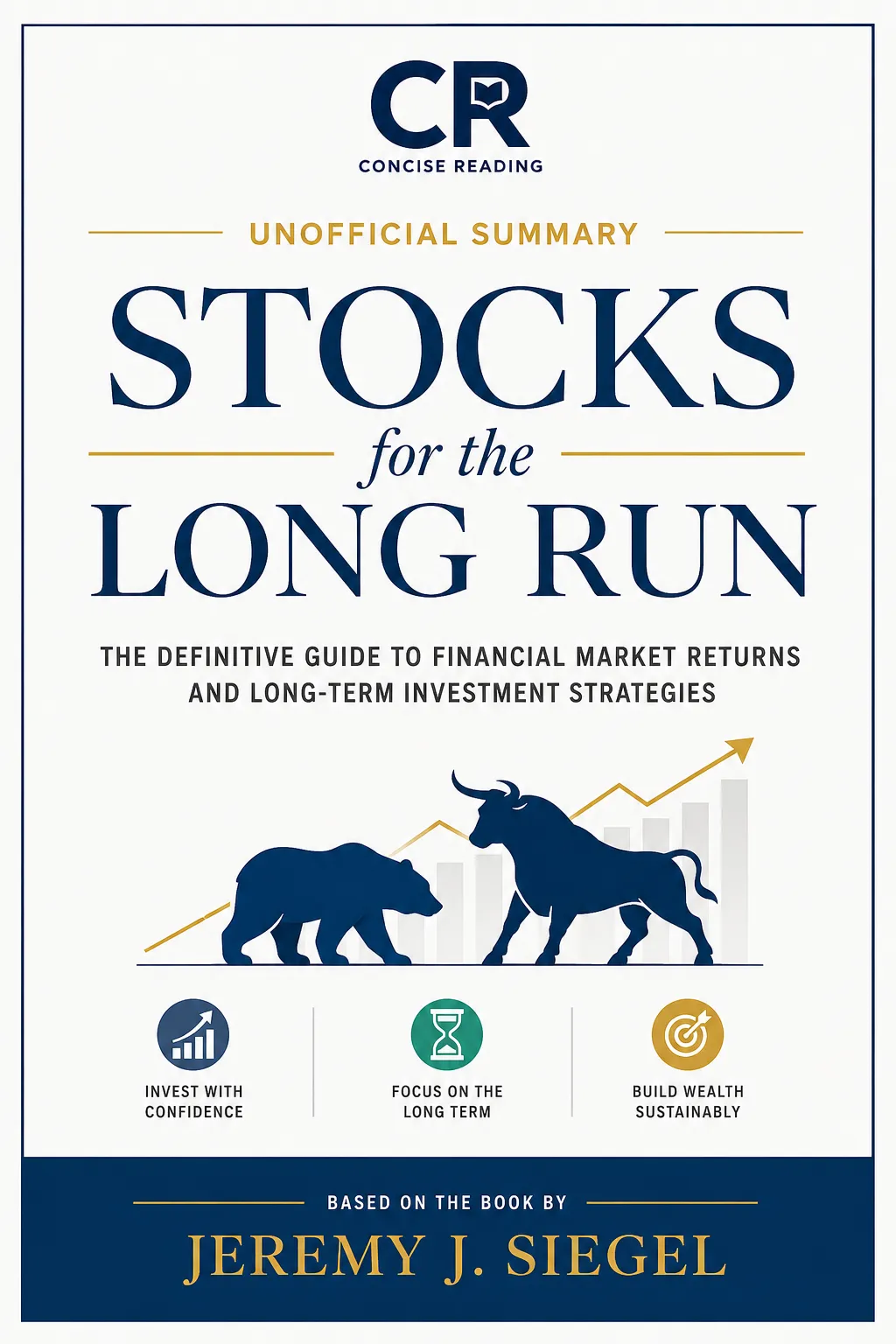
What this book will teach you in the next 10 minutes — and why it matters for your long-term financial security and wealth-building strategy.
Summarized from 380 pages of Wharton-level financial research. Covers 200 years of market data. Zero fluff.
Book Snapshot
- Author – Jeremy J. Siegel
- Category – Investing / Personal Finance / Financial History
- Original Book – ~ 380 pages | Average read time: 9–11 hours
- Free Summary – 08 pages
- Premium Summary – 31 pages | Estimated read time: 45–60 minutes
The Big Idea
Most investors are afraid of the wrong thing. They see a market crash and call it danger. They move to bonds and call it wisdom. Jeremy Siegel spent decades assembling 200 years of real return data — and what he found dismantles that intuition completely. Stocks have outperformed bonds, gold, and cash in every single 20-year period in recorded U.S. financial history. Not most periods. Every period. The greatest financial mistake most people make is not investing in stocks — it is avoiding them. What feels safe quietly destroys purchasing power. What feels risky is the only proven engine of long-term wealth. This book does not ask you to be brave. It asks you to look at the data.
What You’ll Learn — Key Lessons Preview
- Why staying invested through every crash is worth more than any investment strategy you’ll ever find — and the 200-year data that proves it
- How dividends — not stock price gains — drive the majority of real long-run wealth, and the one account setting that activates this for you today
- Why bonds are not “safe” for long-term capital — and what happens to purchasing power when investors treat them as a permanent safe haven
- How to use market valuation signals to make smarter allocation adjustments — without ever trying to time the market
- The exact mental framework that separates investors who build lasting wealth from those who panic-sell at every downturn — and how to build it before the next crash
Free vs Premium Comparison
| Free – $0 | Premium – $4.99 (Recommended) |
| ➡ Book Snapshot ➡ The Big Idea ➡ Key Lessons ➡ Power Quotes ➡ 08 Pages | ✔ Everything in free + ✔ Full Chapter Breakdown ✔ Key frameworks & diagrams ✔ Action steps ✔ Critical analysis ✔ One-page cheat sheet ✔ 31 pages |
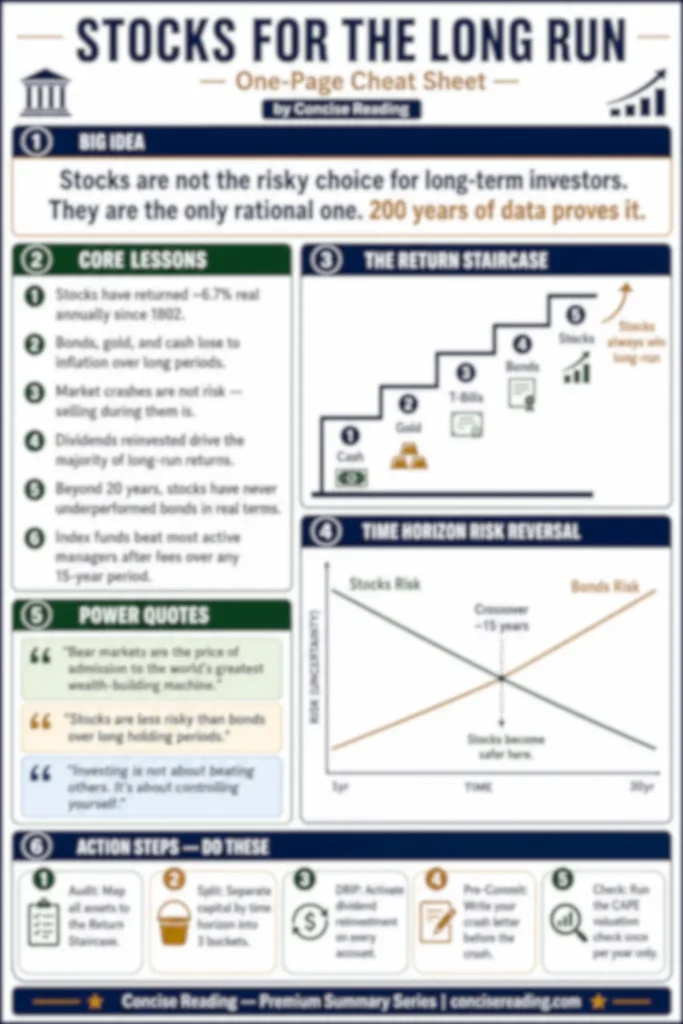
Premium Cheat Sheet Preview
About the Author
Jeremy J. Siegel is the Russell E. Palmer Professor of Finance at The Wharton School, University of Pennsylvania, where he has taught and researched financial markets for over four decades. He is widely regarded as the foremost authority on long-run equity returns and has served as senior investment strategy advisor to WisdomTree Investments. His research has been cited in financial curricula and policy discussions worldwide, and he is a regular contributor to Bloomberg, CNBC, and The Wall Street Journal.
Power Quote From the Book:
“The long-run return on stocks has been so superior to that of bonds and bills that it is not even a close call.”
— Jeremy J. Siegel, Stocks for the Long Run
Who This Summary is For
- This is for you if…
- You are a long-term investor who wants evidence-based conviction behind your asset allocation — not opinion or media noise
- You want to understand why index funds beat active managers and how to build a portfolio around that truth
- You are someone who has panic-sold during a market crash before and never want to make that mistake again
- You are building wealth over a 10–30 year horizon and want the historical framework that explains exactly why equities belong at the center of it
- You are new to investing and want to start with the most important foundational book in the field — in a fraction of the reading time
- Skip this if…
- This summary is not for you if you are looking for stock-picking strategies, day trading systems, or short-term market plays. Siegel’s framework requires time to work — if your investment horizon is under five years, start with our Personal Finance & Wealth Building category instead.
Testimonials
We are building something together at Concise Reading — a library where serious readers get the real ideas from the best books, fast and without compromise. If you have read this summary — free or premium — we would genuinely love to hear what landed for you. Did it shift how you think about market risk? Did it change something in your portfolio? Leave a comment below. Your feedback helps other readers decide whether this summary is right for them, and it helps us make every future summary sharper. The best reviews come from real people who found real value — if that is you, say so.
Jeremy Siegel spent over 40 years researching and four major editions refining this book. The premium summary gives you the complete system — every framework, every action step, the valuation model, the global diversification matrix, and the one-page cheat sheet — in 20 pages and under an hour.
Related Summaries
- The Intelligent Investor — Benjamin Graham – The foundational text on value investing and investor psychology. Where Siegel provides the macro, historical case for stocks, Graham gives you the bottom-up framework for evaluating individual investments and managing the emotional side of markets. Essential companion reading.
- A Random Walk Down Wall Street — Burton Malkiel – Malkiel builds a complementary case to Siegel’s — that markets are largely efficient, stock prices reflect available information, and passive index investing is the rational strategy for most investors. Together, these two books form the strongest possible evidence-based argument for long-term passive investing.
- The Psychology of Money — Morgan Housel – Siegel gives you the data. Housel explains why most investors still fail to act on it. This book examines the behavioral and psychological patterns that cause intelligent people to make terrible financial decisions — panic selling, overtrading, recency bias — and how to overcome them. The perfect behavioral complement to Siegel’s historical framework.