The Innovator’s Dilemma by Clayton M. Christensen — Summary & Key Lessons
What this book will teach you in the next 10 minutes — and why it matters for your business survival in a world that disrupts without warning.
Used in Harvard MBA courses. Cited by Steve Jobs, Jeff Bezos, and Andy Grove. Named one of the six most important business books ever written by The Economist. We’ve distilled the entire framework so you can apply it today.
Book Snapshot
- Author – Clayton M. Christensen
- Category – Business Strategy / Innovation & Disruption
- Original Book – ~ 288 pages | Average read time: 7–9 hours
- Free Summary – 08 pages
- Premium Summary – 34 pages | Estimated read time: 35–45 minutes
The Big Idea
The companies that get disrupted aren’t failing companies — they’re great ones. They listen to their best customers, make rational decisions, and manage by the book. That’s precisely why they lose. Clayton Christensen spent years researching why dominant companies collapse despite doing everything right, and his answer is both disturbing and actionable: the very processes that make a company successful at sustaining innovation make it structurally incapable of responding to disruptive threats. This is not a book about incompetence. It’s a warning about competence — and a framework for surviving it.
What You’ll Learn — Key Lessons Preview
- Why your best customers are your biggest liability — and how listening to them too closely will cost you the entire market
- How to spot a disruptive threat before it becomes an existential one — using the same pattern Christensen identified across a dozen industries
- Why internal budget processes kill innovation — and the one structural fix that actually works
- How disruptors predictably migrate upmarket and take everything — so you can either stop it or be the one doing it
- When to build a separate business unit and when it’s already too late — the decision that separated IBM’s PC success from Kodak’s collapse
- Explore more frameworks like these in our Business Strategy & Execution category, or browse the full Startup & Entrepreneurship library.
Free vs Premium Comparison
| Free – $0 | Premium – $4.99 (Recommended) |
| ➡ Book Snapshot ➡ The Big Idea ➡ Key Lessons ➡ Power Quotes ➡ 08 Pages | ✔ Everything in free + ✔ Full Chapter Breakdown ✔ Key frameworks & diagrams ✔ Action steps ✔ Critical analysis ✔ One-page cheat sheet ✔ 34 pages |
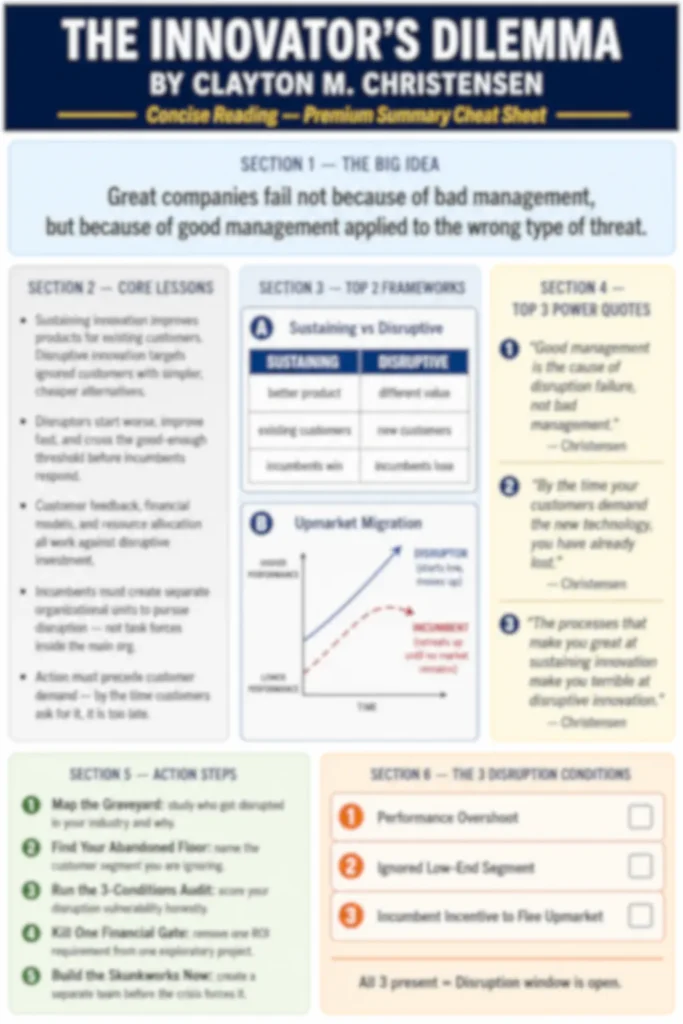
Premium Cheat Sheet Preview
About the Author
Clayton M. Christensen (1952–2020) was a professor at Harvard Business School for over two decades, a Rhodes Scholar, and a Harvard MBA graduate with highest distinction. Before academia, he co-founded a technology company and consulted at the Boston Consulting Group. He was ranked the world’s most influential business thinker by Thinkers50 in both 2011 and 2013, and his disruption theory has been validated across industries from steel to semiconductors to streaming.
Power Quote From the Book:
“The logical, competent decisions of management that are critical to the success of their companies are also the reason why they lose their positions of leadership.”
— Clayton M. Christensen, The Innovator’s Dilemma
Who This Summary is For
- This is for you if…
- You are a founder competing against a larger, slower incumbent and want a strategic playbook for winning without matching their resources
- You are a business leader who suspects your industry is about to be disrupted but can’t get internal buy-in to act on it
- You are an investor trying to identify which dominant companies are vulnerable and which challengers are on a genuine disruption trajectory
- You want to understand not just that disruption happens, but exactly how and why — so you can see it coming in your own market
- You are building a product strategy and keep watching good ideas die in budget meetings without understanding why
- If you’re also working through competitive positioning, our summary of Crossing the Chasm pairs directly with this one. And if you’re thinking about strategy from first principles, Zero to One and Good to Great complete the picture. Browse the full Business Strategy & Execution Pack if you want all three and more in one discounted bundle.
- Skip this if…
- You’re looking for a day-to-day operational guide or a personal development framework. This is strategic and analytical — it will change how you see competition, but it won’t tell you how to run your Monday morning meeting.
Testimonials
We don’t believe in fake five-star reviews. What we do believe in is that the readers who get the most out of these summaries are the ones who engage with the ideas. If you’ve read this summary — free or premium — we’d genuinely like to know what shifted for you. Did the resource allocation framework change how you look at your internal budgeting? Did the upmarket migration model help you identify a threat you were previously dismissing? Leave a comment below. Your experience helps other readers decide whether this summary is worth their time, and it helps us make every future summary sharper. Real feedback, good or critical, is always welcome.
The Innovator’s Dilemma took Clayton Christensen years of empirical research across a dozen industries to write. The Premium Summary gives you the complete system — five key frameworks with visual diagrams, five curated power quotes with context, five action steps specific enough to cause discomfort, a full critical analysis, and the entire book compressed onto one cheat sheet — in under 45 minutes and for less than a cup of coffee.
Looking for more? The Business Strategy & Execution Pack includes this summary alongside thirteen others — including Good Strategy Bad Strategy, Competitive Strategy, and Blue Ocean Strategy — at a fraction of the individual price. Or if you want the deepest possible strategy education in one document, The Strategy Playbook synthesizes ten strategy classics into a single unified framework you can act on immediately.
Not sure where to start? Visit our Start Here page or browse the complete Library.
Related Summaries
- Crossing the Chasm — Geoffrey Moore – If The Innovator’s Dilemma explains why disruptors win, Crossing the Chasm explains the biggest reason they fail mid-flight. Moore maps the dangerous gap between early adopters and mainstream customers — essential reading for anyone building a disruptive product.
- Zero to One — Peter Thiel – Thiel argues the real competitive advantage isn’t disrupting existing markets but creating entirely new ones. Pairs powerfully with Christensen’s framework — read together, they give you both the threat map and the offensive strategy.
- Good to Great — Jim Collins – Collins examines why some companies make the leap to sustained greatness while others don’t. Where Christensen focuses on the external disruptive threat, Collins focuses on the internal discipline required to survive one. The contrast between the two books is instructive.